School of Medicine, College of Medicine, National Taiwan University, Taipei, Taiwan, R.O.C.
School of Physical Therapy and Graduate Institute of Rehabilitation Science, College of Medicine, Chang Gung University, Linkou, Taoyuan, Taiwan, R.O.C.
Nutr J. 2024 Aug 15;23(1):93. doi: 10.1186/s12937-024-00995-5.
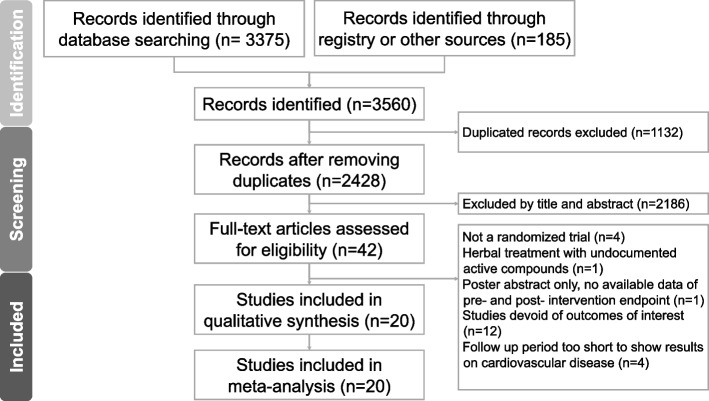
Cardiovascular disease (CVD) remains the foremost cause of mortality globally. Taurine, an amino acid, holds promise for cardiovascular health through mechanisms such as calcium regulation, blood pressure reduction, and antioxidant and anti-inflammatory effects. Despite these potential benefits, previous studies have yielded inconsistent results. This meta-analysis of randomized controlled trials (RCTs) aims to evaluate the existing evidence on the quantitative effects of taurine on hemodynamic parameters and cardiac function grading, which are indicative of overall cardiovascular health and performance.
We conducted an electronic search across multiple databases, including Embase, PubMed, Web of Science, Cochrane CENTRAL, and ClinicalTrials.gov, from their inception to January 2, 2024. Our analysis focused on key cardiovascular outcomes, such as heart rate (HR), systolic blood pressure (SBP), diastolic blood pressure (DBP), left ventricular ejection fraction (LVEF), and New York Heart Association (NYHA) Functional Classification. Meta-regression was applied to explore dose-dependent relationships based on the total taurine dose administered during the treatment period. A subgroup analysis, stratified according to the baseline disease status of patients, was also conducted.
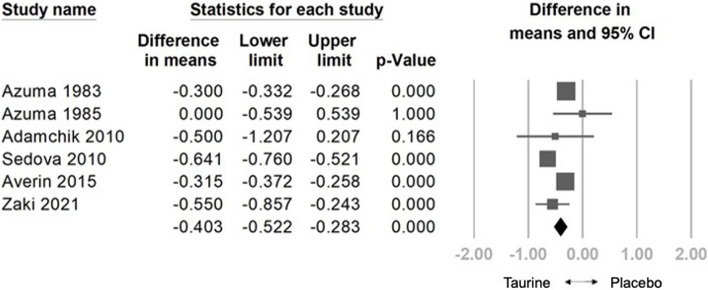
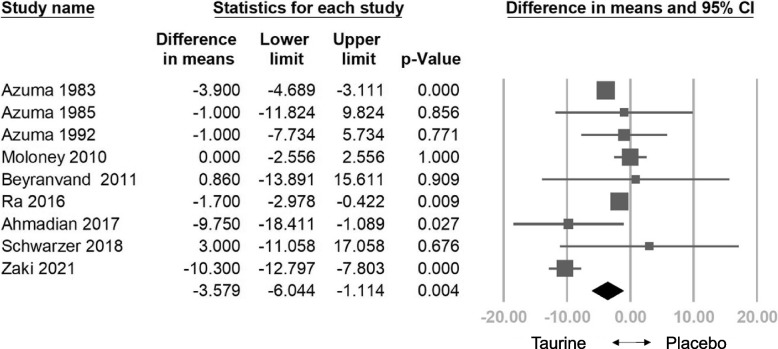
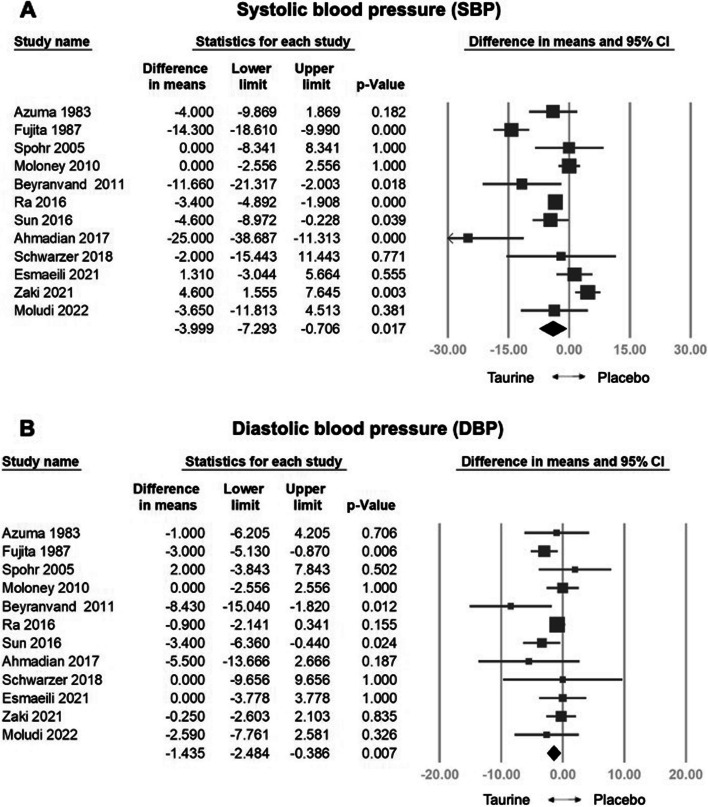
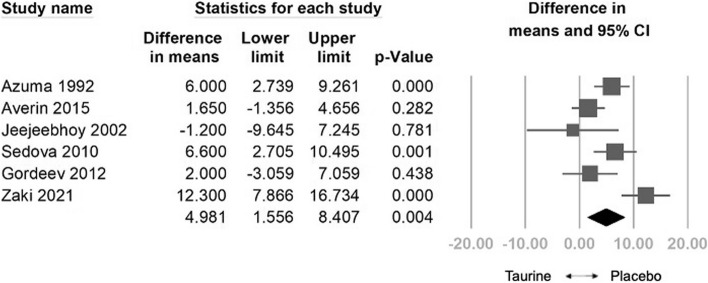
The analysis included a pooled sample of 808 participants from 20 randomized controlled trials. Taurine demonstrated a significant reduction in HR (weighted mean difference [WMD] = -3.579 bpm, 95% confidence interval [CI] = -6.044 to -1.114, p = 0.004), SBP (WMD = -3.999 mm Hg, 95% CI = -7.293 to -0.706, p = 0.017), DBP (WMD: -1.435 mm Hg, 95% CI: -2.484 to -0.386, p = 0.007), NYHA (WMD: -0.403, 95% CI: -0.522 to -0.283, p < 0.001), and a significant increase in LVEF (WMD: 4.981%, 95% CI: 1.556 to 8.407, p = 0.004). Meta-regression indicated a dose-dependent reduction in HR (coefficient = -0.0150 per g, p = 0.333), SBP (coefficient = -0.0239 per g, p = 0.113), DBP (coefficient = -0.0089 per g, p = 0.110), and NYHA (coefficient = -0.0016 per g, p = 0.111), and a positive correlation with LVEF (coefficient = 0.0285 per g, p = 0.308). No significant adverse effects were observed compared to controls. In subgroup analysis, taurine significantly improved HR in heart failure patients and healthy individuals. Taurine significantly reduced SBP in healthy individuals, heart failure patients, and those with other diseases, while significantly lowered DBP in hypertensive patients It notably increased LVEF in heart failure patients and improved NYHA functional class in both heart failure patients and those with other diseases.
Taurine showed noteworthy effects in preventing hypertension and enhancing cardiac function. Individuals prone to CVDs may find it advantageous to include taurine in their daily regimen.
心血管疾病(CVD)仍然是全球首要的死亡原因。牛磺酸是一种氨基酸,通过钙调节、降低血压、抗氧化和抗炎作用等机制,有望对心血管健康产生影响。尽管有这些潜在的益处,但之前的研究结果并不一致。本项荟萃分析旨在评估随机对照试验(RCT)中牛磺酸对血流动力学参数和心功能分级的定量影响,这些参数是整体心血管健康和功能的指标。
我们对包括 Embase、PubMed、Web of Science、Cochrane CENTRAL 和 ClinicalTrials.gov 在内的多个数据库进行了电子检索,检索时间从数据库建立到 2024 年 1 月 2 日。我们的分析主要关注关键的心血管结局,如心率(HR)、收缩压(SBP)、舒张压(DBP)、左心室射血分数(LVEF)和纽约心脏协会(NYHA)功能分级。根据治疗期间给予的总牛磺酸剂量,应用 Meta 回归来探索剂量依赖性关系。还根据患者的基线疾病状况进行了亚组分析。
分析纳入了 20 项随机对照试验的 808 名参与者。牛磺酸可显著降低 HR(加权均数差 [WMD] = -3.579 bpm,95%置信区间 [CI] = -6.044 至 -1.114,p = 0.004)、SBP(WMD = -3.999 mmHg,95% CI = -7.293 至 -0.706,p = 0.017)、DBP(WMD:-1.435 mmHg,95% CI:-2.484 至 -0.386,p = 0.007)、NYHA(WMD:-0.403,95% CI:-0.522 至 -0.283,p < 0.001)和 LVEF(WMD:4.981%,95% CI:1.556 至 8.407,p = 0.004)。Meta 回归表明 HR 呈剂量依赖性降低(每克 0.0150 系数,p = 0.333)、SBP(每克 0.0239 系数,p = 0.113)、DBP(每克 0.0089 系数,p = 0.110)和 NYHA(每克 0.0016 系数,p = 0.111),与 LVEF 呈正相关(每克 0.0285 系数,p = 0.308)。与对照组相比,未观察到明显的不良反应。在亚组分析中,牛磺酸可显著改善心力衰竭患者和健康个体的 HR。牛磺酸可显著降低健康个体、心力衰竭患者和其他疾病患者的 SBP,显著降低高血压患者的 DBP,显著增加心力衰竭患者的 LVEF,并改善心力衰竭患者和其他疾病患者的 NYHA 功能分级。
牛磺酸在预防高血压和增强心脏功能方面表现出显著的效果。易患 CVD 的个体可能会发现将牛磺酸纳入日常治疗方案中获益。