Department of Urology, Xinhua Hospital, School of Medicine, Shanghai Jiao Tong University, 1665 Kongjiang Road, Yangpu District, Shanghai, 200092, China.
Department of Urology, Seventh People's Hospital of Shanghai University of Traditional Chinese Medicine, Shanghai, 200137, China.
Clin Exp Med. 2024 Aug 17;24(1):194. doi: 10.1007/s10238-024-01433-w.
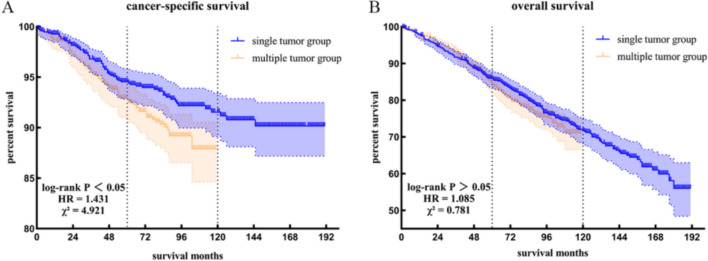
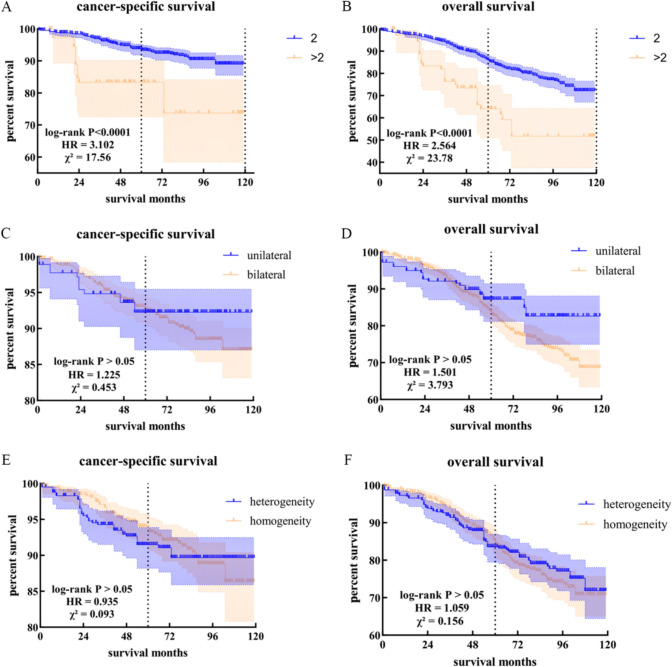
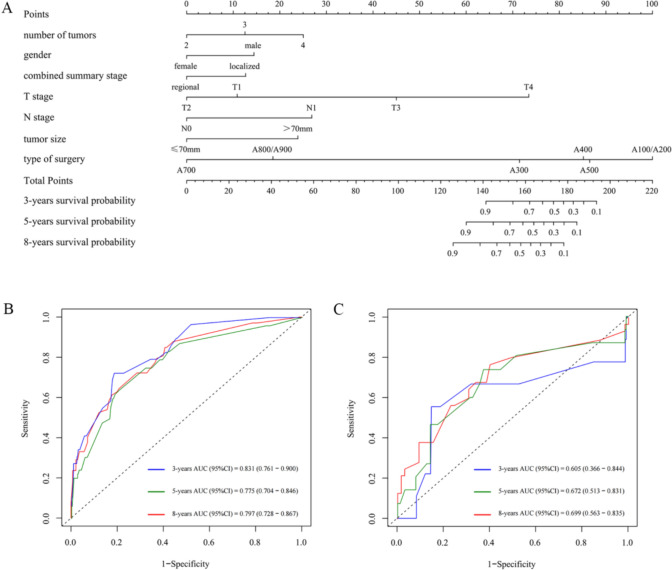
To compare clinical characteristics and survival outcomes of patients with multiple renal cell carcinoma versus single renal cell carcinoma. Develop a prognostic model for predicting prognosis in patients with multiple tumors and analyze prognostic factors. Patients with primary multiple renal cell carcinoma were selected from the Surveillance, Epidemiology, and End Results database (2004-2015). They were divided into single-tumor and multiple-tumor groups. Survival analysis was conducted using the Kaplan-Meier method and log-rank test. A Cox regression model was used to identify potential prognostic factors. A total of 19,489 renal cell carcinoma cases were included, with 947 in the multiple-tumor group and 18,542 in the single-tumor group. The multiple-tumor group had lower cancer-specific survival (P = 0.03, HR = 1.431). Cox regression identified risk factors for the multiple-tumor group including number of tumors, gender, combined summary stage, T stage, N stage, tumor size, and type of surgery. The predicted probabilities showed acceptable agreement with the actual observations at 3-, 5-, and 8-years area under the curve values in both the training and validation cohorts (0.831 vs. 0.605; 0.775 vs. 0.672; and 0.797 vs. 0.699, respectively). Compared with single renal cell carcinoma, multiple renal cell carcinoma is associated with decreased cancer-specific survival. Additionally, we identified several prognostic factors including the number of tumors, T stage, tumor size, and type of surgery. These findings offer valuable insights for selecting appropriate treatment strategies for patients diagnosed with multiple renal cell carcinomas.
比较多发性肾细胞癌与单发性肾细胞癌患者的临床特征和生存结局。制定预测多发性肿瘤患者预后的预后模型,并分析预后因素。从监测、流行病学和最终结果数据库(2004-2015 年)中选择原发性多发性肾细胞癌患者。他们被分为单肿瘤和多肿瘤组。使用 Kaplan-Meier 方法和对数秩检验进行生存分析。使用 Cox 回归模型识别潜在的预后因素。共纳入 19489 例肾细胞癌病例,其中多肿瘤组 947 例,单肿瘤组 18542 例。多肿瘤组癌症特异性生存率较低(P=0.03,HR=1.431)。Cox 回归确定了多肿瘤组的危险因素,包括肿瘤数量、性别、综合分期、T 分期、N 分期、肿瘤大小和手术类型。在训练和验证队列中,预测概率在 3 年、5 年和 8 年的曲线下面积值与实际观察值之间具有可接受的一致性(分别为 0.831 与 0.605;0.775 与 0.672;0.797 与 0.699)。与单发性肾细胞癌相比,多发性肾细胞癌与癌症特异性生存率降低相关。此外,我们确定了几个预后因素,包括肿瘤数量、T 分期、肿瘤大小和手术类型。这些发现为选择多发性肾细胞癌患者的适当治疗策略提供了有价值的见解。