Lakpour Niknam, Sadeghi Mohammad Reza, Jafarzadeh Naser, Henkel Ralf, Hajiparvaneh Azadeh, Fathi Zohreh, Ghods Roya, Gilany Kambiz, Madjd Zahra
Oncopathology Research Center, Iran University of Medical Sciences, Tehran, Iran.
Reproductive Biotechnology Research Center, Avicenna Research Institute, ACECR, Tehran, Iran.
J Reprod Infertil. 2024 Jan-Mar;25(1):3-11. doi: 10.18502/jri.v25i1.15193.
Testicular cancer (TC) is a relatively rare type of cancer in men. Early diagnosis of TC remains challenging. Metabolomics holds promise in offering valuable insights in this regard. In this study, a metabolic fingerprinting approach was employed to identify potential biomarkers in both serum and seminal plasma of TC patients.
A total of 9 patients with testicular cancer and 10 controls were included in the study. The metabolic fingerprinting approach was utilized as a rapid diagnostic tool to analyze the metabolome in serum and seminal plasma of TC patients in comparison to fertile men. Raman spectroscopy was applied for the analysis of metabolites in these biological samples.
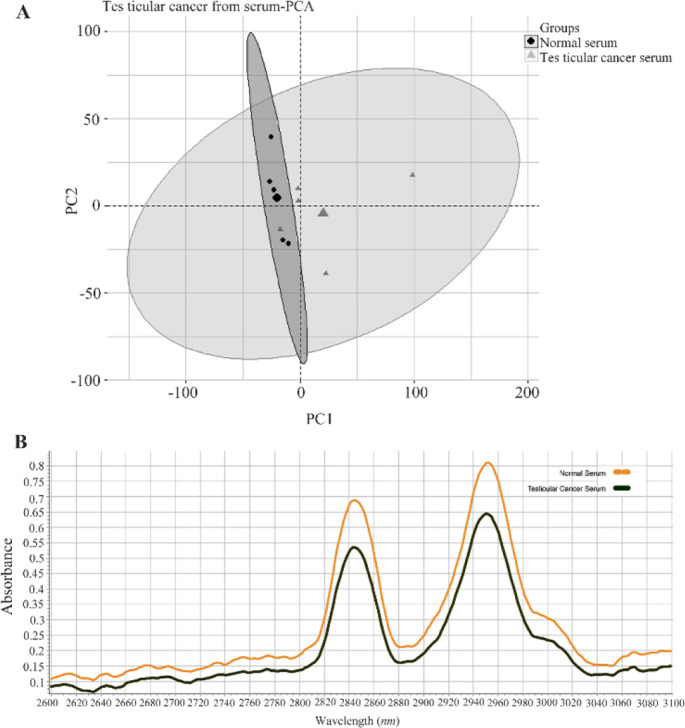
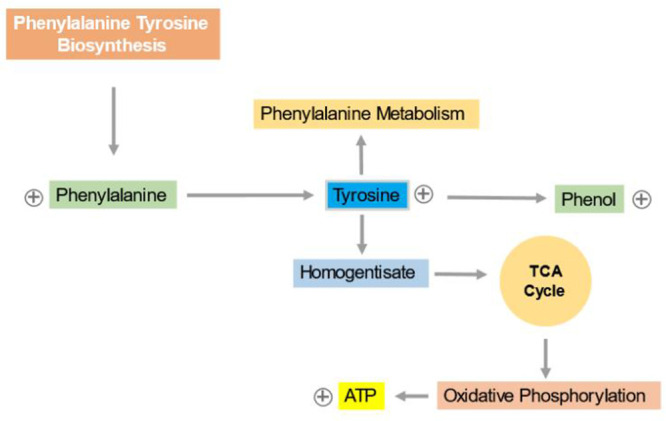
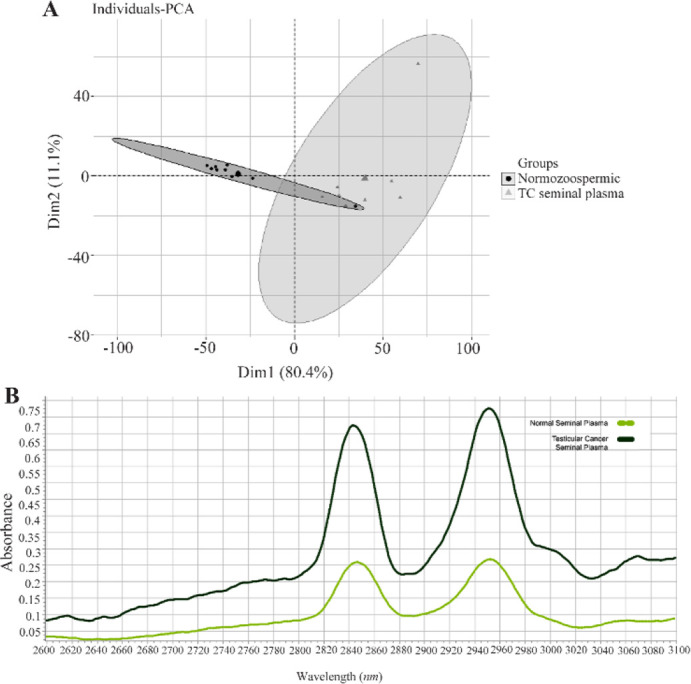
Principal component analysis (PCA) and functional group analysis showed that the differentiation between serum samples from healthy men and TC patients was not possible. However, when analyzing seminal plasma, a significant difference was found between the two groups (p<0.05). Functional group analysis of serum only showed an increase in tryptophan concentration ratio in TC patients as compared to healthy men (p=0.03). In contrast, in seminal plasma of TC patients, this increase was observed in all analyzed compounds, including phenylalanine, tyrosine, lipids, proteins, phenols (p<0.001).
Our study highlights the potential of metabolic fingerprinting as a fast diagnostic tool for screening TC patients, with seminal plasma serving as a valuable biological sample. Furthermore, several potential biomarkers, particularly phenylalanine, were identified in seminal plasma. This research contributes to our understanding of TC pathogenesis and has the potential to pave the way for early detection and personalized treatment approaches.
睾丸癌(TC)是男性中相对罕见的一种癌症。TC的早期诊断仍然具有挑战性。代谢组学有望在这方面提供有价值的见解。在本研究中,采用代谢指纹图谱方法来识别TC患者血清和精浆中的潜在生物标志物。
本研究共纳入9例睾丸癌患者和10例对照。代谢指纹图谱方法被用作一种快速诊断工具,以分析TC患者血清和精浆中的代谢组,并与生育期男性进行比较。拉曼光谱用于分析这些生物样品中的代谢物。
主成分分析(PCA)和官能团分析表明,无法区分健康男性和TC患者的血清样本。然而,在分析精浆时,发现两组之间存在显著差异(p<0.05)。仅血清的官能团分析显示,与健康男性相比,TC患者的色氨酸浓度比有所增加(p=0.03)。相比之下,在TC患者的精浆中,在所有分析的化合物中都观察到了这种增加,包括苯丙氨酸、酪氨酸、脂质、蛋白质、酚类(p<0.001)。
我们的研究强调了代谢指纹图谱作为筛查TC患者的快速诊断工具的潜力,精浆是一种有价值的生物样本。此外,在精浆中鉴定出了几种潜在的生物标志物,特别是苯丙氨酸。这项研究有助于我们理解TC的发病机制,并有可能为早期检测和个性化治疗方法铺平道路。