Kang ZhiHui, Chen Zhongju, Liu GuiYang
Public Sports Department, Ningbo University of Finance and Economics, Ningbo, 315175, Zhejiang, China.
School of Physical Education, Chizhou University, Chizhou, 247000, Anhui, China.
BMC Sports Sci Med Rehabil. 2024 Aug 19;16(1):174. doi: 10.1186/s13102-024-00970-x.
Soccer coaches often employ small-sided games (SSGs) to elicit both physiological and technical responses from players. However, numerous contextual factors can influence the outcomes of these games. This comparative study aimed to investigate how environmental temperature (< 21ºC and > 29ºC) impacts heart rate responses, perception of effort, and technical performance in young male football players during SSGs.
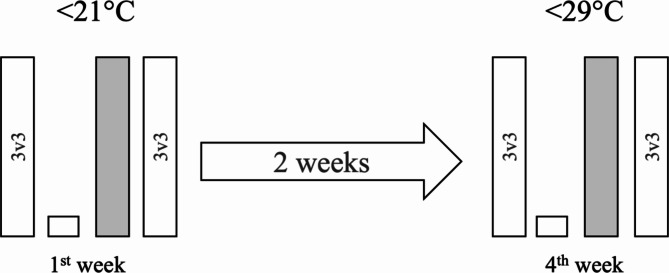
This study compares temperatures below 21ºC (∼ 20.4 ± 0.4ºC) with temperatures above 29ºC (∼ 29.7 ± 0.6ºC). This repeated measures study design involved 60 male football players at a trained/developmental level, selected from under-16 and under-19 teams. It aimed to assess the effects of the 3v3 format, conducted repeatedly under conditions of 21ºC and above 29ºC. Throughout the games, mean heart rate responses (HRmean), measured via heart rate sensors; rate of perceived exertion (RPE), assessed using the CR-10 Borg scale; and successful passes and lost balls, tracked through an ad hoc observational analysis tool, were monitored.
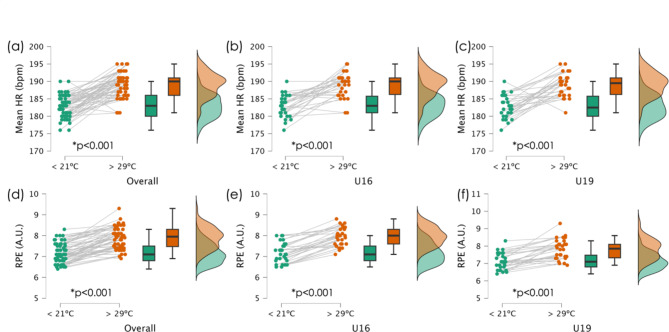
No significant interactions were observed (time*age group) in meanHR (F = 0.159; p = 0.691; [Formula: see text]=0.003), RPE (F=0.646; p=0.425; [Formula: see text]=0.011), number of passes completed (F=0.204; p=0.654; [Formula: see text]=0.003), and number of lost balls (F = 0.157; p = 0.694; [Formula: see text]=0.003). Overall, significantly higher heart rate responses in mean HR (p<0.001) and RPE (p<0.001) were observed at temperatures above 29ºC, while significantly more passes were completed at temperatures below 21ºC (p<0.001).
Heat conditions significantly intensified the psychophysiological responses in players, concurrently leading to a significant impairment in the number of passes. Coaches should contemplate implementing mitigation strategies to avert performance declines during heat conditions when utilizing SSGs.
足球教练经常采用小型比赛(SSG)来激发球员的生理和技术反应。然而,众多背景因素会影响这些比赛的结果。这项比较研究旨在调查环境温度(<21ºC和>29ºC)如何影响年轻男性足球运动员在小型比赛期间的心率反应、主观用力感觉和技术表现。
本研究将21ºC以下(约20.4±0.4ºC)的温度与29ºC以上(约29.7±0.6ºC)的温度进行比较。这种重复测量研究设计涉及60名处于训练/发展水平的男性足球运动员,他们选自16岁以下和19岁以下的球队。其目的是评估在21ºC及29ºC以上条件下重复进行的3对3比赛形式的效果。在整个比赛过程中,通过心率传感器测量平均心率反应(HRmean);使用CR-10博格量表评估主观用力感觉(RPE);通过专门的观察分析工具跟踪成功传球和失球情况。
在平均心率(F = 0.159;p = 0.691;[公式:见正文]=0.003)、主观用力感觉(F = 0.646;p = 0.425;[公式:见正文]=0.011)、完成传球次数(F = 0.204;p = 0.654;[公式:见正文]=0.003)和失球次数(F = 0.157;p = 0.694;[公式:见正文]=0.003)方面,未观察到显著的交互作用(时间*年龄组)。总体而言,在29ºC以上的温度下,平均心率(p<0.001)和主观用力感觉(p<0.001)的心率反应显著更高,而在21ºC以下的温度下完成的传球明显更多(p<0.001)。
炎热条件显著加剧了球员的心理生理反应,同时导致传球次数显著减少。教练在利用小型比赛时,应考虑实施缓解策略,以避免在炎热条件下表现下降。