Zhang Zhihua, Wang Yashen, Luo Fei, Li Jian
Department of Urology, Tianjin Union Medical Center, No. 190 Jie-yuan Road, Hong-qiao District, Tianjin, China.
Biol Proced Online. 2024 Aug 20;26(1):26. doi: 10.1186/s12575-024-00253-2.
To investigate the survival outcome of "radical" GreenLight photoselective vaporization of bladder tumor (RPVBT) in conjunction with postoperative chemotherapy for patients with single, < 3 cm in diameter, T2 stage muscle invasive bladder cancer (MIBC).
Thirty-eight patients with single, < 3 cm, T2 stage bladder cancer were treated with RPVBT combined with chemotherapy and were included in the RPVBT group. To compare the differences in survival outcome, 80 patients with Ta/T1 bladder cancer and 30 patients with T2 bladder cancer were included as controls. The 80 patients with Ta/T1 bladder cancer underwent GreenLight photoselective vaporization of bladder tumors(PVBT), while 30 patients with T2 bladder cancer underwent radical cystectomy (RC) combined with pelvic lymph node dissection (PLND). Tumor recurrence and death were recorded, and recurrence-free survival (RFS) and overall survival (OS) curves were plotted to compare the survival difference between the RPVBT and control groups.
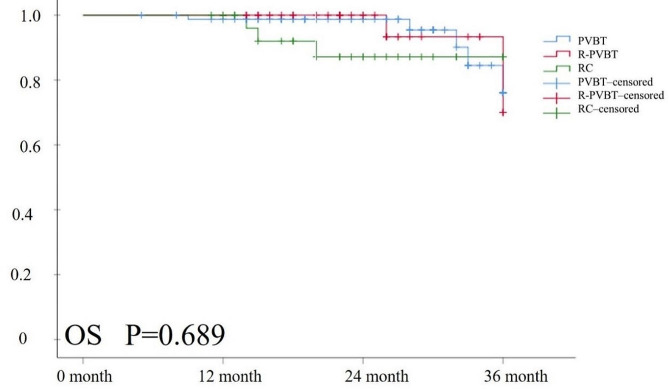
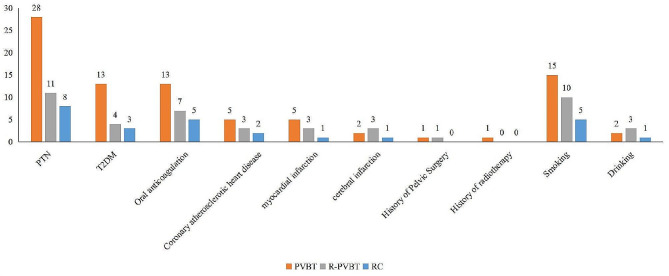
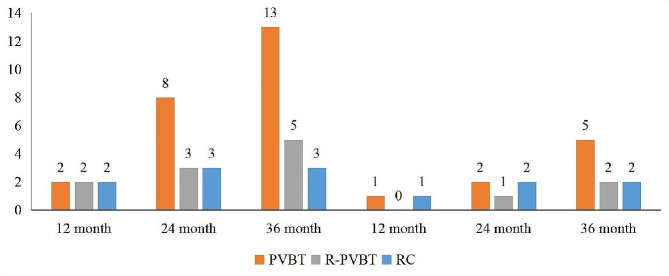
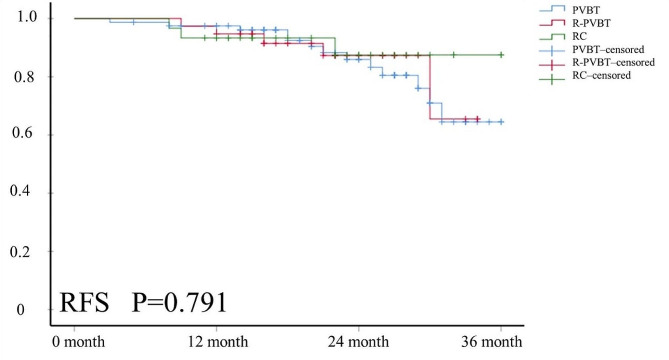
No significant differences were observed in comorbidities or living habits between the RPVBT and control groups. Blood loss [RPVBT: 20 (IQR10, 20) vs. RC: 100 (IQR90, 150) mL] and postoperative hospital stay [RPVBT: 5.5 (IQR5, 6), vs. RC: 10 (IQR8, 12) days] in the RPVBT group were significantly lower than that in the RC group. Urinary tract infection [RPVBT: 6 (15.8%) vs. PVBT: 14 (17.5%)] and bladder irritation sign [RPVBT: 11 (28.9%) vs. PVBT: 23 (28.8%) ] were the most common short-term complications in the RPVBT group, with no statistical difference between the RPVBT and PVBT group. The median follow-up time for survival endpoints was 22 (16, 27) months for the included patients after surgery. The outcomes of tumor recurrence at 12, 24, and 36 months were 2 (5.3%), 3 (7.9%), and 5 (13.2%) patients in the RPVBT groups, 13 (16.3%) and 3 (10%) patients experienced recurrence in the PVBT and RC groups at 36 months. No significant differences were noted among the three groups (P = 0.778). Additionally, Kaplan-Meier survival analysis revealed no statistically significant differences in RFS (P = 0.791) and OS (P = 0.689) among the three groups.
Our findings indicate that RPVBT combined with chemotherapy is a simple and feasible treatment option with fewer complications and satisfactory survival outcomes in patients with single, < 3 cm, T2 stage bladder cancer.
探讨“根治性”绿激光选择性汽化膀胱肿瘤(RPVBT)联合术后化疗对直径<3 cm的单发T2期肌层浸润性膀胱癌(MIBC)患者的生存结局。
38例直径<3 cm的单发T2期膀胱癌患者接受RPVBT联合化疗,纳入RPVBT组。为比较生存结局的差异,纳入80例Ta/T1期膀胱癌患者和30例T2期膀胱癌患者作为对照组。80例Ta/T1期膀胱癌患者接受绿激光选择性汽化膀胱肿瘤(PVBT),30例T2期膀胱癌患者接受根治性膀胱切除术(RC)联合盆腔淋巴结清扫术(PLND)。记录肿瘤复发和死亡情况,绘制无复发生存(RFS)和总生存(OS)曲线,比较RPVBT组与对照组的生存差异。
RPVBT组与对照组在合并症或生活习惯方面未观察到显著差异。RPVBT组的失血量[RPVBT:20(IQR10,20)ml vs. RC:100(IQR90,150)ml]和术后住院时间[RPVBT:5.5(IQR5,6)天,vs. RC:10(IQR8,12)天]显著低于RC组。尿路感染[RPVBT:6例(占15.8%)vs. PVBT:14例(占17.5%)]和膀胱刺激征[RPVBT:11例(占28.9%)vs. PVBT:23例(占28.8%)]是RPVBT组最常见的短期并发症,RPVBT组与PVBT组之间无统计学差异。术后纳入患者生存终点的中位随访时间为22(16,27)个月。RPVBT组在12、24和36个月时的肿瘤复发情况分别为2例(占5.3%)、3例(占7.9%)和5例(占13.2%),PVBT组和RC组在36个月时分别有13例(占16.3%)和3例(占10%)患者复发。三组之间未观察到显著差异(P = 0.778)。此外,Kaplan-Meier生存分析显示,三组在RFS(P = 0.791)和OS(P = 0.689)方面无统计学显著差异。
我们的研究结果表明,RPVBT联合化疗是一种简单可行的治疗选择,对于直径<3 cm的单发T2期膀胱癌患者,并发症较少,生存结局令人满意。