Zhu Shiben, Tan Xinyi, Huang He, Zhou Yi, Liu Yang
School of Nursing and Health Studies, Hong Kong Metropolitan University, Kowloon, Hong Kong, SAR, 999077, China.
Department of Spleen and Gastroenterology, Hubei Provincial Hospital of Traditional Chinese Medicine, Affiliated Hospital of Hubei University of Chinese Medicine, Wuhan, Hubei 430061, China.
Heliyon. 2024 Aug 2;10(15):e35586. doi: 10.1016/j.heliyon.2024.e35586. eCollection 2024 Aug 15.
is a significant global health concern, posing a high risk for gastric cancer. Conventional diagnostic and screening approaches are inaccessible, invasive, inaccurate, time-consuming, and expensive in primary clinics.
This study aims to apply machine learning (ML) models to detect infection using limited laboratory parameters from routine blood tests and to investigate the association of these biomarkers with clinical outcomes in primary clinics.
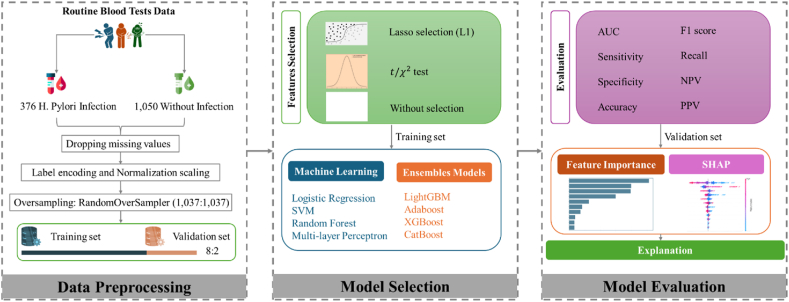
A retrospective analysis with three ML and five ensemble models was conducted on 1409 adults from Hubei Provincial Hospital of Traditional Chinese Medicine. evaluating twenty-three blood test parameters and using the urea breath test as the gold standard for diagnosing infection.
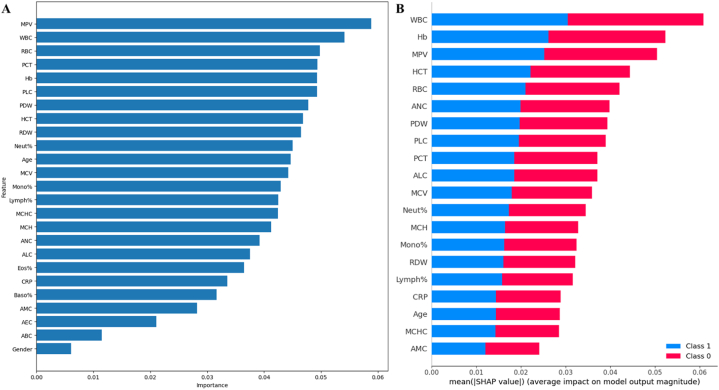
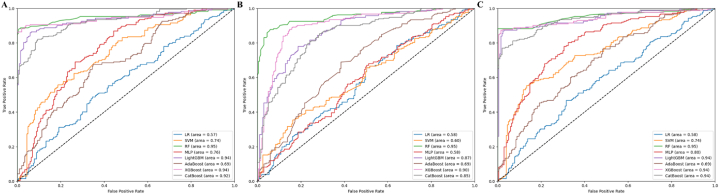
In our comparative study employing three different feature selection strategies, Random Forest (RF) model exhibited superior performance over other ML and ensemble models. Multiple evaluation metrics underscored the optimal performance of the RF model (ROC = 0.951, sensitivity = 0.882, specificity = 0.906, F1 = 0.906, accuracy = 0.894, PPV = 0.908, NPV = 0.880) without feature selection. Key biomarkers identified through importance ranking and shapley additive Explanations (SHAP) analysis using the RF model without feature selection include White Blood Cell Count (WBC), Mean Platelet Volume (MPV), Hemoglobin (Hb), Red Blood Cell Count (RBC), Platelet Crit (PCT), and Platelet Count (PLC). These biomarkers were found to be significantly associated with the presence of infection, reflecting the immune response and inflammation levels.
Abnormalities in key biomarkers could prompt clinical workers to consider infection. The RF model effectively identifies infection using routine blood tests, offering potential for clinical application in primary clinics. This ML approach can enhance diagnosis and screening, reducing medical burdens and reliance on invasive diagnostics.
是一个重大的全球健康问题,对胃癌构成高风险。在基层诊所,传统的诊断和筛查方法难以获得、具有侵入性、不准确、耗时且昂贵。
本研究旨在应用机器学习(ML)模型,利用常规血液检测中的有限实验室参数来检测感染,并调查这些生物标志物与基层诊所临床结局的关联。
对湖北省中医院的1409名成年人进行了一项回顾性分析,采用三种ML模型和五种集成模型。评估23项血液检测参数,并将尿素呼气试验作为诊断感染的金标准。
在我们采用三种不同特征选择策略的比较研究中,随机森林(RF)模型表现出优于其他ML模型和集成模型的性能。多个评估指标强调了RF模型的最佳性能(ROC = 0.951,灵敏度 = 0.882,特异性 = 0.906,F1 = 0.906,准确度 = 0.894,阳性预测值 = 0.908,阴性预测值 = 0.880),且无需特征选择。通过使用无特征选择的RF模型进行重要性排序和夏普利值附加解释(SHAP)分析确定的关键生物标志物包括白细胞计数(WBC)、平均血小板体积(MPV)、血红蛋白(Hb)、红细胞计数(RBC)、血小板压积(PCT)和血小板计数(PLC)。发现这些生物标志物与感染的存在显著相关,反映了免疫反应和炎症水平。
关键生物标志物的异常可能促使临床工作者考虑感染。RF模型利用常规血液检测有效地识别感染,在基层诊所具有临床应用潜力。这种ML方法可以加强诊断和筛查,减轻医疗负担并减少对侵入性诊断的依赖。