Gharaat Mohammad Ali, Choobdari Hamid Reza, Sheykhlouvand Mohsen
Department Physical Education, Farhangian University, P.O.Box 14665-889, Tehran, Iran.
Department Exercise Physiology, University of Bu-Ali Sina, Hamedan, Iran.
ARYA Atheroscler. 2024 Mar-Apr;20(2):50-60. doi: 10.48305/arya.2024.41976.2911.
The present study evaluated the effects of aerobic training with variable intensities on apoptotic indices of cardiac tissue in fatty diabetic rats.
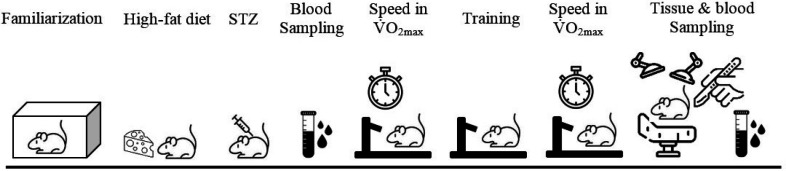
Twenty-four male Wistar rats were randomly divided into non-diabetic (ND, n=8), trained diabetic (TD, n=8), and control diabetic (CD, n=8) groups. Following a high-fat dietary regimen, type 2 diabetes was induced by streptozotocin, with blood glucose levels above 300 mg/dL considered indicative of diabetes. The TD group underwent aerobic exercise five times a week for six weeks. Subsequently, measurements were taken for left ventricular end-diastolic (LVEDV) and end-systolic volumes (LVESV), ejection fraction (EF%), catalase, caspase-9, P53, glucose, insulin, and HOMA-IR.
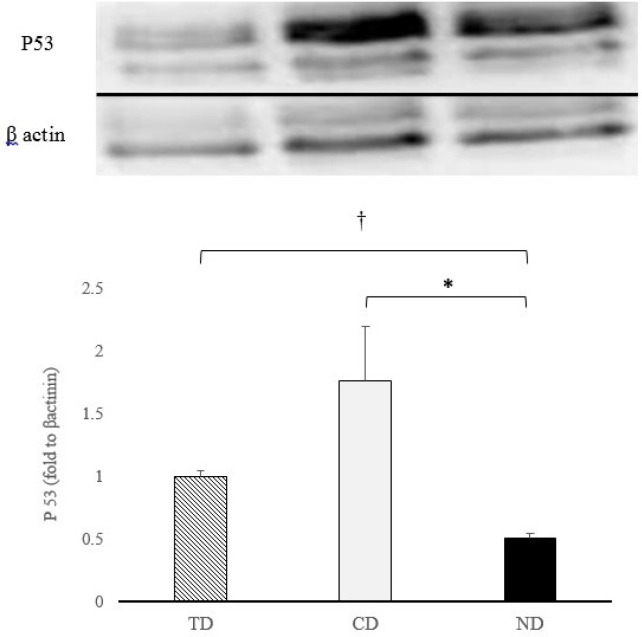
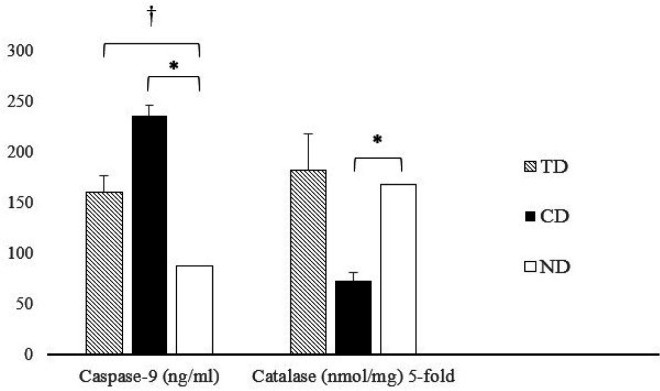
Aerobic training led to a significant decrease in blood glucose levels (P < 0.01), caspase-9 (P < 0.05), HOMA-IR (P < 0.05), and P53 expression (P < 0.001) compared with the CD group. LVEDV and LVESV decreased significantly (P < 0.05 for both), while LVEF increased significantly (P < 0.05). Catalase activation showed an insignificant increase in the TD group pre- to post-training compared to CD.
Incremental aerobic exercise training (6 weeks) may exert a cardioprotective effect in diabetic rats by reducing apoptosis and oxidative stress indices, while simultaneously increasing aerobic fitness and reducing body weight.
本研究评估了不同强度有氧运动训练对肥胖糖尿病大鼠心脏组织凋亡指标的影响。
将24只雄性Wistar大鼠随机分为非糖尿病组(ND,n = 8)、训练糖尿病组(TD,n = 8)和对照糖尿病组(CD,n = 8)。在高脂饮食方案后,用链脲佐菌素诱导2型糖尿病,血糖水平高于300mg/dL被认为是糖尿病的指征。TD组每周进行5次有氧运动,持续6周。随后,测量左心室舒张末期容积(LVEDV)、收缩末期容积(LVESV)、射血分数(EF%)、过氧化氢酶、半胱天冬酶-9、P53、血糖、胰岛素和胰岛素抵抗指数(HOMA-IR)。
与CD组相比,有氧运动训练导致血糖水平(P < 0.01)、半胱天冬酶-9(P < 0.05)、HOMA-IR(P < 0.05)和P53表达(P < 0.001)显著降低。LVEDV和LVESV显著降低(两者均P < 0.05),而LVEF显著增加(P < 0.05)。与CD组相比,TD组训练前至训练后过氧化氢酶激活的增加不显著。
递增式有氧运动训练(6周)可能通过降低凋亡和氧化应激指标,同时提高有氧适能和减轻体重,对糖尿病大鼠发挥心脏保护作用。