Department of Nursing, The First Affiliated Hospital, College of Medicine, Zhejiang University, Hangzhou, Zhejiang Province, China.
BMC Cardiovasc Disord. 2024 Aug 23;24(1):438. doi: 10.1186/s12872-024-04114-4.
Empowerment is a comprehensive concept involving intrapersonal, interactional, and behavioral aspects. However, there is a lack of a specific empowerment scale for Coronary artery disease (CAD) related to knowledge and skills in China. The reliability and validity of the Coronary Artery Disease Empowerment Scale (CADES) need to be tested. This study aimed to assess the reliability and validity of the Chinese version of CADES among patients with CAD in China.
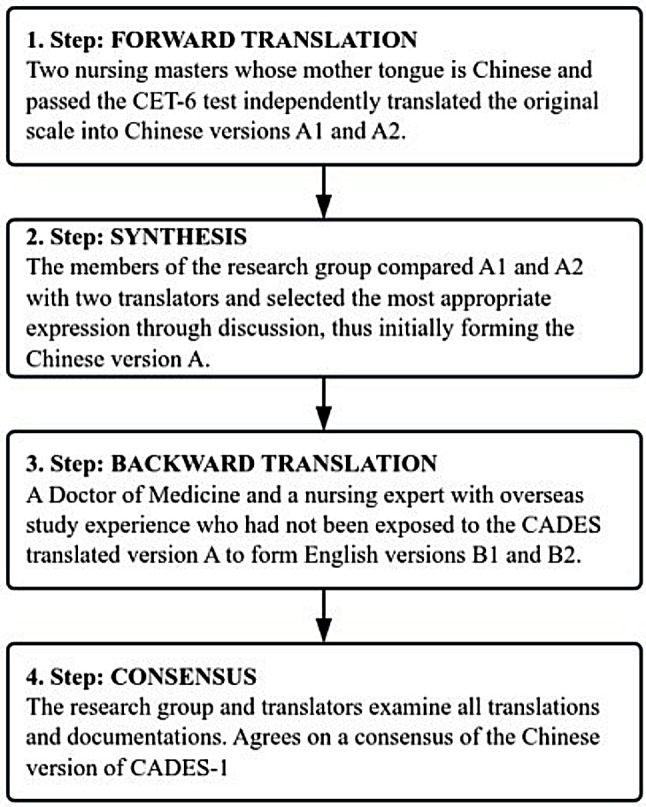
The study adopted a cross-sectional design. After obtaining the copyright by contacting the author, the original English CADES was developed into Chinese by forward translation, back-translation, cross-cultural adaptation, and a pretest (30 patients). The Chinese version of CADES was administered to 391 CAD patients between September 2022 and June 2023, with the reliability and validity of the version evaluated. Exploratory factor analysis and confirmatory factor analysis were performed to examine the underlying factor structure of the translated questionnaire. The Cronbach's α coefficient, Guttman's split-half coefficient, and McDonald's omega coefficient were calculated to verify the scale's reliability.
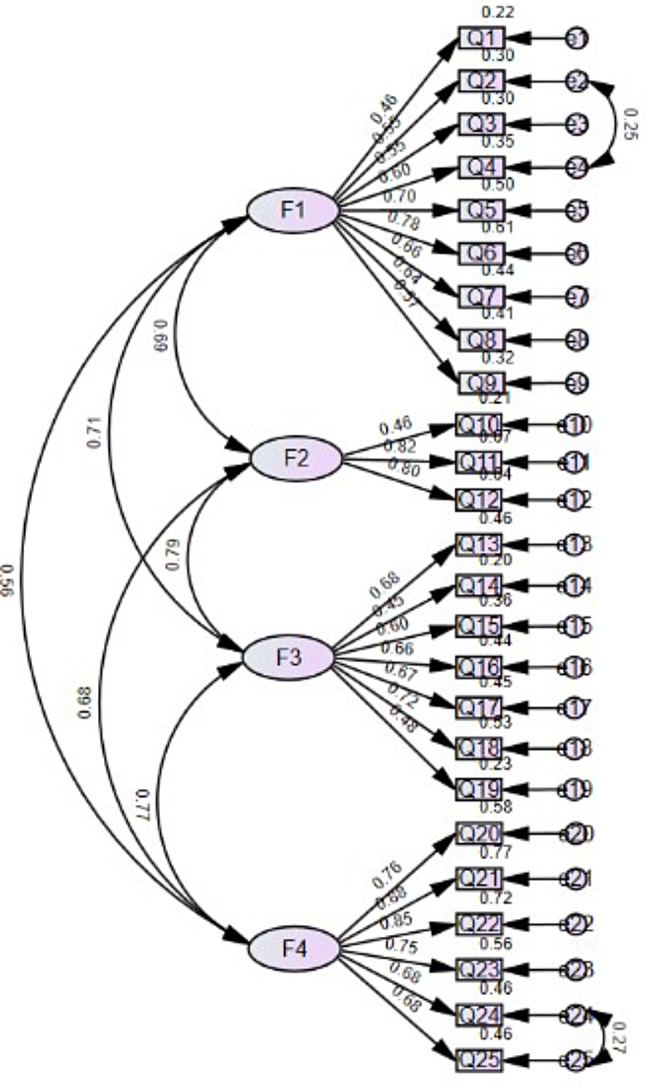
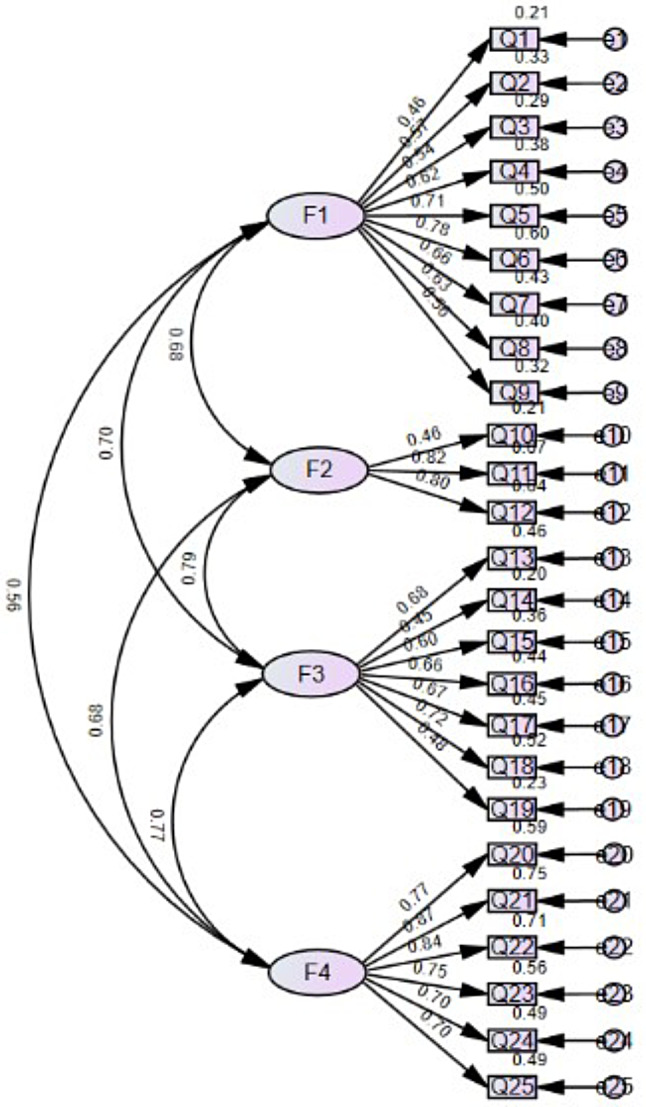
For the Chinese version of CADES, the scale-content validity index was 0.972, with the item-content validity index ranging from 0.86 to 1.00. The questionnaire comprised 25 items, and exploratory factor analysis extracted four factors with loadings > 0.40, explaining 62.382% of the total variance. An acceptable model fit was achieved (χ/df = 1.764, RMSEA = 0.060, TLI = 0.901, CFI = 0.912, IFI = 0.913). The Cronbach's α coefficient of the total questionnaire was 0.928, with coefficients for the four factors ranging from 0.683 to 0.913. The split-half reliability coefficient was 0.777, and the McDonald's omega reliability coefficient was 0.926.
The Chinese version of CADES is reliable and valid among CAD patients in China. This instrument can serve as a valuable reference for guiding the implementation of targeted intervention strategies tailored to the empowerment status of CAD patients in clinical practice.
赋权是一个涉及内在、互动和行为方面的综合概念。然而,在中国,针对冠心病(CAD)相关知识和技能,缺乏特定的赋权量表。需要对冠心病赋权量表(CADES)的信度和效度进行检验。本研究旨在评估 CADES 的中文版在中国 CAD 患者中的信度和效度。
采用横断面设计。通过与作者联系获得版权后,将原始的英文 CADES 通过正向翻译、反向翻译、跨文化调适和预测试(30 例患者)改编为中文。2022 年 9 月至 2023 年 6 月,对 391 例 CAD 患者进行了中文版 CADES 评估,评价其信度和效度。采用探索性因子分析和验证性因子分析来检验问卷的潜在因子结构。计算克朗巴赫 α系数、古特曼分半系数和麦克唐纳 ω系数以验证量表的信度。
中文版 CADES 的量表内容效度指数为 0.972,项目内容效度指数为 0.861.00。问卷包括 25 个条目,探索性因子分析提取出 4 个因子,负荷值均>0.40,共解释总方差的 62.382%。可接受的模型拟合度(χ/df=1.764,RMSEA=0.060,TLI=0.901,CFI=0.912,IFI=0.913)。总量表的克朗巴赫 α 系数为 0.928,4 个因子的系数为 0.6830.913。半分信度系数为 0.777,麦克唐纳 ω 信度系数为 0.926。
中文版 CADES 在中国 CAD 患者中具有可靠性和有效性。该工具可为指导临床实践中针对 CAD 患者赋权状况实施有针对性的干预策略提供有价值的参考。