Kim Taebin, Li Yao, Calhoun Benjamin C, Thennavan Aatish, Carey Lisa A, Symmans W Fraser, Troester Melissa A, Perou Charles M, Marron J S
University of North Carolina at Chapel Hill, Department of Statistics and Operations Research, Chapel Hill, North Carolina, United States.
University of North Carolina at Chapel Hill, Department of Pathology and Laboratory Medicine, Chapel Hill, North Carolina, United States.
J Med Imaging (Bellingham). 2024 Jul;11(4):044006. doi: 10.1117/1.JMI.11.4.044006. Epub 2024 Aug 23.
We address the need for effective stain domain adaptation methods in histopathology to enhance the performance of downstream computational tasks, particularly classification. Existing methods exhibit varying strengths and weaknesses, prompting the exploration of a different approach. The focus is on improving stain color consistency, expanding the stain domain scope, and minimizing the domain gap between image batches.
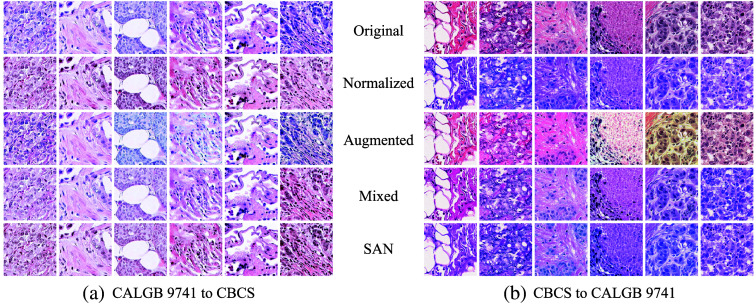
We introduce a new domain adaptation method, Stain simultaneous augmentation and normalization (SAN), designed to adjust the distribution of stain colors to align with a target distribution. Stain SAN combines the merits of established methods, such as stain normalization, stain augmentation, and stain mix-up, while mitigating their inherent limitations. Stain SAN adapts stain domains by resampling stain color matrices from a well-structured target distribution.
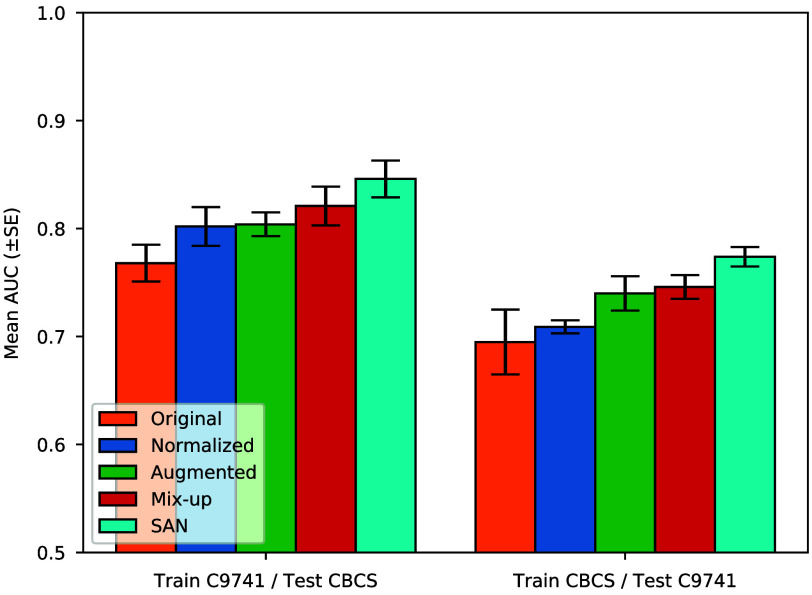
Experimental evaluations of cross-dataset clinical estrogen receptor status classification demonstrate the efficacy of Stain SAN and its superior performance compared with existing stain adaptation methods. In one case, the area under the curve (AUC) increased by 11.4%. Overall, our results clearly show the improvements made over the history of the development of these methods culminating with substantial enhancement provided by Stain SAN. Furthermore, we show that Stain SAN achieves results comparable with the state-of-the-art generative adversarial network-based approach without requiring separate training for stain adaptation or access to the target domain during training. Stain SAN's performance is on par with HistAuGAN, proving its effectiveness and computational efficiency.
Stain SAN emerges as a promising solution, addressing the potential shortcomings of contemporary stain adaptation methods. Its effectiveness is underscored by notable improvements in the context of clinical estrogen receptor status classification, where it achieves the best AUC performance. The findings endorse Stain SAN as a robust approach for stain domain adaptation in histopathology images, with implications for advancing computational tasks in the field.
我们致力于解决组织病理学中有效染色域适应方法的需求,以提高下游计算任务(尤其是分类任务)的性能。现有方法各有优劣,促使我们探索一种不同的方法。重点在于提高染色颜色一致性、扩大染色域范围以及最小化图像批次之间的域差距。
我们引入了一种新的域适应方法,即染色同步增强与归一化(SAN),旨在调整染色颜色的分布以使其与目标分布对齐。染色SAN结合了诸如染色归一化、染色增强和染色混合等现有方法的优点,同时减轻了它们固有的局限性。染色SAN通过从结构良好的目标分布中重新采样染色颜色矩阵来适应染色域。
跨数据集临床雌激素受体状态分类的实验评估证明了染色SAN的有效性及其与现有染色适应方法相比的优越性能。在一个案例中,曲线下面积(AUC)提高了11.4%。总体而言,我们的结果清楚地表明了在这些方法的发展历程中所取得的改进,最终以染色SAN提供的显著增强为 culminating。此外,我们表明染色SAN在无需单独进行染色适应训练或在训练期间访问目标域的情况下,能够取得与基于生成对抗网络的最先进方法相当的结果。染色SAN的性能与HistAuGAN相当,证明了其有效性和计算效率。
染色SAN成为一种有前景的解决方案,解决了当代染色适应方法的潜在缺点。其有效性在临床雌激素受体状态分类的背景下通过显著改进得到了强调,在该分类中它实现了最佳的AUC性能。这些发现认可染色SAN作为组织病理学图像中染色域适应的一种稳健方法,对推进该领域的计算任务具有重要意义。