IncellDx Inc, 30920 Huntwood Ave, San Carlos, Hayward, CA, 94544, USA.
Lab of Tumor Chemosensitivity, Faculty of Microbiology, CIET/CICICA, Universidad de Costa Rica, San José, Costa Rica.
Sci Rep. 2024 Aug 26;14(1):19743. doi: 10.1038/s41598-024-70929-y.
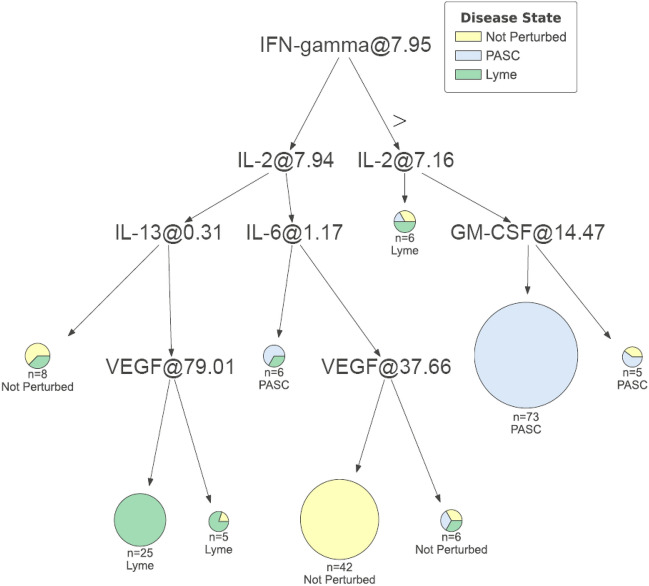
The absence of a long COVID (LC) or post-acute sequelae of COVID-19 (PASC) diagnostic has profound implications for research and potential therapeutics given the lack of specificity with symptom-based identification of LC and the overlap of symptoms with other chronic inflammatory conditions. Here, we report a machine-learning approach to LC/PASC diagnosis on 347 individuals using cytokine hubs that are also capable of differentiating LC from chronic lyme disease (CLD). We derived decision tree, random forest, and gradient-boosting machine (GBM) classifiers and compared their diagnostic capabilities on a dataset partitioned into training (178 individuals) and evaluation (45 individuals) sets. The GBM model generated 89% sensitivity and 96% specificity for LC with no evidence of overfitting. We tested the GBM on an additional random dataset (106 LC/PASC and 18 Lyme), resulting in high sensitivity (97%) and specificity (90%) for LC. We constructed a Lyme Index confirmatory algorithm to discriminate LC and CLD.
缺乏长新冠(LC)或新冠后急性后遗症(PASC)的诊断,这对研究和潜在治疗方法产生了深远的影响,因为基于症状的 LC 识别缺乏特异性,而且症状与其他慢性炎症性疾病存在重叠。在这里,我们报告了一种使用细胞因子枢纽的机器学习方法,对 347 个人进行 LC/PASC 诊断,这些枢纽还能够区分 LC 和慢性莱姆病(CLD)。我们得出了决策树、随机森林和梯度提升机(GBM)分类器,并比较了它们在数据集上的诊断能力,该数据集分为训练(178 个人)和评估(45 个人)集。GBM 模型对 LC 的敏感性为 89%,特异性为 96%,没有过度拟合的证据。我们在另一个随机数据集(106 个 LC/PASC 和 18 个莱姆)上测试了 GBM,结果显示 LC 的敏感性(97%)和特异性(90%)都很高。我们构建了一个莱姆指数确认算法来区分 LC 和 CLD。