Pulcinella Antonio, Chandra Tiwari Prakash, Luridiana Alberto, Yamazaki Ken, Mazzarella Daniele, Sadhoe Akshay K, Alfano Antonella Ilenia, Tiekink Eveline H, Hamlin Trevor A, Noël Timothy
Flow Chemistry Group, Van't Hoff Institute for Molecular Sciences (HIMS), University of Amsterdam, Science Park 904, 1098 XH, Amsterdam, The Netherlands.
Dipartimento di Scienze Chimiche e Geologiche Università degli Studi di Cagliari, S.S. 554, bivio per Sestu, 09042, Monserrato, CA, Italy.
Angew Chem Int Ed Engl. 2025 Jan 10;64(2):e202413846. doi: 10.1002/anie.202413846. Epub 2024 Oct 25.
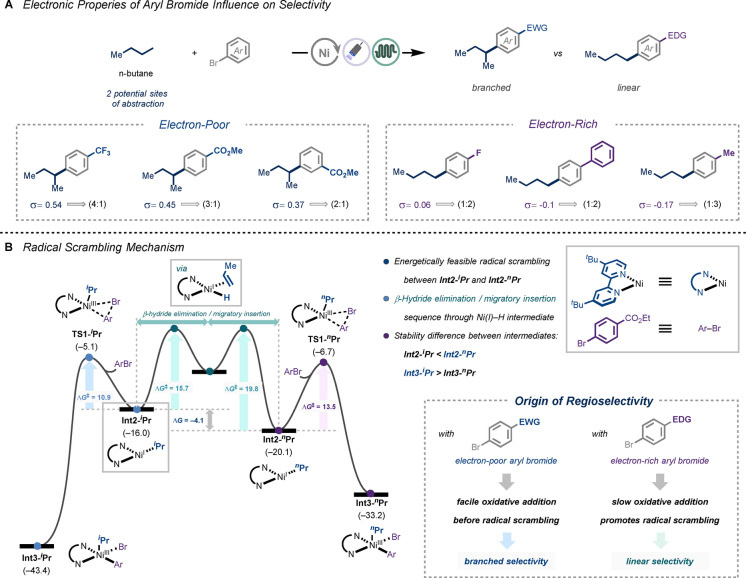
The homologous series of gaseous C1-4 alkanes represents one of the most abundant sources of short alkyl fragments. However, their application in synthetic organic chemistry is exceedingly rare due to the challenging C-H bond cleavage, which typically demands high temperatures and pressures, thereby limiting their utility in the construction of complex organic molecules. In particular, the formation of C(sp)-C(sp) bonds is crucial for constructing biologically active molecules, including pharmaceuticals and agrochemicals. In this study, we present the previously elusive coupling between gaseous alkanes and (hetero)aryl bromides, achieved through a combination of Hydrogen Atom Transfer (HAT) photocatalysis and nickel-catalyzed cross coupling at room temperature. Utilizing flow technology allowed us to conduct this novel coupling reaction with reduced reaction times and in a scalable fashion, rendering it practical for widespread adoption in both academia and industry. Density Functional Theory (DFT) calculations unveiled that the oxidative addition constitutes the rate-determining step, with the activation energy barrier increasing with smaller alkyl radicals. Furthermore, radical isomerization observed in propane and butane analogues could be attributed to the electronic properties of the bromoarene coupling partner, highlighting the crucial role of oxidative addition in the observed selectivity of this transformation.
气态C1-4烷烃的同系物是短烷基片段最丰富的来源之一。然而,由于具有挑战性的C-H键裂解,它们在合成有机化学中的应用极为罕见,这种裂解通常需要高温高压,从而限制了它们在构建复杂有机分子中的效用。特别是,C(sp)-C(sp)键的形成对于构建包括药物和农用化学品在内的生物活性分子至关重要。在本研究中,我们展示了气态烷烃与(杂)芳基溴化物之间此前难以实现的偶联,该偶联是通过氢原子转移(HAT)光催化和镍催化的交叉偶联在室温下实现的。利用流动技术使我们能够以缩短的反应时间和可扩展的方式进行这种新型偶联反应,使其在学术界和工业界广泛应用成为现实。密度泛函理论(DFT)计算表明,氧化加成是速率决定步骤,活化能垒随着较小的烷基自由基而增加。此外,在丙烷和丁烷类似物中观察到的自由基异构化可归因于溴代芳烃偶联伙伴的电子性质,突出了氧化加成在该转化所观察到的选择性中的关键作用。