Dam-On Adisorn, Nimako Collins, Kulprasertsri Sittinee, Ikenaka Yoshinori, Yohannes Yared B, Nakayama Shouta M M, Ishizuka Mayumi, Poapolathep Saranya, Poapolathep Amnart, Khidkhan Kraisiri
Department of Pharmacology, Faculty of Veterinary Medicine, Kasetsart University, Bangkok 10900, Thailand.
Laboratory of Toxicology, Department of Environmental Veterinary Sciences, Faculty of Veterinary Medicine, Hokkaido University, Kita 18 Nishi 9, Kita-ku, Sapporo 060-0818, Japan.
Toxics. 2024 Aug 21;12(8):618. doi: 10.3390/toxics12080618.
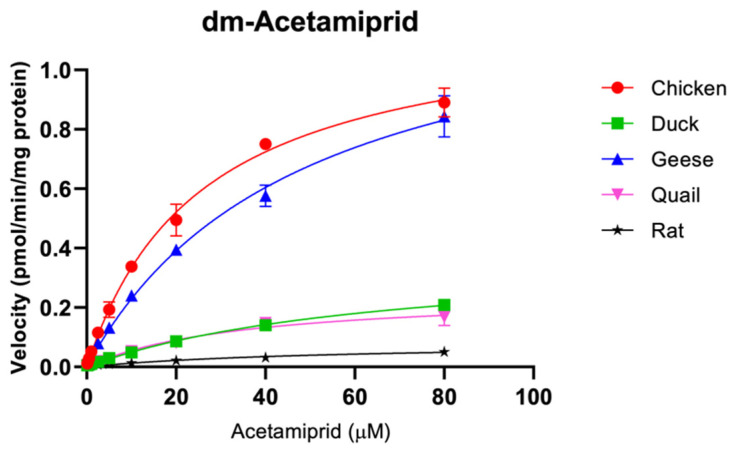
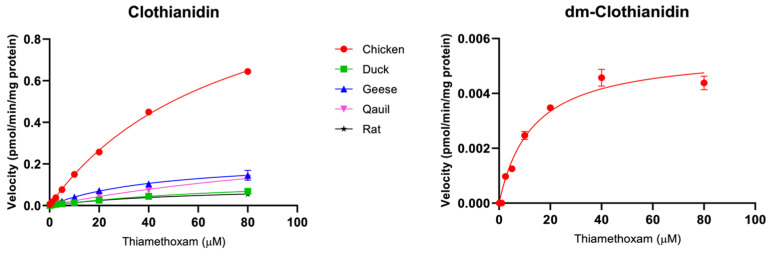
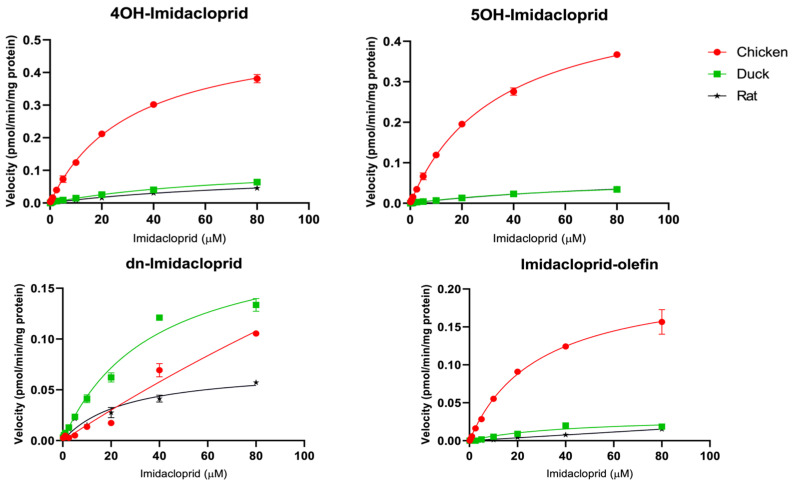
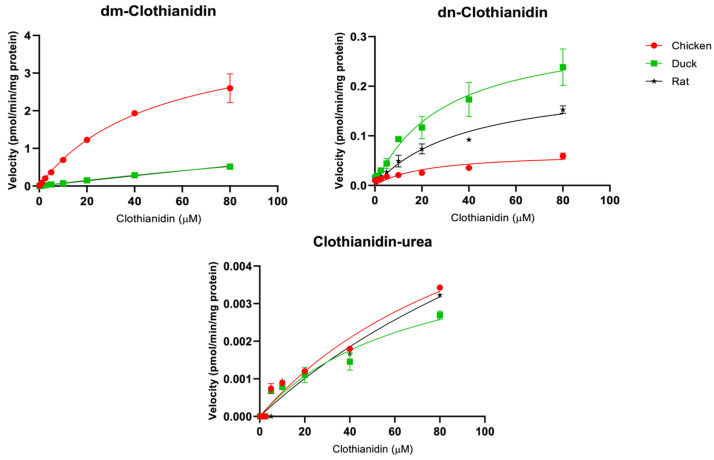
Neonicotinoids, a neuro-effective class of insecticides, are heavily applied in agricultural activities worldwide. Poultry can be exposed to neonicotinoids by several routes, but the knowledge of neonicotinoid's metabolism in poultry and its associated interspecies differences is highly limited. Hence, this study aims to investigate the species differences in metabolite formations, as well as cytochrome P450 (CYP)-dependent metabolism of four major neonicotinoid compounds, acetamiprid, imidacloprid, clothianidin, and thiamethoxam, in poultry. In vitro biotransformation assays using hepatic microsomes of chicken, ducks, geese, quails, and rats were conducted. Metabolites of neonicotinoids were then screened by LC/Q-TOF and quantified by LC/MS/MS. The results revealed an existence of interspecies differences in the formations of -[(6-chloro-3-pyridyl) methyl] --methyl acetamidine (IM-1-5) of acetamiprid and dm-clothianidin of clothianidin between chicken and other species. In addition, the greatest CYP activities in the metabolism of most neonicotinoid substrates, such as acetamiprid to dm-acetamiprid, imidacloprid to hydroxylated-imidacloprid and imidacloprid-olefin, clothianidin to dm-clothianidin, and thiamethoxam to clothianidin, were found in chicken. These results suggested that the CYPs in chicken may have a greater capacity for metabolism of neonicotinoids compared to other poultry. This study further revealed that the maximum intrinsic clearance of dn-imidacloprid and dn-clothianidin in ducks may be superintended by CYP-mediated nitro-reductions of imidacloprid and clothianidin. Further studies employing CYP recombinant enzymes may be required to elucidate the specific CYP isoforms that may be involved in neonicotinoid metabolism in avian species.
新烟碱类是一类对神经有作用的杀虫剂,在全球农业活动中大量使用。家禽可通过多种途径接触新烟碱类,但关于新烟碱类在家禽体内的代谢及其相关种间差异的了解非常有限。因此,本研究旨在调查家禽体内四种主要新烟碱类化合物(啶虫脒、吡虫啉、噻虫胺和噻虫嗪)代谢产物形成的种间差异以及细胞色素P450(CYP)依赖性代谢。使用鸡、鸭、鹅、鹌鹑和大鼠的肝微粒体进行了体外生物转化试验。然后通过液相色谱/四极杆飞行时间质谱(LC/Q-TOF)筛选新烟碱类的代谢产物,并通过液相色谱/串联质谱(LC/MS/MS)进行定量。结果显示,鸡与其他物种之间在啶虫脒的-[(6-氯-3-吡啶基)甲基]--甲基乙脒(IM-1-5)和噻虫胺的脱甲基噻虫胺形成方面存在种间差异。此外,在鸡体内发现,大多数新烟碱类底物代谢过程中CYP活性最高,如啶虫脒代谢为脱甲基啶虫脒、吡虫啉代谢为羟基化吡虫啉和吡虫啉烯烃、噻虫胺代谢为脱甲基噻虫胺以及噻虫嗪代谢为噻虫胺。这些结果表明,与其他家禽相比,鸡体内的CYPs可能具有更强的新烟碱类代谢能力。本研究进一步表明,鸭体内脱硝基吡虫啉和脱硝基噻虫胺的最大内在清除率可能受CYP介导的吡虫啉和噻虫胺硝基还原作用的调控。可能需要进一步使用CYP重组酶进行研究,以阐明可能参与鸟类新烟碱类代谢的特定CYP同工酶。