Liu Yuan, Shu Yan, Huang Yuling, Tan Jinchao, Wang Fengmei, Tang Lin, Fang Tingting, Yuan Shibin, Wang Le
Key Laboratory of Southwest China Wildlife Resources Conservation (Ministry of Education), China West Normal University, Nanchong 637009, China.
Nanchong Key Laboratory of Wildlife Nutrition Ecology and Disease Control, Nanchong 637009, China.
Microorganisms. 2024 Aug 4;12(8):1587. doi: 10.3390/microorganisms12081587.
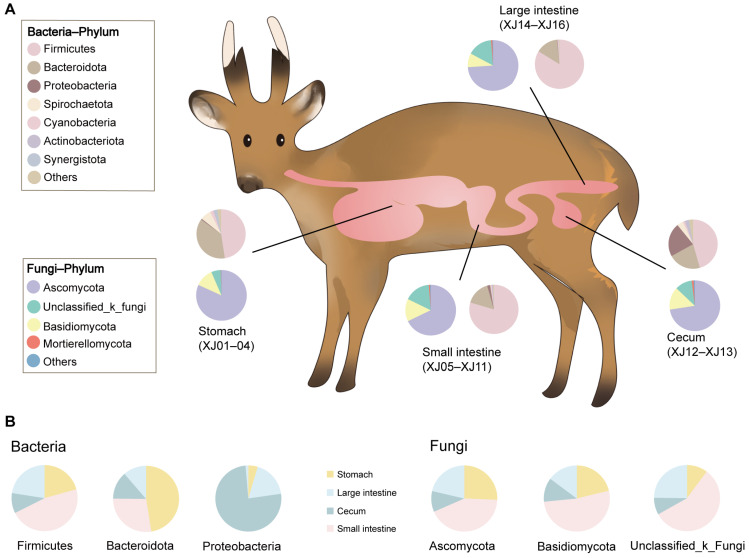
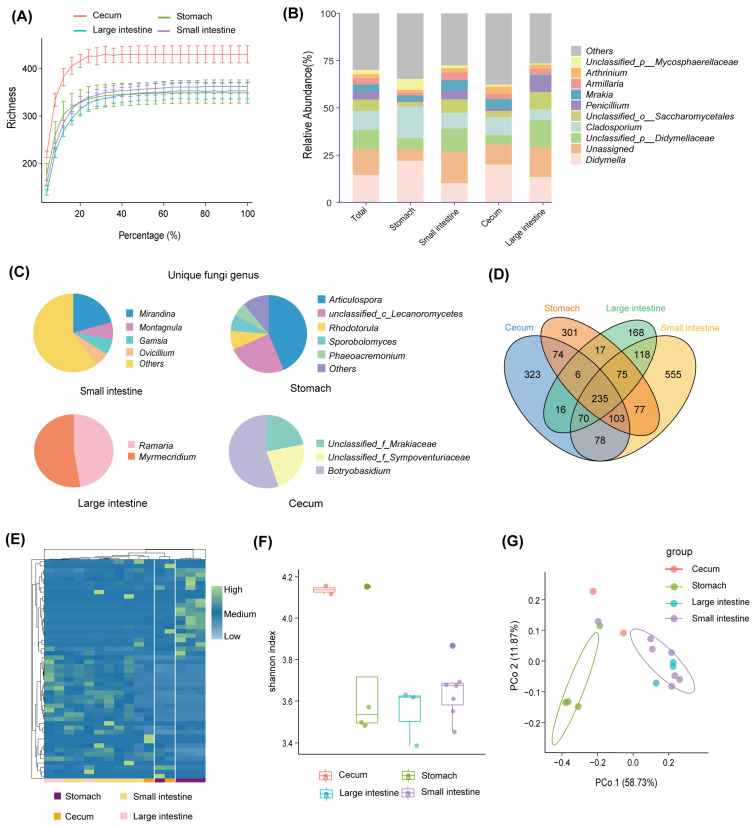
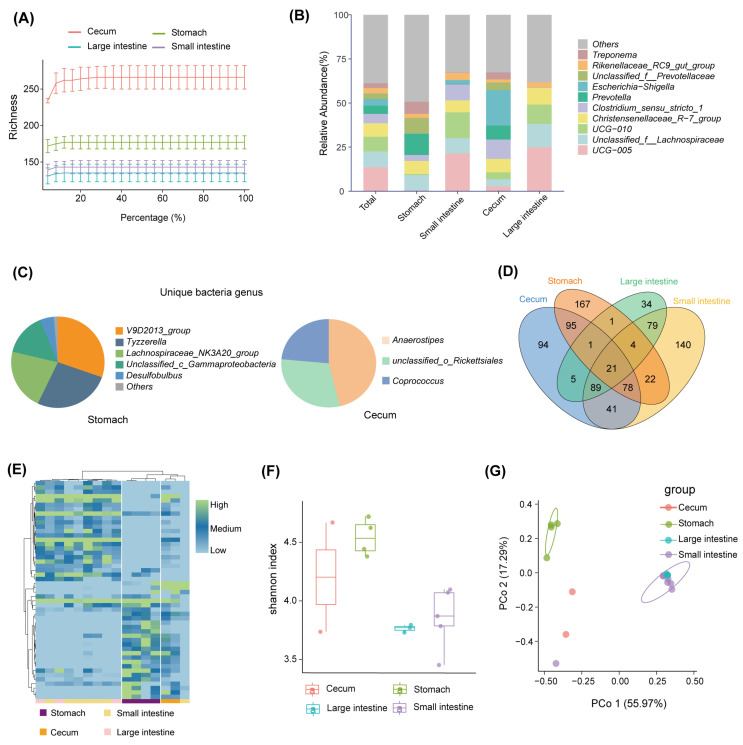
The gut microbiota plays an important role in host nutrient absorption, immune function, and behavioral patterns. Much research on the gut microbiota of wildlife has focused on feces samples, so the microbial composition along the gastrointestinal tract of wildlife is not well reported. To address this gap, we performed high-throughput sequencing of 16s rRNA genes and ITs rRNA genes in the gastrointestinal contents of a wild adult male Chinese muntjac () to comparatively analyze the microbial diversity of different gastrointestinal regions. The results showed that the dominant bacterial phyla were Firmicutes (66.19%) and Bacteroidetes (22.7%), while the dominant fungal phyla were Ascomycetes (72.81%). The highest bacterial diversity was found in the stomach, and the highest fungal diversity was found in the cecum. The microbial communities of the large intestine and small intestine were of similar structures, which were distinct from that of the stomach. These results would facilitate the continued exploration of the microbial composition and functional diversity of the gastrointestinal tract of wild Chinese muntjacs and provide a scientific basis for microbial resource conservation of more wildlife.
肠道微生物群在宿主营养吸收、免疫功能和行为模式中发挥着重要作用。许多关于野生动物肠道微生物群的研究都集中在粪便样本上,因此野生动物胃肠道沿线的微生物组成尚未得到充分报道。为了填补这一空白,我们对一只野生成年雄性中华麂( )胃肠道内容物中的16s rRNA基因和ITS rRNA基因进行了高通量测序,以比较分析不同胃肠道区域的微生物多样性。结果表明,主要细菌门为厚壁菌门(66.19%)和拟杆菌门(22.7%),而主要真菌门为子囊菌门(72.81%)。胃中的细菌多样性最高,盲肠中的真菌多样性最高。大肠和小肠的微生物群落结构相似,与胃的微生物群落不同。这些结果将有助于继续探索野生中华麂胃肠道的微生物组成和功能多样性,并为更多野生动物的微生物资源保护提供科学依据。