Rappelt Ludwig, Held Steffen, Wiedenmann Tim, Micke Florian, Donath Lars
Department of Intervention Research in Exercise Training, German Sport University Cologne, Cologne, Germany.
Department of Movement and Training Science, University of Wuppertal, Wuppertal, Germany.
Front Physiol. 2024 Aug 14;15:1447421. doi: 10.3389/fphys.2024.1447421. eCollection 2024.
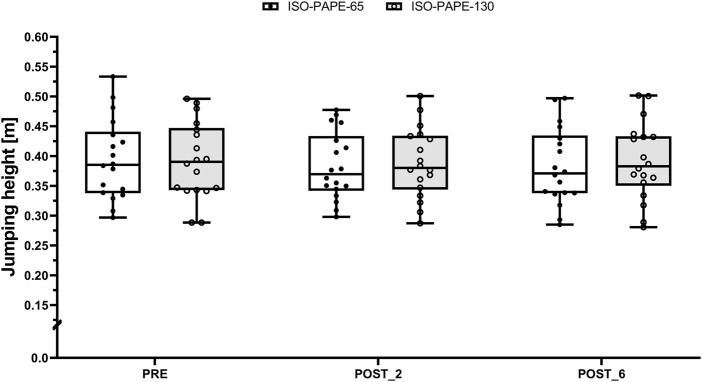
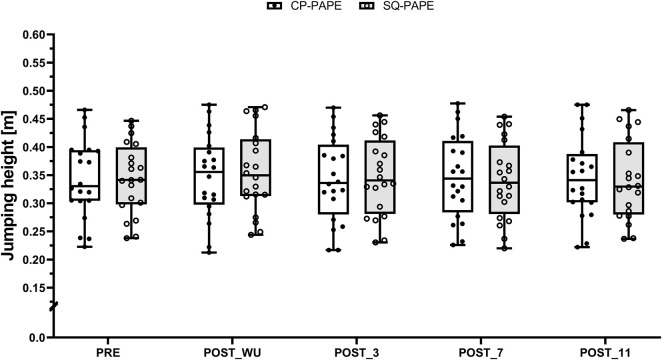
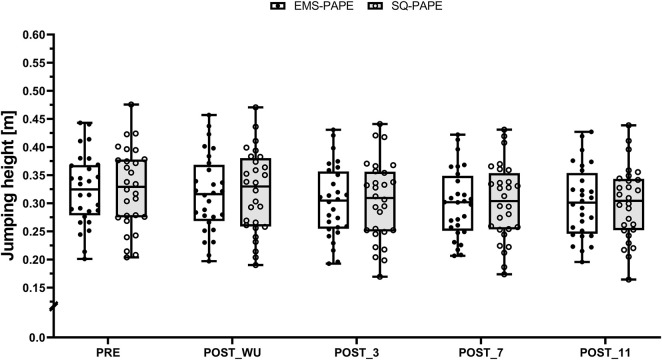
Post-activation performance enhancement (PAPE) cannot be clearly distinguished from and may be explained in large by warm-up effects. To disentangle PAPE from a systemic warm-up effect, we conducted three randomized crossover trials (RCT). Each RCT consisted of a familiarization/one-repetition-maximum (1RM) assessment session followed by two interventional sessions (random order). In Study I, 18 participants (age: 26 ± 4 years; height: 1.84 ± 0.06 m; mass: 83.7 ± 8.7 kg; Squat-1RM: 146 ± 19 kg) performed either a 3-s isometric squat at 130%1RM or a 6-s isometric squat at 65%1RM. In Study II, 28 participants (11 female; age: 23 ± 3 years; height: 1.77 ± 0.08 m; mass: 76.5 ± 10.4 kg; Squat-1RM: 109 ± 38 kg) completed either Squat (3 × 3 repetitions, 85%1RM) or local electromyostimulation of the quadriceps muscle (85% of individual pain threshold). In Study III, 20 participants (6 female, age: 25.0 ± 3.5 years, mass: 78.5 ± 15.8 kg, height: 1.75 ± 0.08 m; SQ-1RM: 114 ± 33 kg, chest-press-1RM: 74 ± 29 kg) performed either squats or chest press (4 repetitions, 80%1RM). Counter-Movement-Jump height (CMJ) was assessed after a general (PRE) and/or muscle-specific warm-up (POST_WU) and for up to 11 min after the PAPE protocols. To identify possible differences in CMJ between the experimental conditions, mixed-design ANOVA models were used for each study individually, with condition and time modelled as fixed effects, while participants were included as a random effect blocking factor. The level of statistical significance was set at α = 5%. In studies I and II, significant effects for time ( < 0.05, ω = 0.06 and < 0.001, ω = 0.43) were found with the highest CMJ compared to all other time points at PRE (≤8.2 ± 4.6%, standardized mean difference: ≤0.39), regardless of condition. In study III, no significant effects were observed. Thus, PAPE protocols do not further improve jumping performance compared to a general and muscle-specific traditional warm-up. Prior to tasks requiring explosive strength, general and sport-specific warm-up strategies should be used.
激活后表现增强(PAPE)与热身效应难以明确区分,且很大程度上可能由热身效应来解释。为了将PAPE与全身性热身效应区分开来,我们进行了三项随机交叉试验(RCT)。每项RCT都包括一个熟悉/一次重复最大值(1RM)评估环节,随后是两个干预环节(随机顺序)。在研究I中,18名参与者(年龄:26±4岁;身高:1.84±0.06米;体重:83.7±8.7千克;深蹲1RM:146±19千克)进行了一次130%1RM的3秒等长深蹲或一次65%1RM的6秒等长深蹲。在研究II中,28名参与者(11名女性;年龄:23±3岁;身高:1.77±0.08米;体重:76.5±10.4千克;深蹲1RM:109±38千克)完成了深蹲(3组,每组3次重复,85%1RM)或股四头肌局部肌电刺激(个体疼痛阈值的85%)。在研究III中,20名参与者(6名女性,年龄:25.0±3.5岁,体重:78.5±15.8千克,身高:1.75±0.08米;深蹲1RM:114±33千克,卧推1RM:74±29千克)进行了深蹲或卧推(4次重复,80%1RM)。在进行一般性(PRE)和/或特定肌肉热身(POST_WU)后以及PAPE方案实施后长达11分钟内,评估了反向纵跳高度(CMJ)。为了确定实验条件之间CMJ的可能差异,对每项研究分别使用混合设计方差分析模型,将条件和时间建模为固定效应,同时将参与者作为随机效应阻断因素纳入。统计显著性水平设定为α = 5%。在研究I和II中,发现时间有显著影响(P < 0.05,ω = 0.06和P < 0.001,ω = 0.43),与PRE时的所有其他时间点相比,CMJ最高(≤8.2±4.6%,标准化均值差异:≤0.39),与条件无关。在研究III中,未观察到显著影响。因此,与一般性和特定肌肉的传统热身相比,PAPE方案并不能进一步提高跳跃表现。在需要爆发力的任务之前,应采用一般性和特定运动的热身策略。