Department of Hematology, Oncology and Rheumatology, Internal Medicine V, University Hospital Heidelberg, Heidelberg, Germany.
Institute of Virology, Medical Center-University of Freiburg, Freiburg, Germany.
RMD Open. 2024 Aug 28;10(3):e004190. doi: 10.1136/rmdopen-2024-004190.
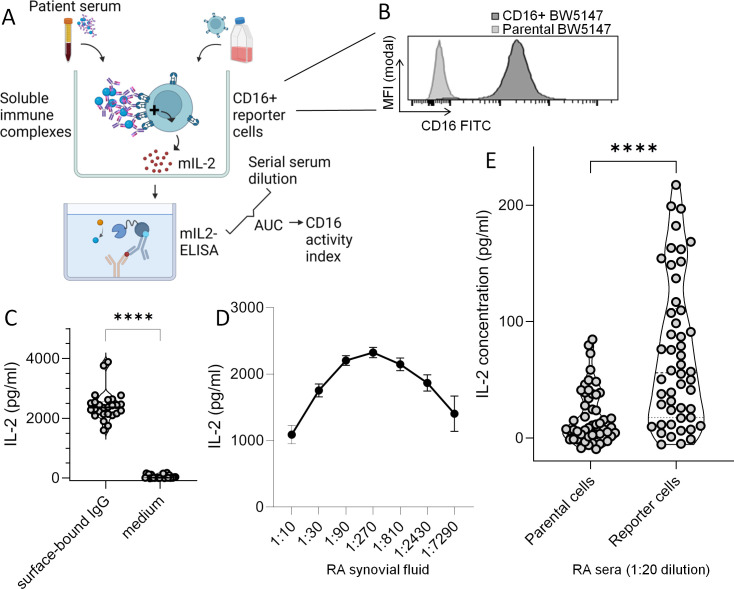
Previous technical limitations prevented the proof of Fcγ-receptor (FcγR)-activation by soluble immune complexes (sICs) in patients. FcγRIIIa (CD16) is a risk factor in rheumatoid arthritis (RA). We aimed at determining the presence of CD16-activating sICs in RA and control diseases.
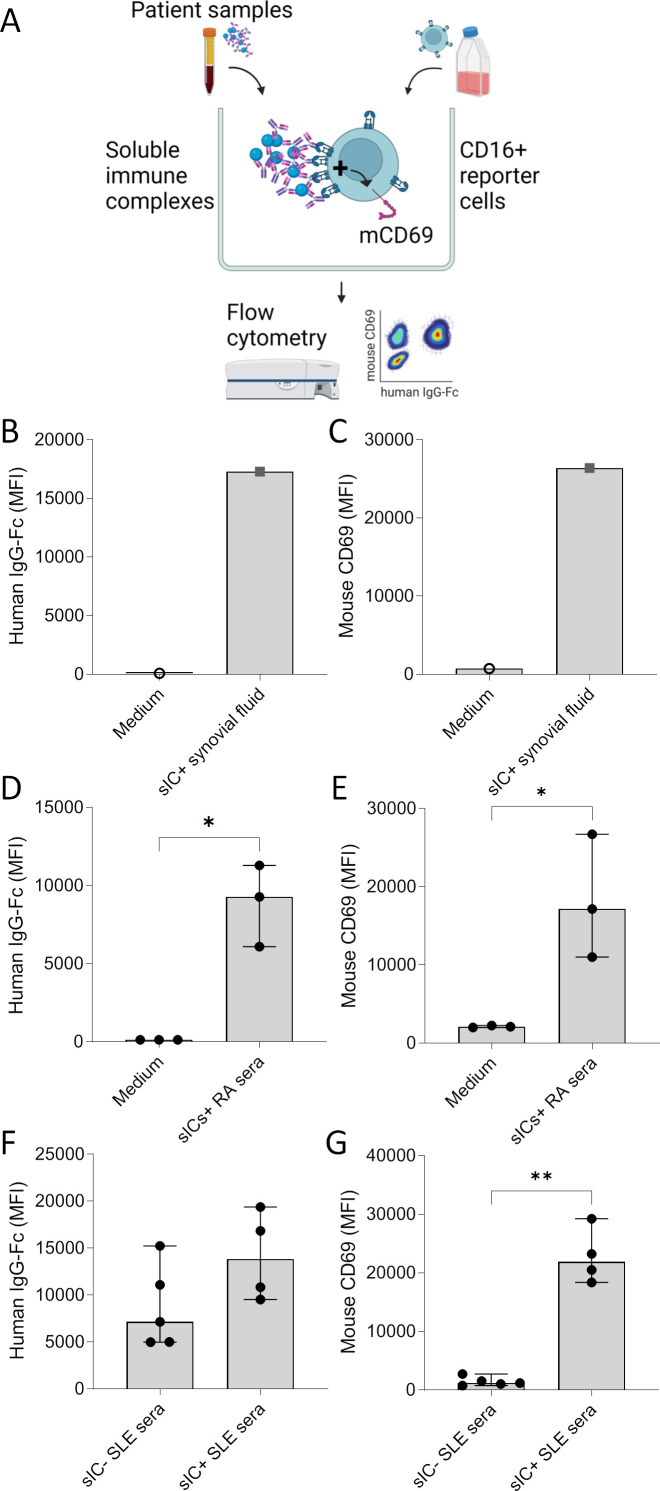
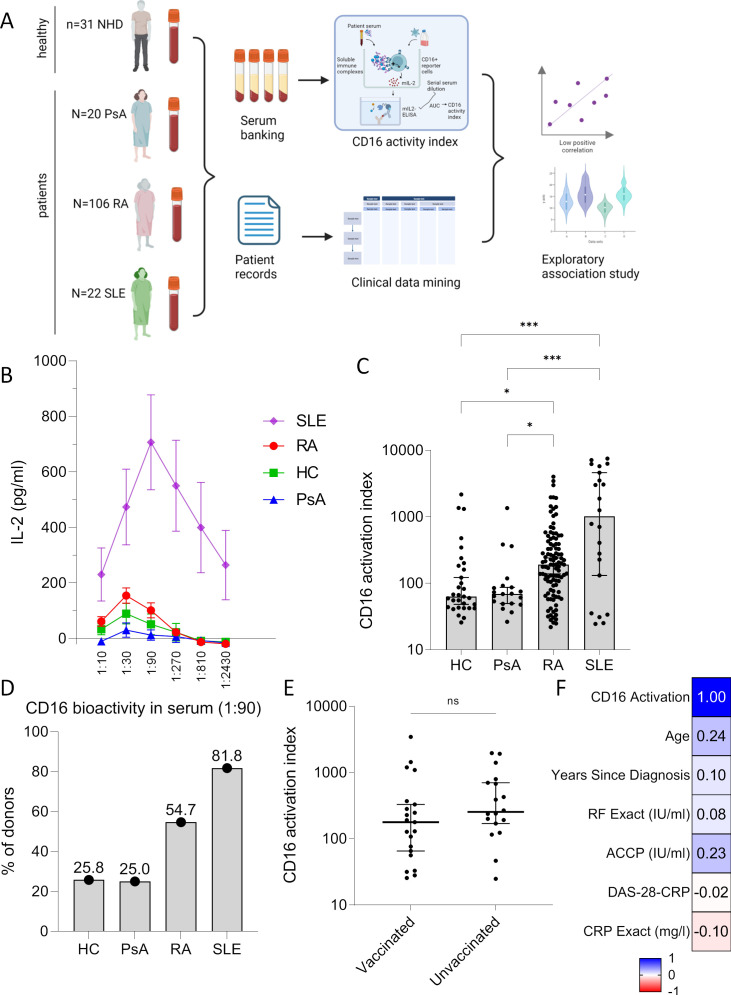
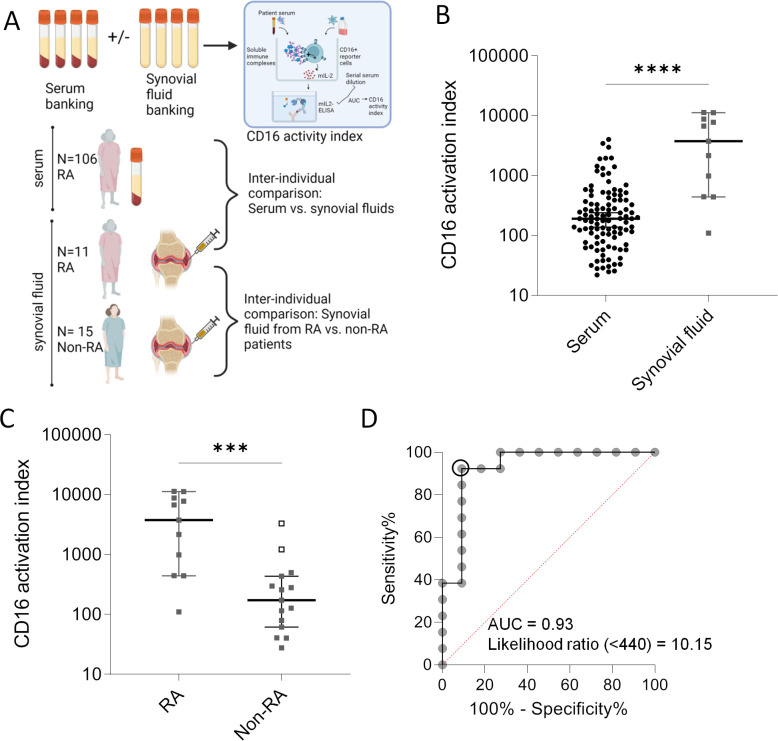
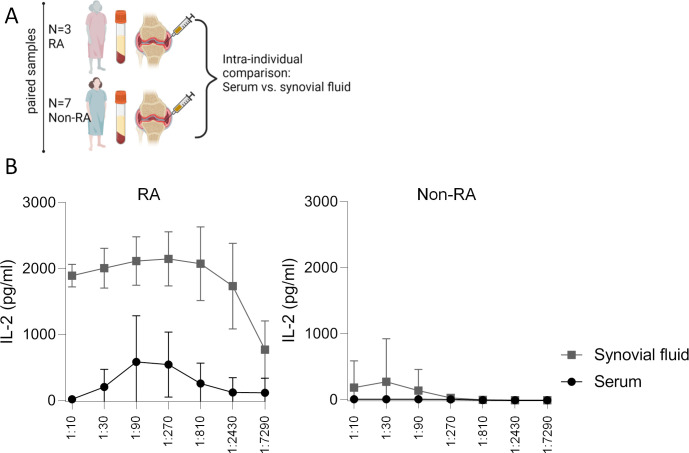
Sera from an exploratory cohort (n=50 patients with RA) and a validation cohort (n=106 patients with RA, 20 patients with psoriasis arthritis (PsA), 22 patients with systemic lupus erythematosus (SLE) and 31 healthy controls) were analysed using a new reporter cell assay. Additionally, 26 synovial fluid samples were analysed, including paired serum/synovial samples.
For the first time using a reliable and sensitive functional assay, the presence of sICs in RA sera was confirmed. sICs possess an intrinsic capacity to activate CD16 and can be found in both synovial fluid and in blood. In low experimental dilutions, circulating sICs were also detected in a subset of healthy people and in PsA. However, we report a significantly increased frequency of bioactive circulating sICs in RA. While the bioactivity of circulating sICs was low and did not correlate with clinical parameters, synovial sICs were highly bioactive and correlated with serum autoantibody levels. Receiver operator curves indicated that sICs bioactivity in synovial fluid could be used to discriminate immune complex-associated arthritis from non-associated forms. Finally, circulating sICs were more frequently found in SLE than in RA. The degree of CD16 bioactivity showed strong donor-dependent differences, especially in SLE.
RA is characterised by the presence of circulating and synovial sICs that can engage and activate CD16.
先前的技术限制阻碍了可溶性免疫复合物(sICs)在患者中激活 Fcγ 受体(FcγR)的证明。FcγRIIIa(CD16)是类风湿关节炎(RA)的一个风险因素。我们旨在确定 RA 和对照疾病中是否存在激活 CD16 的 sICs。
使用新的报告细胞测定法分析了来自探索性队列(n=50 例 RA 患者)和验证性队列(n=106 例 RA 患者、20 例银屑病关节炎(PsA)患者、22 例系统性红斑狼疮(SLE)患者和 31 名健康对照者)的血清。此外,还分析了 26 份滑膜液样本,包括配对的血清/滑膜样本。
首次使用可靠和敏感的功能测定法,证实了 RA 血清中 sICs 的存在。sICs 具有内在激活 CD16 的能力,可在滑膜液和血液中找到。在低实验稀释度下,在一部分健康人和 PsA 患者中也检测到循环 sICs。然而,我们报告说,RA 中循环生物活性 sICs 的频率显著增加。虽然循环 sICs 的生物活性较低且与临床参数无关,但滑膜 sICs 的生物活性较高且与血清自身抗体水平相关。接收者操作特征曲线表明,滑膜液中的 sICs 生物活性可用于区分免疫复合物相关关节炎与非相关形式。最后,SLE 患者中循环 sICs 的频率高于 RA 患者。CD16 生物活性的程度表现出强烈的供体依赖性差异,尤其是在 SLE 中。
RA 的特征是存在可结合并激活 CD16 的循环和滑膜 sICs。