Ruffini Giulio, Salvador Ricardo, Castaldo Francesca, Baleeiro Thais, Camprodon Joan A, Chopra Mohit, Cappon Davide, Pascual-Leone Alvaro
Brain Modeling Department, Neuroelectrics Barcelona, Barcelona, Spain.
Division of Neuropsychiatry and Neuromodulation, Massachusetts General Hospital, Harvard Medical School, Boston, MA, United States.
Front Psychiatry. 2024 Aug 15;15:1427365. doi: 10.3389/fpsyt.2024.1427365. eCollection 2024.
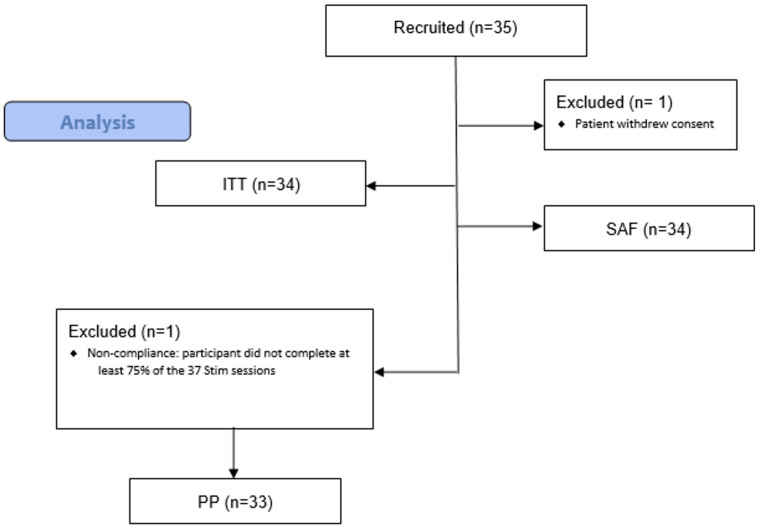
Proof-of-principle human studies suggest that transcranial direct current stimulation (tDCS) over the dorsolateral prefrontal cortex (DLPFC) may improve depression severity. This open-label multicenter study tested remotely supervised multichannel tDCS delivered at home in patients (N=35) with major depressive disorder (MDD). The primary aim was to assess the feasibility and safety of our protocol. As an exploratory aim, we evaluated therapeutic efficacy: the primary efficacy measure was the median percent change from baseline to the end of the 4-week post-treatment follow-up period in the observer-rated Montgomery-Asberg Depression Mood Rating Scale (MADRS).
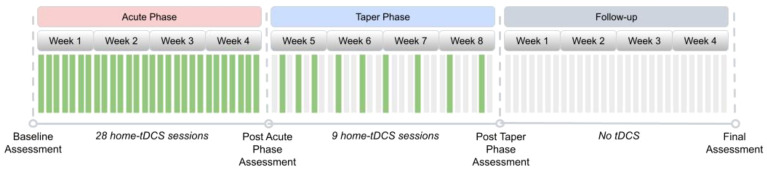
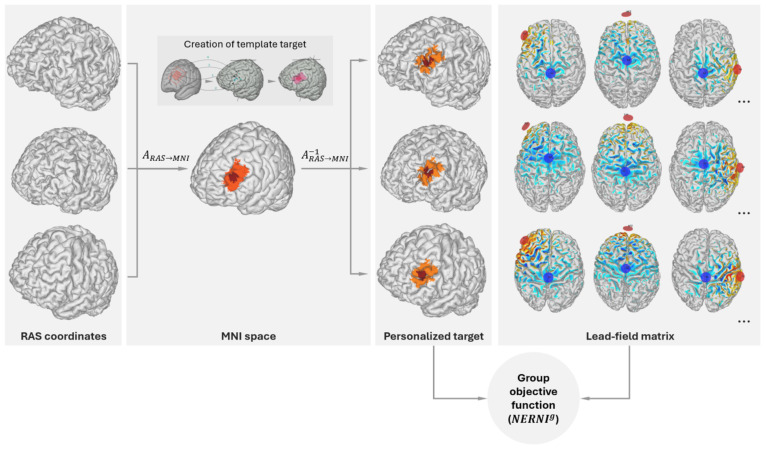
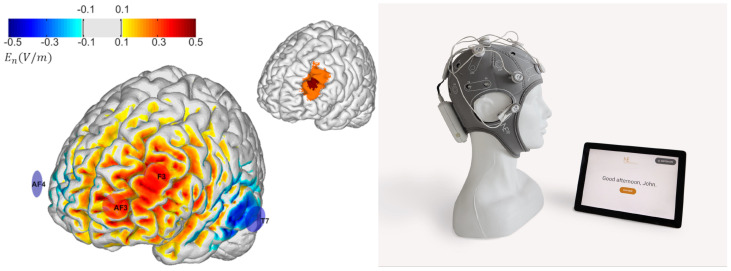
Participants received 37 at-home stimulation sessions (30 minutes each) of specifically designed multichannel tDCS targeting the left DLPFC administered over eight weeks (4 weeks of daily treatments plus 4 weeks of taper), with a follow-up period of 4 weeks following the final stimulation session. The stimulation montage (electrode positions and currents) was optimized by employing computational models of the electric field generated by multichannel tDCS using available structural data from a similar population (group optimization). Conducted entirely remotely, the study employed the MADRS for assessment at baseline, at weeks 4 and 8 during treatment, and at 4-week follow-up visits.
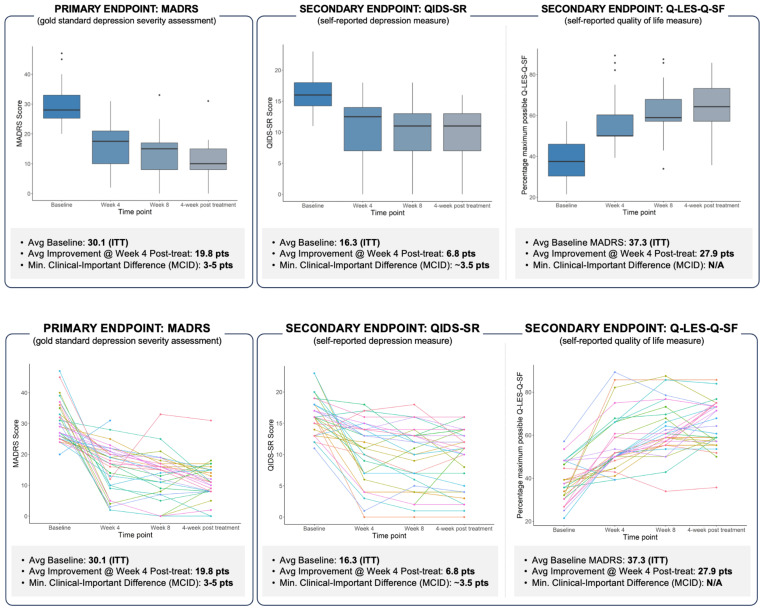
34 patients (85.3% women) with a mean age of 59 years, a diagnosis of MDD according to DSM-5 criteria, and a MADRS score ≥20 at the time of study enrolment completed all study visits. At baseline, the mean time since MDD diagnosis was 24.0 (SD 19.1) months. Concerning compliance, 85% of the participants (n=29) completed the complete course of 37 stimulation sessions at home, while 97% completed at least 36 sessions. No detrimental effects were observed, including suicidal ideation and/or behavior. The study observed a median MADRS score reduction of 64.5% (48.6, 72.4) 4 weeks post-treatment (Hedge's = -3.1). We observed a response rate (≥ 50% improvement in MADRS scores) of 72.7% (n=24) from baseline to the last visit 4 weeks post-treatment. Secondary measures reflected similar improvements.
These results suggest that remotely supervised and supported multichannel home-based tDCS is safe and feasible, and antidepressant efficacy motivates further appropriately controlled clinical studies.
https://clinicaltrials.gov/study/NCT05205915?tab=results, identifier NCT05205915.
原理验证性人体研究表明,经颅直流电刺激(tDCS)作用于背外侧前额叶皮质(DLPFC)可能会改善抑郁严重程度。这项开放标签的多中心研究对35例重度抑郁症(MDD)患者在家中接受远程监督的多通道tDCS进行了测试。主要目的是评估我们方案的可行性和安全性。作为探索性目的,我们评估了治疗效果:主要疗效指标是在观察者评定的蒙哥马利-阿斯伯格抑郁情绪评定量表(MADRS)中,从基线到治疗后4周随访期结束时的中位百分比变化。
参与者在八周内(4周每日治疗加4周逐渐减量)接受37次在家刺激疗程(每次30分钟),具体设计为针对左侧DLPFC的多通道tDCS,在最后一次刺激疗程后有4周的随访期。通过使用来自相似人群的可用结构数据(组优化),采用多通道tDCS产生的电场计算模型优化刺激蒙太奇(电极位置和电流)。该研究完全通过远程方式进行,在基线、治疗期间的第4周和第8周以及4周随访时使用MADRS进行评估。
34例患者(85.3%为女性)完成了所有研究访视,平均年龄59岁,根据DSM-5标准诊断为MDD,入组时MADRS评分≥20。基线时,自MDD诊断以来的平均时间为24.0(标准差19.1)个月。关于依从性,85%的参与者(n = 29)在家中完成了37次刺激疗程的完整疗程,而97%的参与者至少完成了36次疗程。未观察到有害影响,包括自杀意念和/或行为。该研究观察到治疗后4周MADRS评分中位数降低了64.5%(48.6,72.4)(Hedge's = -3.1)。从基线到治疗后4周的最后一次访视,我们观察到反应率(MADRS评分改善≥50%)为72.7%(n = 24)。次要指标反映了类似的改善。
这些结果表明,远程监督和支持的多通道家庭式tDCS是安全可行的,其抗抑郁疗效促使开展进一步适当对照的临床研究。
https://clinicaltrials.gov/study/NCT05205915?tab=results,标识符NCT05205915 。