Department of Health, University of Bath, Bath, Somerset, United Kingdom.
Department of Computer Science, University of Bath, Bath, Somerset, United Kingdom.
PeerJ. 2024 Aug 29;12:e17896. doi: 10.7717/peerj.17896. eCollection 2024.
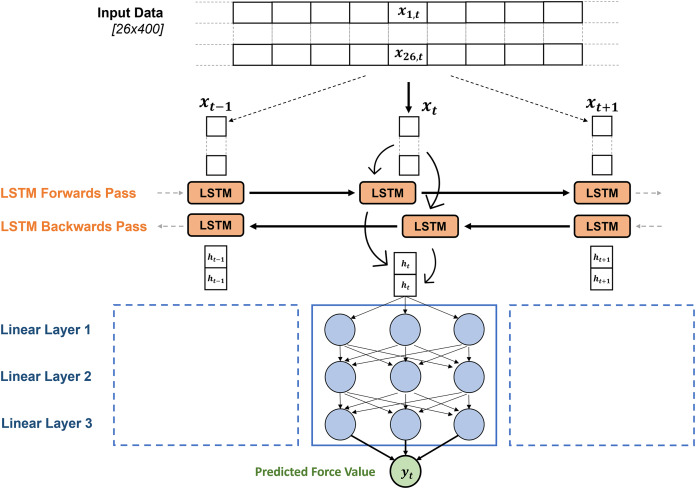
Ground reaction force (GRF) data is often collected for the biomechanical analysis of running, due to the performance and injury risk insights that GRF analysis can provide. Traditional methods typically limit GRF collection to controlled lab environments, recent studies have looked to combine the ease of use of wearable sensors with the statistical power of machine learning to estimate continuous GRF data outside of these restrictions. Before such systems can be deployed with confidence outside of the lab they must be shown to be a valid and accurate tool for a wide range of users. The aim of this study was to evaluate how accurately a consumer-priced sensor system could estimate GRFs whilst a heterogeneous group of runners completed a treadmill protocol with three different personalised running speeds and three gradients. Fifty runners (25 female, 25 male) wearing pressure insoles made up of 16 resistive sensors and an inertial measurement unit ran at various speeds and gradients on an instrumented treadmill. A long short term memory (LSTM) neural network was trained to estimate both vertical and anteroposterior force traces using leave one subject out validation. The average relative root mean squared error (rRMSE) was 3.2% and 3.1%, respectively. The mean rRMSE across the evaluated participants ranged from 0.8% to 8.8% and from 1.3% to 17.3% in the estimation. The findings from this study suggest that current consumer-priced sensors could be used to accurately estimate two-dimensional GRFs for a wide range of runners at a variety of running intensities. The estimated kinetics could be used to provide runners with individualised feedback as well as form the basis of data collection for running injury risk factor studies on a much larger scale than is currently possible with lab based methods.
地面反作用力(GRF)数据通常用于跑步的生物力学分析,因为 GRF 分析可以提供有关性能和受伤风险的见解。传统方法通常将 GRF 采集限制在受控的实验室环境中,最近的研究试图将可穿戴传感器的易用性与机器学习的统计能力结合起来,以在这些限制之外估计连续的 GRF 数据。在这些系统能够在实验室之外有信心地部署之前,必须证明它们是一种针对广泛用户的有效和准确的工具。本研究的目的是评估消费者价格传感器系统在异质跑步者群体完成具有三种不同个性化跑步速度和三种坡度的跑步机方案时,能够多准确地估计 GRF。五十名跑步者(25 名女性,25 名男性)穿着由 16 个电阻传感器和惯性测量单元组成的压力鞋垫,在配备仪器的跑步机上以各种速度和坡度跑步。长短期记忆(LSTM)神经网络经过训练,使用“留出一个受试者”验证来估计垂直和前向后力轨迹。平均相对均方根误差(rRMSE)分别为 3.2%和 3.1%。评估参与者的平均 rRMSE 范围为 0.8%至 8.8%,在估计中为 1.3%至 17.3%。本研究的结果表明,目前的消费者价格传感器可用于在各种跑步强度下为广泛的跑步者准确估计二维 GRF。估计的动力学可以为跑步者提供个性化反馈,也可以为基于实验室方法目前不可能进行的更大规模的跑步受伤风险因素研究提供数据收集基础。