Pitts Mackenzie N, Ebers Megan R, Agresta Cristine E, Steele Katherine M
Mechanical Engineering, University of Washington, Seattle, WA 98195, USA.
Applied Mathematics, University of Washington, Seattle, WA 98195, USA.
Sensors (Basel). 2025 Mar 27;25(7):2105. doi: 10.3390/s25072105.
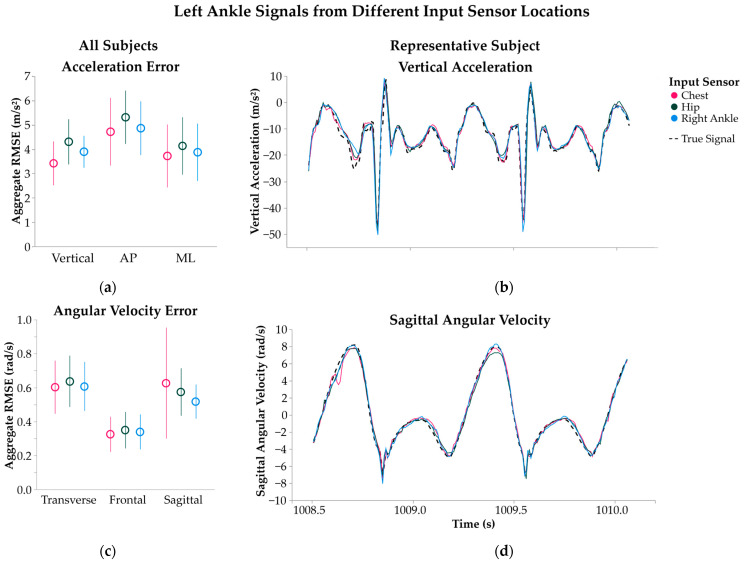
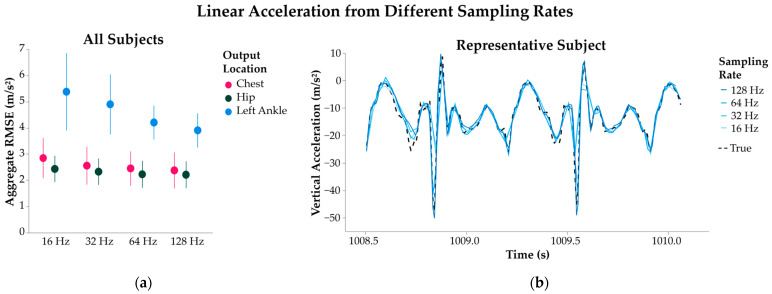
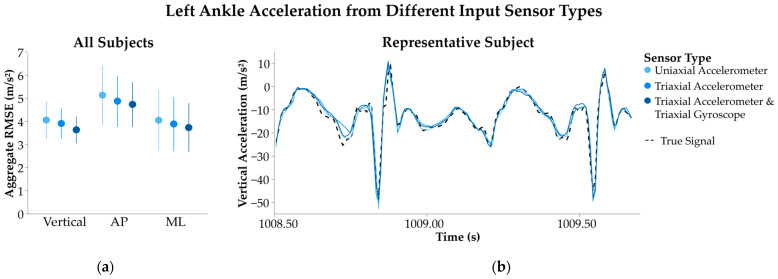
Inertial measurement units (IMUs) are used to analyze running performance. While leveraging one sensor to estimate kinematic and kinetic variables is common, sparsity limits the number of digital biomarkers that can be evaluated. Shallow recurrent decoder networks (SHRED) can reconstruct a dense set of time-series signals from a single input sensor and have been successful in human mobility applications, highlighting the potential for this algorithm to monitor running. We trained and tested subject-specific SHRED models of nine subjects running on a treadmill to map from one input sensor to the remaining three IMUs. We varied the type of input to reflect experimental parameters that are important in running studies-sensor location, sensor type, sampling rate, and running speed-and compared the error of inferred signals from each input type. Sensor location and type did not impact SHRED inference accuracy, while decreasing the sampling rate affected the accuracy of ankle measurements. All ankle acceleration inferences from these models remained below the minimal detectable change threshold of 12.0 m/s. SHRED models trained and tested at multiple speeds did not accurately infer IMU measurements below this threshold. SHRED may broaden the scope of motion analysis by expanding datasets with fewer sensors.
惯性测量单元(IMU)用于分析跑步表现。虽然利用单个传感器来估计运动学和动力学变量很常见,但稀疏性限制了可评估的数字生物标志物的数量。浅层循环解码器网络(SHRED)可以从单个输入传感器重建一组密集的时间序列信号,并且在人类移动性应用中取得了成功,凸显了该算法在监测跑步方面的潜力。我们训练并测试了九个在跑步机上跑步的受试者的特定受试者SHRED模型,以从一个输入传感器映射到其余三个IMU。我们改变输入类型以反映跑步研究中重要的实验参数——传感器位置、传感器类型、采样率和跑步速度——并比较每种输入类型的推断信号误差。传感器位置和类型不影响SHRED推断准确性,而降低采样率会影响脚踝测量的准确性。这些模型的所有脚踝加速度推断均保持在12.0 m/s的最小可检测变化阈值以下。在多个速度下训练和测试的SHRED模型无法准确推断低于此阈值的IMU测量值。SHRED可能通过使用更少的传感器扩展数据集来拓宽运动分析的范围。