Department of Health Management Center, The Second Affiliated Hospital of Nanchang University, Jiangxi Medical College, Nanchang University, Nanchang, 330006, Jiangxi Province, China.
Huan Kui Academy, Jiangxi Medical College, Nanchang University, Nanchang, 330006, Jiangxi Province, China.
Sci Rep. 2024 Sep 4;14(1):20604. doi: 10.1038/s41598-024-70640-y.
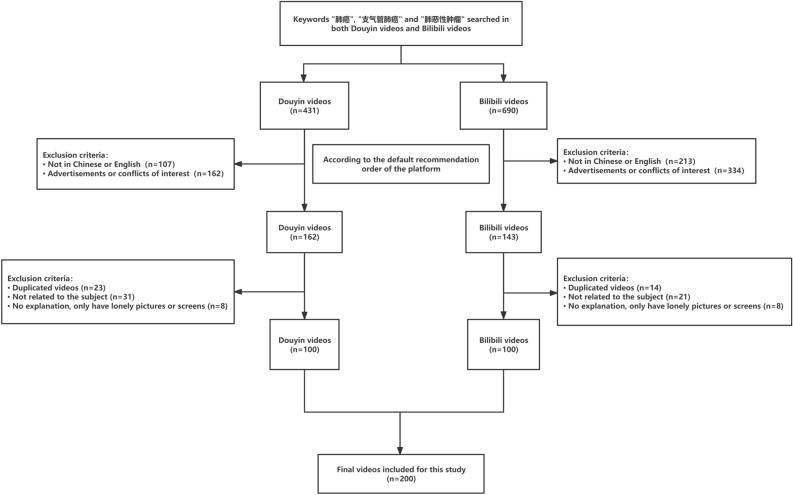
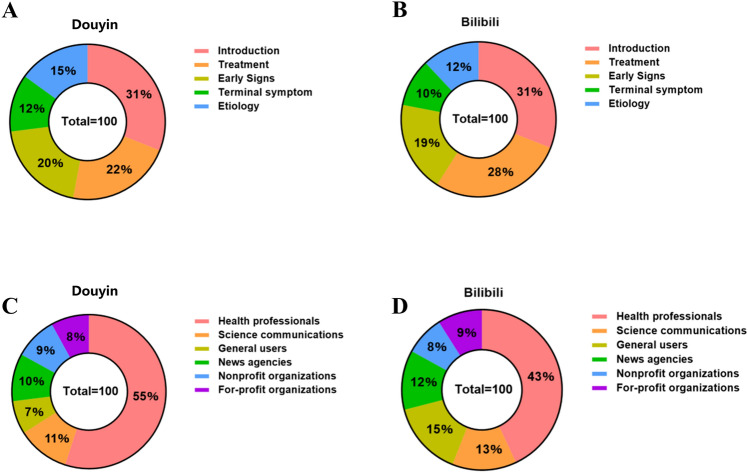
Lung cancer has emerged as a major global public health concern. With growing public interest in lung cancer, online searches for related information have surged. However, a comprehensive evaluation of the credibility, quality, and value of lung cancer-related videos on digital media platforms remains unexamined. This study aimed to assess the informational quality and content of lung cancer-related videos on Douyin and Bilibili. A total of 200 lung cancer-related videos that met the criteria were selected from Douyin and Bilibili for evaluation and analysis. The first step involved recording and analyzing the basic information provided in the videos. Subsequently, the source and type of content for each video were identified. All videos' educational content and quality were then evaluated using JAMA, GQS, and Modified DISCERN. Douyin videos were found to be more popular in terms of likes, comments, favorites, and shares, whereas Bilibili videos were longer in duration (P < .001). The majority of video content on both platforms comprised lung cancer introductions (31/100, 31%), with medical professionals being the primary source of uploaded videos (Douyin, n = 55, 55%; Bilibili, n = 43, 43%). General users on Douyin scored the lowest on the JAMA scale, whereas for-profit businesses scored the highest (2.50 points). The results indicated that the videos' informational quality was insufficient. Videos from science communications and health professionals were deemed more reliable regarding completeness and content quality compared to videos from other sources. The public should exercise caution and consider the scientific validity when seeking healthcare information on short video platforms.
肺癌已成为全球主要的公共卫生关注点之一。随着公众对肺癌的关注度不断提高,针对相关信息的在线搜索量也大幅增加。然而,对于数字媒体平台上肺癌相关视频的可信度、质量和价值,尚未进行全面评估。本研究旨在评估抖音和哔哩哔哩上肺癌相关视频的信息质量和内容。
从抖音和哔哩哔哩上共选取了 200 个符合标准的肺癌相关视频进行评估和分析。首先记录并分析视频中提供的基本信息,然后确定每个视频的来源和内容类型。使用 JAMA、GQS 和 Modified DISCERN 评估所有视频的教育内容和质量。抖音视频在点赞、评论、收藏和分享方面更受欢迎,而哔哩哔哩视频的时长更长(P < .001)。
两个平台上的视频内容主要包括肺癌介绍(31/100,31%),上传视频的主要来源是医学专业人士(抖音,n = 55,55%;哔哩哔哩,n = 43,43%)。抖音上的普通用户在 JAMA 量表上得分最低,而营利性企业得分最高(2.50 分)。结果表明,这些视频的信息质量不足。与其他来源的视频相比,来自科学传播和健康专业人士的视频在完整性和内容质量方面被认为更可靠。公众在短视频平台上获取医疗保健信息时应保持警惕,并考虑其科学有效性。