Sciensano, Belgian Institute for Health, Brussels, Belgium.
Laboratory of Immunology, Department of Translational Physiology, Infectiology and Public Health, Faculty of Veterinary Medicine, Ghent University, Merelbeke, Belgium.
Parasit Vectors. 2024 Sep 5;17(1):380. doi: 10.1186/s13071-024-06427-x.
Ticks carry a variety of microorganisms, some of which are pathogenic to humans. The human risk of tick-borne diseases depends on, among others, the prevalence of pathogens in ticks biting humans. To follow-up on this prevalence over time, a Belgian study from 2017 was repeated in 2021.
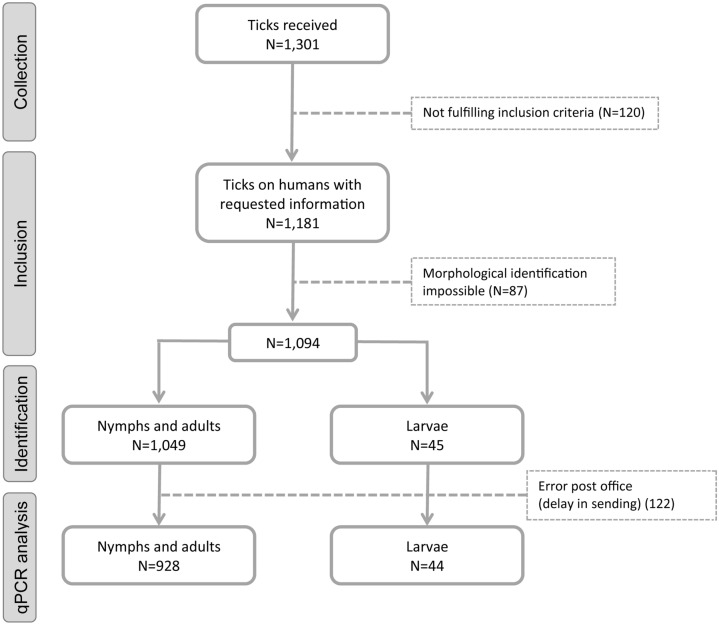
During the tick season 2021, citizens were invited to have ticks removed from their skin, send them and fill in a short questionnaire on an existing citizen science platform for the notification of tick bites (TekenNet). Ticks were morphologically identified to species and life stage level and screened using multiplex qPCR targeting, among others, Borrelia burgdorferi (sensu lato), Anaplasma phagocytophilum, Borrelia miyamotoi, Neoehrlichia mikurensis, Babesia spp., Rickettsia helvetica and tick-borne encephalitis virus (TBEV). The same methodology as in 2017 was used.
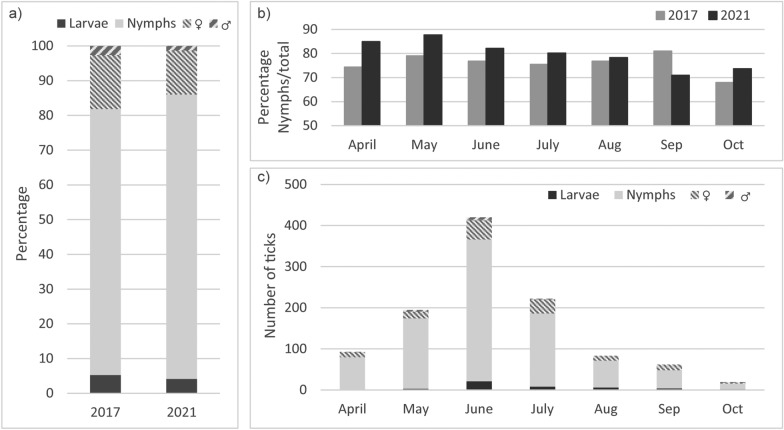
In 2021, the same tick species as in 2017 were identified in similar proportions; of 1094 ticks, 98.7% were Ixodes ricinus, 0.8% Ixodes hexagonus and 0.5% Dermacentor reticulatus. A total of 928 nymphs and adults could be screened for the presence of pathogens. Borrelia burgdorferi (s.l.) was detected in 9.9% (95% CI 8.2-12.0%), which is significantly lower than the prevalence of 13.9% (95% CI 12.2-15.7%) in 2017 (P = 0.004). The prevalences of A. phagocytophilum (4.7%; 95% CI 3.5-6.3%) and R. helvetica (13.3%; 95% CI 11.2-15.6%) in 2021 were significantly higher compared to 2017 (1.8%; 95% CI 1.3-2.7% and 6.8%; 95% CI 5.6-8.2% respectively) (P < 0.001 for both). For the other pathogens tested, no statistical differences compared to 2017 were found, with prevalences ranging between 1.5 and 2.9% in 2021. Rickettsia raoultii was again found in D. reticulatus ticks (n = 3/5 in 2021). Similar to 2017, no TBEV was detected in the ticks. Co-infections were found in 5.1% of ticks. When combining co-infection occurrence in 2017 and 2021, a positive correlation was observed between B. burgdorferi (s.l.) and N. mikurensis and B. burgdorferi (s.l.) and B. miyamotoi (P < 0.001 for both).
Although the 2021 prevalences fell within expectations, differences were found compared to 2017. Further research to understand the explanations behind these differences is needed.
蜱虫携带多种微生物,其中一些对人类具有致病性。人类患蜱传疾病的风险取决于病原体在叮咬人类的蜱虫中的流行程度。为了跟踪这些病原体随时间的变化,2017 年比利时的一项研究在 2021 年进行了重复。
在 2021 年的蜱虫季节,邀请市民将皮肤中的蜱虫取下,将其送到现有的公民科学平台(TekenNet)上报告,并填写一份简短的问卷。对蜱虫进行形态学鉴定,确定其物种和生活阶段,并使用多重 qPCR 进行筛查,以检测 Borrelia burgdorferi(广义)、Anaplasma phagocytophilum、Borrelia miyamotoi、Neoehrlichia mikurensis、Babesia spp.、Rickettsia helvetica 和 tick-borne encephalitis virus(TBEV)等病原体。使用了 2017 年相同的方法。
2021 年鉴定出与 2017 年相同的蜱虫种类,比例相似;在 1094 只蜱虫中,98.7%为 Ixodes ricinus,0.8%为 Ixodes hexagonus,0.5%为 Dermacentor reticulatus。共对 928 只若虫和成虫进行了病原体检测。检测到 Borrelia burgdorferi(广义)的比例为 9.9%(95%CI 8.2-12.0%),明显低于 2017 年的 13.9%(95%CI 12.2-15.7%)(P=0.004)。2021 年,A. phagocytophilum(4.7%;95%CI 3.5-6.3%)和 R. helvetica(13.3%;95%CI 11.2-15.6%)的流行率明显高于 2017 年(1.8%;95%CI 1.3-2.7%和 6.8%;95%CI 5.6-8.2%)(均 P<0.001)。与 2017 年相比,其他检测的病原体没有统计学差异,2021 年的流行率在 1.5%至 2.9%之间。与 2017 年一样,在 D. reticulatus 蜱虫中再次发现了 Rickettsia raoultii(n=3/5,2021 年)。与 2017 年一样,在蜱虫中未检测到 TBEV。发现了 5.1%的蜱虫存在合并感染。当将 2017 年和 2021 年的合并感染情况结合起来时,发现 Borrelia burgdorferi(广义)和 N. mikurensis 以及 Borrelia burgdorferi(广义)和 B. miyamotoi 之间存在正相关(均 P<0.001)。
尽管 2021 年的流行率在预期范围内,但与 2017 年相比存在差异。需要进一步研究以了解这些差异的原因。