Carmo Ana Sofia, Abreu Mariana, Baptista Maria Fortuna, de Oliveira Carvalho Miguel, Peralta Ana Rita, Fred Ana, Bentes Carla, da Silva Hugo Plácido
Department of Bioengineering, Instituto Superior Técnico, Universidade de Lisboa, Lisboa, Portugal.
Instituto de Telecomunicações, Lisboa, Portugal.
J Neurol. 2024 Oct;271(10):6573-6587. doi: 10.1007/s00415-024-12655-z. Epub 2024 Sep 6.
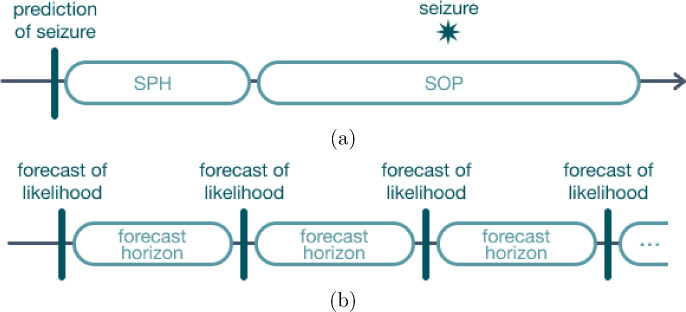
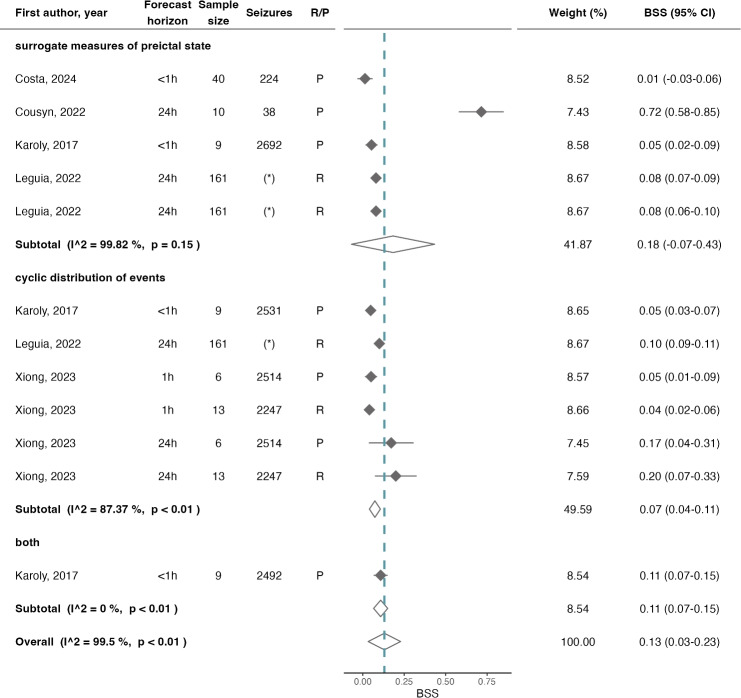
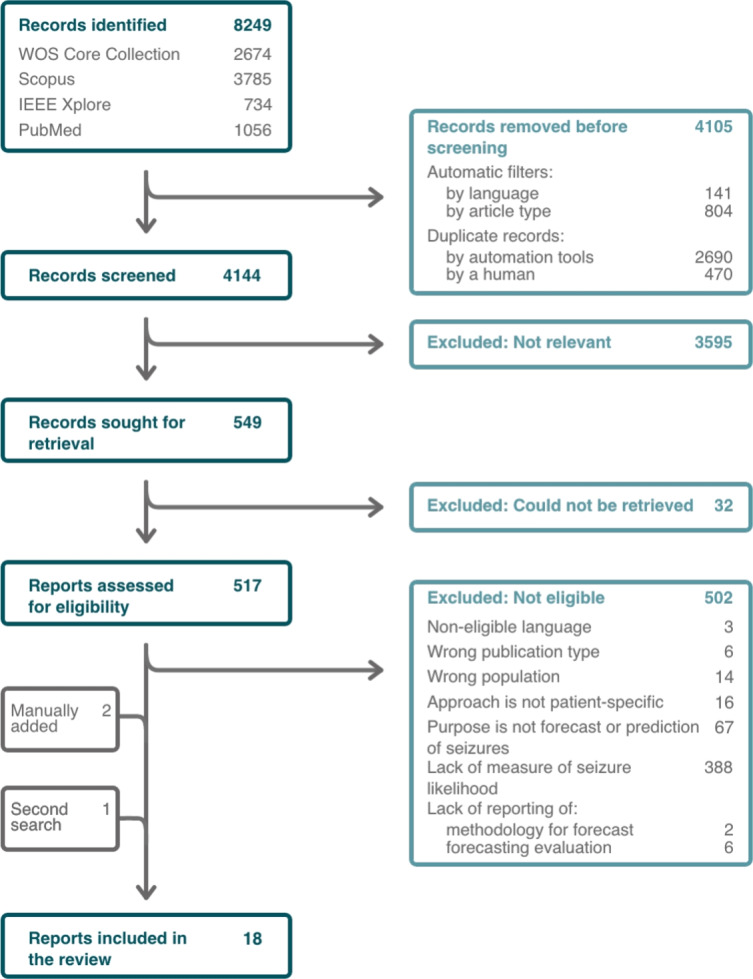
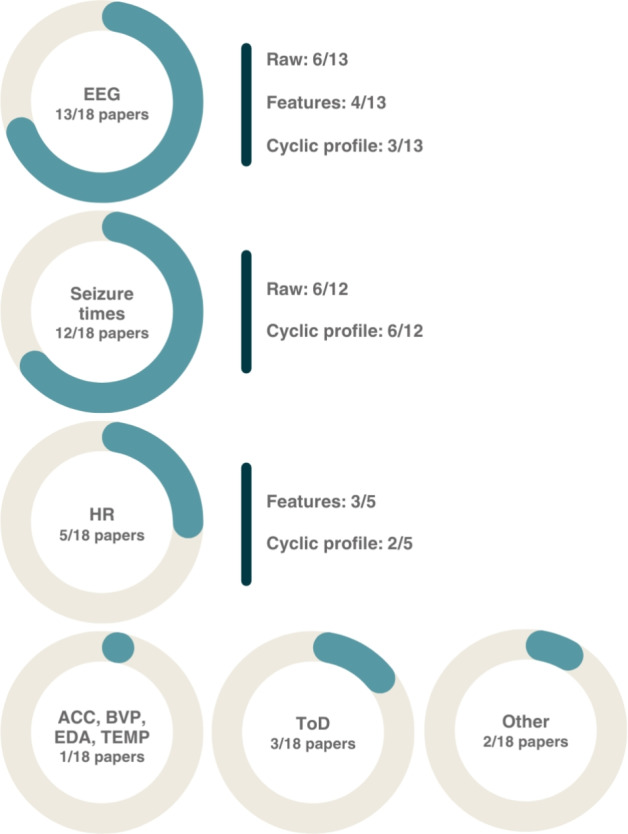
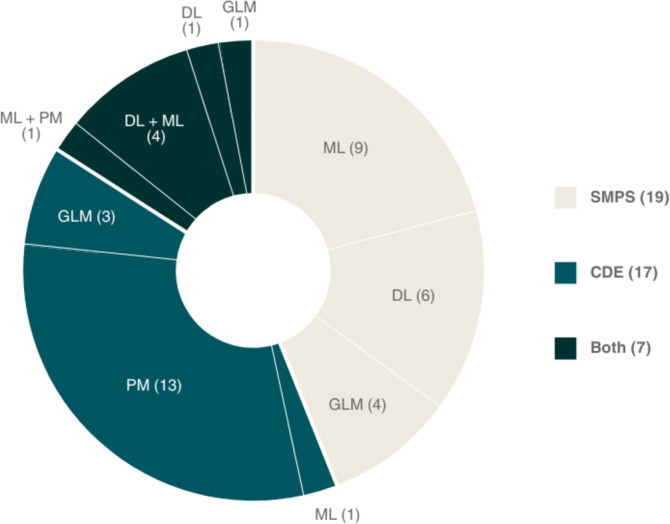
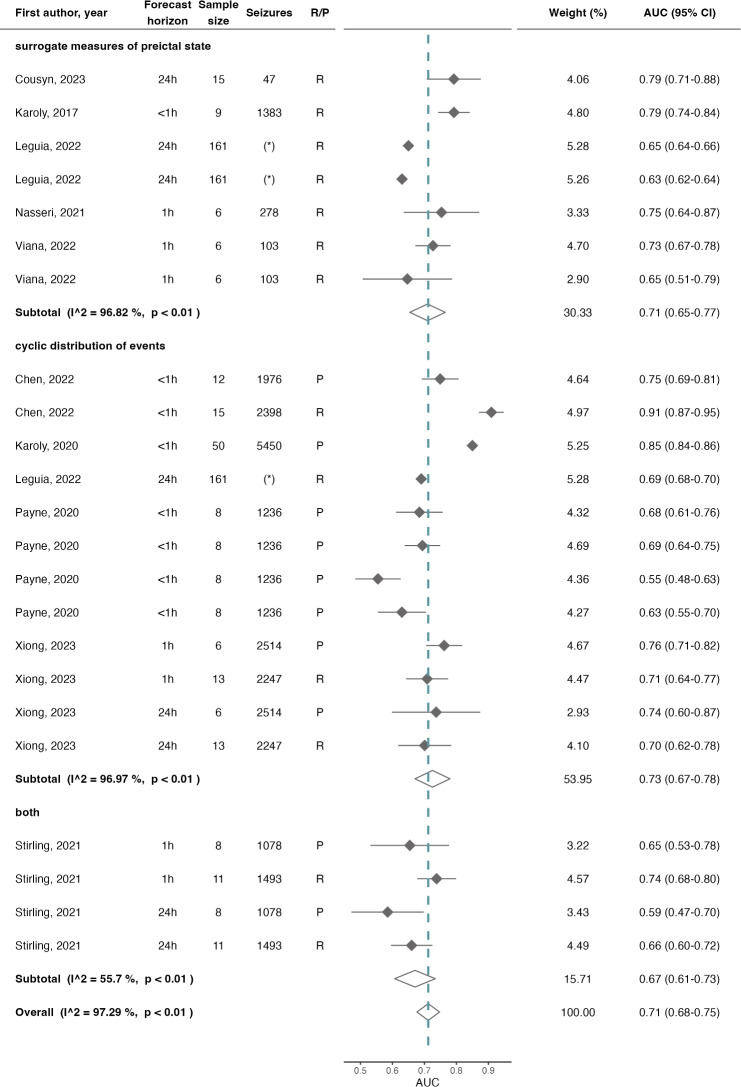
This study aims to review the proposed methodologies and reported performances of automated algorithms for seizure forecast. A systematic review was conducted on studies reported up to May 10, 2024. Four databases and registers were searched, and studies were included when they proposed an original algorithm for automatic human epileptic seizure forecast that was patient specific, based on intraindividual cyclic distribution of events and/or surrogate measures of the preictal state and provided an evaluation of the performance. Two meta-analyses were performed, one evaluating area under the ROC curve (AUC) and another Brier Skill Score (BSS). Eighteen studies met the eligibility criteria, totaling 43 included algorithms. A total of 419 patients participated in the studies, and 19442 seizures were reported across studies. Of the analyzed algorithms, 23 were eligible for the meta-analysis with AUC and 12 with BSS. The overall mean AUC was 0.71, which was similar between the studies that relied solely on surrogate measures of the preictal state, on cyclic distributions of events, and on a combination of these. BSS was also similar for the three types of input data, with an overall mean BSS of 0.13. This study provides a characterization of the state of the art in seizure forecast algorithms along with their performances, setting a benchmark for future developments. It identified a considerable lack of standardization across study design and evaluation, leading to the proposal of guidelines for the design of seizure forecast solutions.
本研究旨在回顾用于癫痫发作预测的自动化算法的提议方法和报告的性能。对截至2024年5月10日报告的研究进行了系统综述。搜索了四个数据库和登记处,当研究提出一种针对个体的、基于事件的个体内循环分布和/或发作前期状态替代指标的自动人类癫痫发作预测原始算法,并提供性能评估时,将其纳入。进行了两项荟萃分析,一项评估ROC曲线下面积(AUC),另一项评估布里尔技能得分(BSS)。18项研究符合纳入标准,共包括43种算法。共有419名患者参与了这些研究,各项研究共报告了19442次癫痫发作。在分析的算法中,23种符合AUC荟萃分析的条件,12种符合BSS荟萃分析的条件。总体平均AUC为0.71,仅依赖发作前期状态替代指标、事件循环分布以及两者结合的研究之间的AUC相似。三种类型的输入数据的BSS也相似,总体平均BSS为0.13。本研究对癫痫发作预测算法的现状及其性能进行了描述,为未来发展设定了基准。它指出研究设计和评估中存在相当大的标准化缺失问题,从而提出了癫痫发作预测解决方案设计的指南。