Department of Animal Science and Technology, College of Animal Sciences, Zhejiang University, Hangzhou, 310058, China.
Department of Agricultural, Food and Nutritional Science, University of Alberta, Edmonton, AB, T6G 2E1, Canada.
Microbiome. 2024 Sep 7;12(1):168. doi: 10.1186/s40168-024-01881-2.
Next-generation sequencing (NGS) approaches have revolutionized gut microbiome research and can provide strain-level resolution, but these techniques have limitations in that they are only semi-quantitative, suffer from high detection limits, and generate data that is compositional. The present study aimed to systematically compare quantitative PCR (qPCR) and droplet digital PCR (ddPCR) for the absolute quantification of Limosilactobacillus reuteri strains in human fecal samples and to develop an optimized protocol for the absolute quantification of bacterial strains in fecal samples.
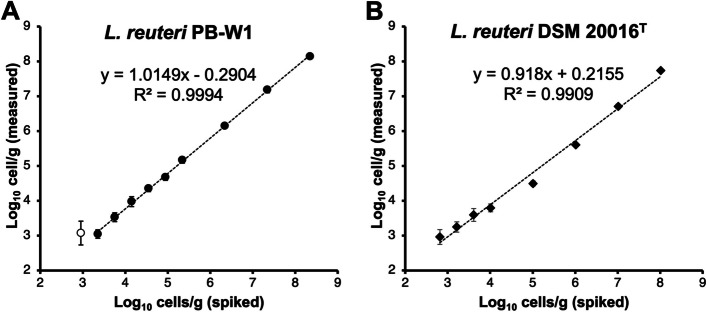
Using strain-specific PCR primers for L. reuteri 17938, ddPCR showed slightly better reproducibility, but qPCR was almost as reproducible and showed comparable sensitivity (limit of detection [LOD] around 10 cells/g feces) and linearity (R > 0.98) when kit-based DNA isolation methods were used. qPCR further had a wider dynamic range and is cheaper and faster. Based on these findings, we conclude that qPCR has advantages over ddPCR for the absolute quantification of bacterial strains in fecal samples. We provide an optimized and easy-to-follow step-by-step protocol for the design of strain-specific qPCR assays, starting from primer design from genome sequences to the calibration of the PCR system. Validation of this protocol to design PCR assays for two L. reuteri strains, PB-W1 and DSM 20016, resulted in a highly accurate qPCR with a detection limit in spiked fecal samples of around 10 cells/g feces. Applying our strain-specific qPCR assays to fecal samples collected from human subjects who received live L. reuteri PB-W1 or DSM 20016 during a human trial demonstrated a highly accurate quantification and sensitive detection of these two strains, with a much lower LOD and a broader dynamic range compared to NGS approaches (16S rRNA gene sequencing and whole metagenome sequencing).
Based on our analyses, we consider qPCR with kit-based DNA extraction approaches the best approach to accurately quantify gut bacteria at the strain level in fecal samples. The provided step-by-step protocol will allow scientists to design highly sensitive strain-specific PCR systems for the accurate quantification of bacterial strains of not only L. reuteri but also other bacterial taxa in a broad range of applications and sample types. Video Abstract.
下一代测序(NGS)方法彻底改变了肠道微生物组研究,可以提供菌株水平的分辨率,但这些技术存在局限性,因为它们只是半定量的,检测限高,并且产生的是组成数据。本研究旨在系统比较定量 PCR(qPCR)和液滴数字 PCR(ddPCR)在人粪便样本中对雷氏乳杆菌菌株的绝对定量,并为粪便样本中细菌菌株的绝对定量开发一种优化方案。
使用针对 L. reuteri 17938 的菌株特异性 PCR 引物,ddPCR 显示出稍好的重现性,但 qPCR 几乎具有相同的重现性,并且当使用基于试剂盒的 DNA 分离方法时,具有可比的灵敏度(检测限[LOD]约为 10 个细胞/g 粪便)和线性度(R > 0.98)。qPCR 进一步具有更宽的动态范围,并且更便宜且更快。基于这些发现,我们得出结论,qPCR 优于 ddPCR,可用于粪便样本中细菌菌株的绝对定量。我们提供了一种优化且易于遵循的分步协议,用于从基因组序列设计菌株特异性 qPCR 测定开始,一直到 PCR 系统的校准。针对 L. reuteri 的两个菌株 PB-W1 和 DSM 20016 设计 PCR 测定的验证导致具有高度准确性的 qPCR,在粪便样品中添加检测限约为 10 个细胞/g 粪便。将我们的菌株特异性 qPCR 测定应用于在人体试验中接受活 L. reuteri PB-W1 或 DSM 20016 的人类粪便样本中,证明了对这两个菌株的高度准确量化和敏感检测,与 NGS 方法(16S rRNA 基因测序和全宏基因组测序)相比,检测限更低,动态范围更广。
基于我们的分析,我们认为使用基于试剂盒的 DNA 提取方法的 qPCR 是在粪便样本中准确量化菌株水平肠道细菌的最佳方法。所提供的分步协议将使科学家能够设计高度敏感的菌株特异性 PCR 系统,不仅可以对雷氏乳杆菌而且还可以对广泛应用和样本类型中的其他细菌分类群的细菌菌株进行准确量化。视频摘要。