Patella Vincent Michael, El-Nimri Nevin W, Flanagan John G, Durbin Mary K, Bossie Timothy, Ho Derek Y, Tafreshi Mayra, Chaglasian Michael A, Kasanoff David, Inoue Satoshi, Moghimi Sasan, Nishida Takashi, Fingeret Murray, Weinreb Robert N
Department of Ophthalmology, University of Iowa Health Care, Iowa City, Iowa.
Topcon Healthcare, Oakland, New Jersey.
Ophthalmol Sci. 2024 Jul 20;4(6):100583. doi: 10.1016/j.xops.2024.100583. eCollection 2024 Nov-Dec.
To construct a comprehensive reference database (RDB) for a novel binocular automated perimeter.
A four-site prospective randomized clinical trial.
Three hundred fifty-six healthy subjects without ocular conditions that might affect visual function were categorized into 7 age groups.
Subjects underwent comprehensive ocular examination of both eyes before enrollment. Using the TEMPO/IMOvifa automated perimeter (Topcon Healthcare/CREWT Medical Systems), each subject completed 4 binocular threshold visual field (VF) tests during a single visit: First, practice 24-2 and 10-2 tests were obtained from both eyes. Next, study 24-2 and 10-2 tests were obtained from both eyes. Test order of each sequence was randomized, and the tests were conducted under standard automated perimetry testing conditions: Goldmann stimulus size III, 3183 cd/m maximum stimulus intensity, and background intensity of 10 cd/m, using AIZE-Rapid test strategy. Standard VF reliability indices were assessed. For each subject, 24-2 and 10-2 test results from 1 randomly selected eye were analyzed.
Perimetric threshold sensitivity and reference limits for each test analysis parameter.
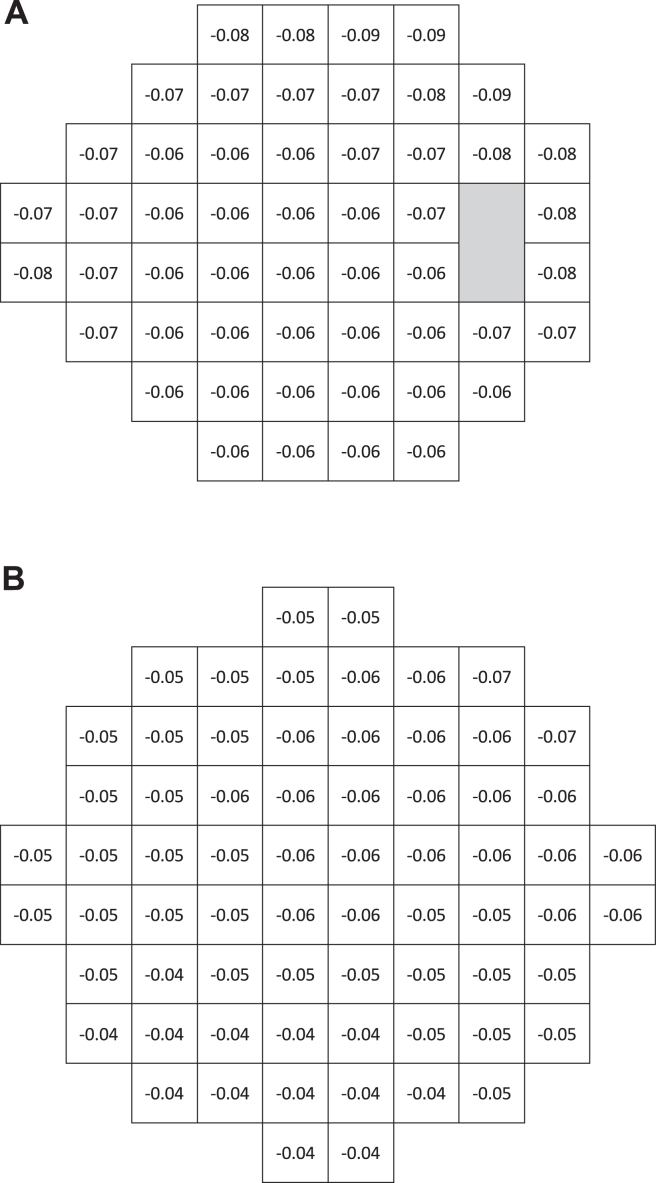
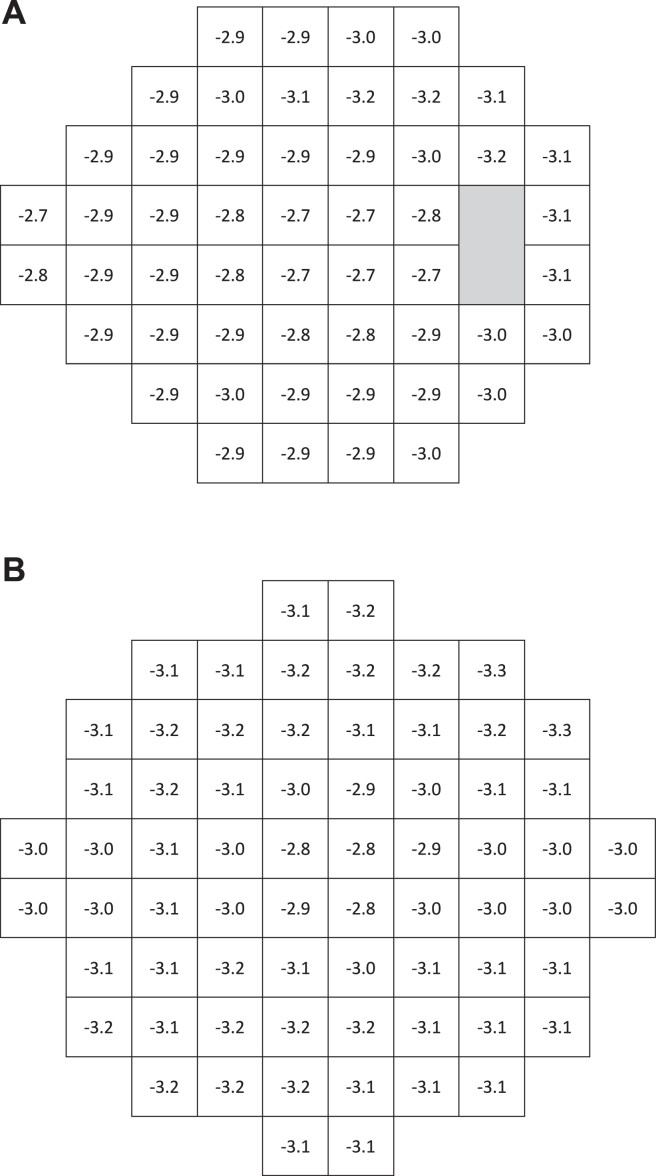
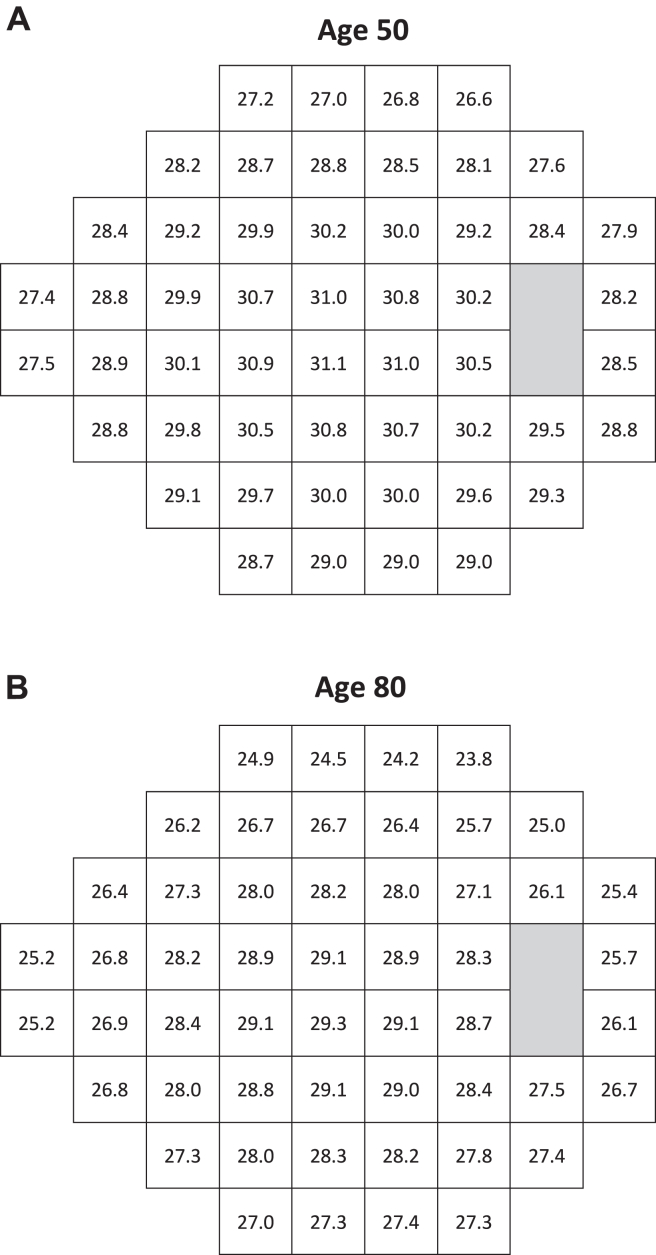
The ages of the study cohort were widely distributed, with a mean age (standard deviation [SD]) of 52.3 (18.5) years. Sex assignment was 44.0% male and 56.0% female. The majority of subjects self-identified as White (67.4%), followed by Black or African American (13.5%) and Asian (8.7%), with 14.6% self-identified as Hispanic or Latino ethnicity. Mean sensitivity (SD) was 29.1 (1.3) decibels (dB) for the 24-2 and 32.4 (1.0) dB for the 10-2 test. For the 24-2 and 10-2, mean sensitivity (SD) age-related changes averaged -0.06 (0.01) dB and -0.05 (0.01) dB per year, respectively. The normal range of pointwise threshold sensitivity increased with eccentricity and showed asymmetry around the mean, particularly notable in the 24-2 test. Mean (SD) binocular test duration was 3.18 (0.38) minutes (1 minute 35 seconds per eye) for the 24-2 test and 3.58 (0.43) minutes (1 minute 47 seconds per eye) for the 10-2 test.
An RDB for the TEMPO/IMOvifa perimeter was established, highlighting the significance of considering both age and stimulus eccentricity in interpreting threshold VF test results.
Proprietary or commercial disclosure may be found in the Footnotes and Disclosures at the end of this article.
为一种新型双眼自动视野计构建一个综合参考数据库(RDB)。
一项四中心前瞻性随机临床试验。
356名无可能影响视觉功能的眼部疾病的健康受试者被分为7个年龄组。
受试者在入组前接受了双眼的全面眼部检查。使用TEMPO/IMOvifa自动视野计(拓普康医疗保健公司/ CREWT医疗系统公司),每位受试者在单次就诊期间完成4次双眼阈值视野(VF)测试:首先,从双眼获得练习性24-2和10-2测试结果。接下来,从双眼获得研究性24-2和10-2测试结果。每个序列的测试顺序是随机的,并且测试在标准自动视野检查测试条件下进行:戈德曼刺激大小III,最大刺激强度3183 cd/m²,背景强度10 cd/m²,使用AIZE-快速测试策略。评估标准VF可靠性指标。对于每位受试者,分析1只随机选择眼睛的24-2和10-2测试结果。
每次测试分析参数的视野阈值敏感性和参考限值。
研究队列的年龄分布广泛,平均年龄(标准差[SD])为52.3(18.5)岁。性别分布为男性44.0%,女性56.0%。大多数受试者自我认定为白人(67.4%),其次是黑人或非裔美国人(13.5%)和亚洲人(8.7%),14.6%自我认定为西班牙裔或拉丁裔。24-2测试的平均敏感性(SD)为29.1(1.3)分贝(dB),10-2测试为32.4(1.0)dB。对于24-2和10-2测试,平均敏感性(SD)与年龄相关的变化分别平均每年为-0.06(0.01)dB和-0.05(0.01)dB。逐点阈值敏感性的正常范围随偏心度增加,并且在平均值周围显示不对称,在24-2测试中尤为明显。24-2测试的平均(SD)双眼测试持续时间为3.18(0.38)分钟(每只眼睛1分35秒),10-2测试为3.58(0.43)分钟(每只眼睛1分47秒)。
建立了TEMPO/IMOvifa视野计的RDB,突出了在解释阈值VF测试结果时考虑年龄和刺激偏心度的重要性。
专有或商业披露信息可在本文末尾的脚注和披露部分中找到。