Edao Habib Gemechu, Chang Chia-Yu, Dilebo Woldesenbet Bafe, Angerasa Fikiru Temesgen, Moges Endalkachew Asefa, Nikodimos Yosef, Guta Chemeda Barasa, Lakshmanan Keseven, Chen Jeng-Lung, Tsai Meng-Che, Su Wei-Nien, Hwang Bing Joe
Nano-Electrochemistry Laboratory, Department of Chemical Engineering, National Taiwan University of Science and Technology, Taipei 106, Taiwan.
Sustainable Electrochemical Energy Development Center, National Taiwan University of Science and Technology, Taipei 106, Taiwan.
ACS Appl Mater Interfaces. 2024 Sep 25;16(38):50602-50613. doi: 10.1021/acsami.4c08215. Epub 2024 Sep 12.
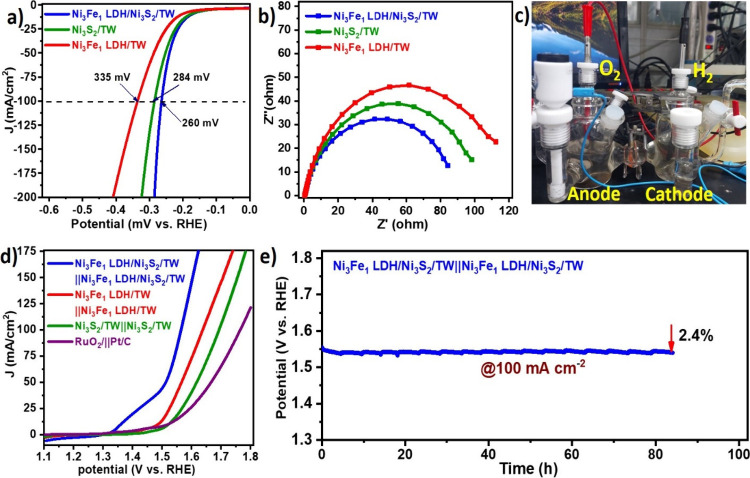
Electrochemical approaches for generating hydrogen from water splitting can be more promising if the challenges in the anodic oxygen evolution reaction (OER) can be harnessed. The interface heterostructure materials offer strong electronic coupling and appropriate charge transport at the interface regions, promoting accessible active sites to prompt kinetics and optimize the adsorption-desorption of active species. Herein, we have designed an efficient multi-interface-engineered NiFe LDH/NiS/TW heterostructure on in situ generated titanate web layers from the titanium foam. The synergistic effects of the multi-interface heterostructure caused the exposure of rich interfacial electronic coupling, fast reaction kinetics, and enhanced accessible site activity and site populations. The as-prepared electrocatalyst demonstrates outstanding OER activity, demanding a low overpotential of 220 mV at a high current density of 100 mA cm. Similarly, the designed NiFe LDH/NiS/TW electrocatalyst exhibits a low Tafel slope of 43.2 mV dec and excellent stability for 100 h of operation, suggesting rapid kinetics and good structural stability. Also, the electrocatalyst shows a low overpotential of 260 mV at 100 mA cm for HER activity. Moreover, the integrated electrocatalyst exhibits an incredible OER activity in simulated seawater with an overpotential of 370 mV at 100 mA cm and stability for 100 h of operation, indicating good OER selectivity. This work might benefit further fabricating effective and stable self-sustained electrocatalysts for water splitting in large-scale applications.
如果能够克服阳极析氧反应(OER)中的挑战,那么通过电化学方法从水分解中制氢可能会更具前景。界面异质结构材料在界面区域提供了强电子耦合和适当的电荷传输,促进了可及的活性位点,从而加快动力学并优化活性物种的吸附-解吸。在此,我们在由泡沫钛原位生成的钛酸盐网层上设计了一种高效的多界面工程化NiFe LDH/NiS/TW异质结构。多界面异质结构的协同效应导致了丰富的界面电子耦合的暴露、快速的反应动力学以及增强的可及位点活性和位点数量。所制备的电催化剂表现出出色的OER活性,在100 mA cm的高电流密度下所需的过电位低至220 mV。同样,所设计的NiFe LDH/NiS/TW电催化剂表现出43.2 mV dec的低塔菲尔斜率以及在100小时运行中的出色稳定性,表明其具有快速的动力学和良好的结构稳定性。此外,该电催化剂在HER活性方面,在100 mA cm时的过电位为260 mV。而且,该集成电催化剂在模拟海水中表现出令人难以置信的OER活性,在100 mA cm时过电位为370 mV且具有100小时运行的稳定性,表明其具有良好的OER选择性。这项工作可能有助于进一步制备用于大规模水分解应用的有效且稳定的自持电催化剂。