• 文献检索
  • 文档翻译
  • 深度研究
  • 学术资讯
  • Suppr Zotero 插件Zotero 插件
  • 邀请有礼
  • 套餐&价格
  • 历史记录
应用&插件
Suppr Zotero 插件Zotero 插件浏览器插件Mac 客户端Windows 客户端微信小程序
定价
高级版会员购买积分包购买API积分包
服务
文献检索文档翻译深度研究API 文档MCP 服务
关于我们
关于 Suppr公司介绍联系我们用户协议隐私条款
关注我们

Suppr 超能文献

核心技术专利:CN118964589B侵权必究
粤ICP备2023148730 号-1Suppr @ 2026

文献检索

告别复杂PubMed语法,用中文像聊天一样搜索,搜遍4000万医学文献。AI智能推荐,让科研检索更轻松。

立即免费搜索

文件翻译

保留排版,准确专业,支持PDF/Word/PPT等文件格式,支持 12+语言互译。

免费翻译文档

深度研究

AI帮你快速写综述,25分钟生成高质量综述,智能提取关键信息,辅助科研写作。

立即免费体验

用于计算病理学的可解释人工智能可识别模型局限性和组织生物标志物。

Explainable AI for computational pathology identifies model limitations and tissue biomarkers.

作者信息

Kaczmarzyk Jakub R, Saltz Joel H, Koo Peter K

机构信息

Department of Biomedical Informatics, Stony Brook University, Stony Brook, NY, USA.

Simons Center for Quantitative Biology, Cold Spring Harbor Laboratory, Cold Spring Harbor, NY, USA.

出版信息

ArXiv. 2024 Nov 18:arXiv:2409.03080v2.

PMID:39279830
原文链接:https://pmc.ncbi.nlm.nih.gov/articles/PMC11398542/
Abstract

INTRODUCTION

Deep learning models hold great promise for digital pathology, but their opaque decision-making processes undermine trust and hinder clinical adoption. Explainable AI methods are essential to enhance model transparency and reliability.

METHODS

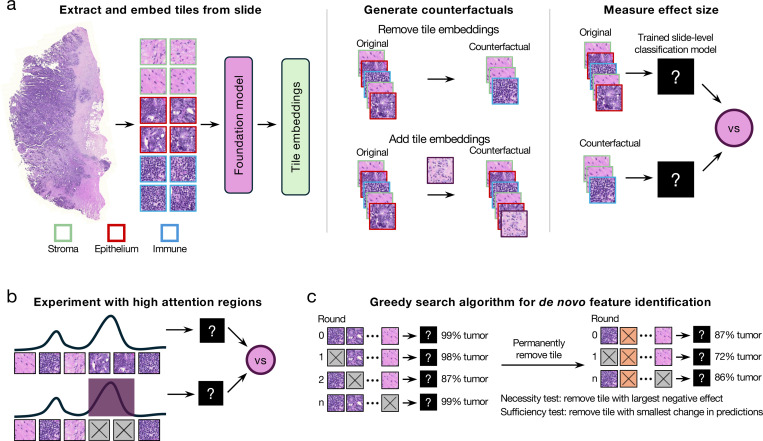
We developed HIPPO, an explainable AI framework that systematically modifies tissue regions in whole slide images to generate image counterfactuals, enabling quantitative hypothesis testing, bias detection, and model evaluation beyond traditional performance metrics. HIPPO was applied to a variety of clinically important tasks, including breast metastasis detection in axillary lymph nodes, prognostication in breast cancer and melanoma, and mutation classification in gliomas. In computational experiments, HIPPO was compared against traditional metrics and attention-based approaches to assess its ability to identify key tissue elements driving model predictions.

RESULTS

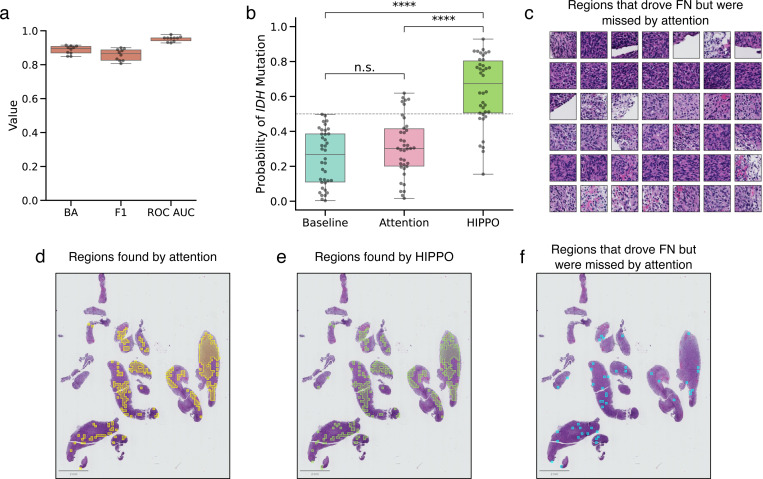
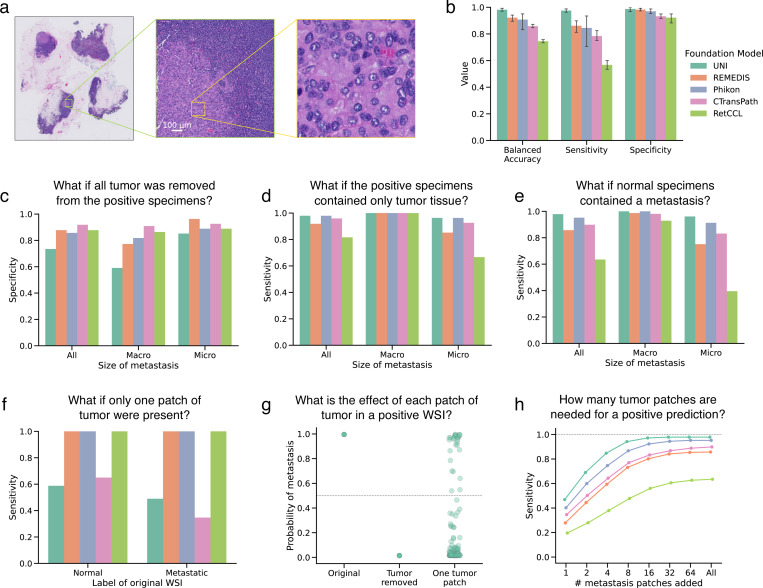
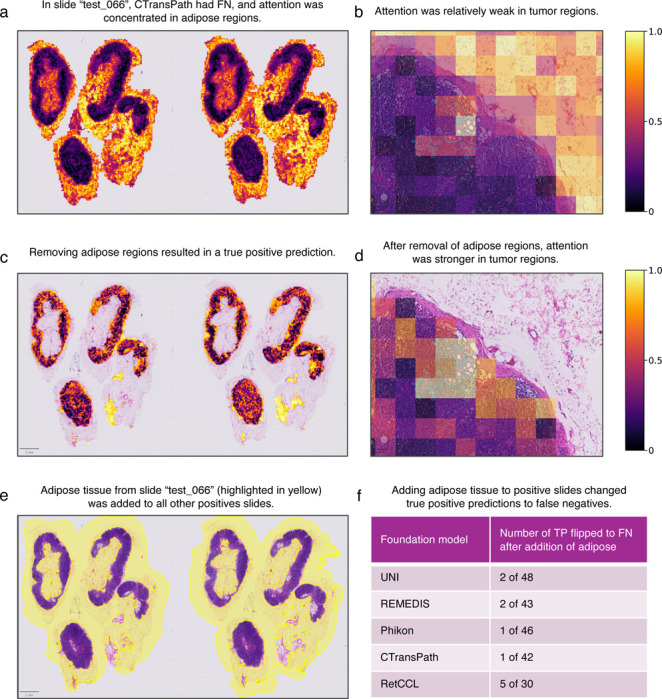
In metastasis detection, HIPPO uncovered critical model limitations that were undetectable by standard performance metrics or attention-based methods. For prognostic prediction, HIPPO outperformed attention by providing more nuanced insights into tissue elements influencing outcomes. In a proof-of-concept study, HIPPO facilitated hypothesis generation for identifying melanoma patients who may benefit from immunotherapy. In mutation classification, HIPPO more robustly identified the pathology regions responsible for false negatives compared to attention, suggesting its potential to outperform attention in explaining model decisions.

CONCLUSIONS

HIPPO expands the explainable AI toolkit for computational pathology by enabling deeper insights into model behavior. This framework supports the trustworthy development, deployment, and regulation of weakly-supervised models in clinical and research settings, promoting their broader adoption in digital pathology.

摘要

引言

深度学习模型在数字病理学领域具有巨大潜力,但其不透明的决策过程破坏了信任并阻碍了临床应用。可解释人工智能方法对于提高模型的透明度和可靠性至关重要。

方法

我们开发了HIPPO,这是一个可解释的人工智能框架,它系统地修改全切片图像中的组织区域以生成图像反事实,从而能够进行定量假设检验、偏差检测以及超越传统性能指标的模型评估。HIPPO被应用于各种临床重要任务,包括腋窝淋巴结中的乳腺转移检测、乳腺癌和黑色素瘤的预后预测以及神经胶质瘤中的突变分类。在计算实验中,将HIPPO与传统指标和基于注意力的方法进行比较,以评估其识别驱动模型预测的关键组织元素的能力。

结果

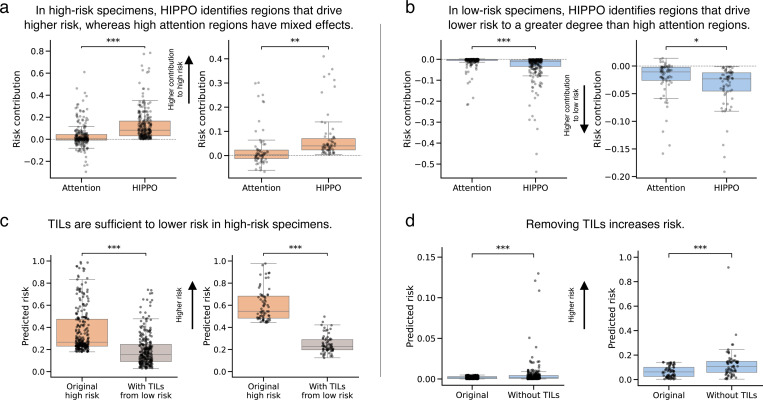
在转移检测中,HIPPO发现了标准性能指标或基于注意力的方法无法检测到的关键模型局限性。对于预后预测,HIPPO通过对影响结果的组织元素提供更细致入微的见解,优于基于注意力的方法。在一项概念验证研究中,HIPPO促进了假设生成,以识别可能从免疫治疗中受益的黑色素瘤患者。在突变分类中,与基于注意力的方法相比,HIPPO更稳健地识别了导致假阴性的病理区域,表明其在解释模型决策方面优于基于注意力的方法的潜力。

结论

HIPPO通过能够更深入地洞察模型行为,扩展了用于计算病理学的可解释人工智能工具包。该框架支持在临床和研究环境中对弱监督模型进行可靠的开发、部署和监管,促进其在数字病理学中的更广泛应用。
https://cdn.ncbi.nlm.nih.gov/pmc/blobs/3c91/11589951/7edc0aa8f616/nihpp-2409.03080v2-f0005.jpg
https://cdn.ncbi.nlm.nih.gov/pmc/blobs/3c91/11589951/a9b4a3d93eab/nihpp-2409.03080v2-f0001.jpg
https://cdn.ncbi.nlm.nih.gov/pmc/blobs/3c91/11589951/534f8fa06eda/nihpp-2409.03080v2-f0002.jpg
https://cdn.ncbi.nlm.nih.gov/pmc/blobs/3c91/11589951/fb6d02979c77/nihpp-2409.03080v2-f0003.jpg
https://cdn.ncbi.nlm.nih.gov/pmc/blobs/3c91/11589951/eb35edd531bf/nihpp-2409.03080v2-f0004.jpg
https://cdn.ncbi.nlm.nih.gov/pmc/blobs/3c91/11589951/7edc0aa8f616/nihpp-2409.03080v2-f0005.jpg
https://cdn.ncbi.nlm.nih.gov/pmc/blobs/3c91/11589951/a9b4a3d93eab/nihpp-2409.03080v2-f0001.jpg
https://cdn.ncbi.nlm.nih.gov/pmc/blobs/3c91/11589951/534f8fa06eda/nihpp-2409.03080v2-f0002.jpg
https://cdn.ncbi.nlm.nih.gov/pmc/blobs/3c91/11589951/fb6d02979c77/nihpp-2409.03080v2-f0003.jpg
https://cdn.ncbi.nlm.nih.gov/pmc/blobs/3c91/11589951/eb35edd531bf/nihpp-2409.03080v2-f0004.jpg
https://cdn.ncbi.nlm.nih.gov/pmc/blobs/3c91/11589951/7edc0aa8f616/nihpp-2409.03080v2-f0005.jpg

相似文献

1
Explainable AI for computational pathology identifies model limitations and tissue biomarkers.用于计算病理学的可解释人工智能可识别模型局限性和组织生物标志物。
ArXiv. 2024 Nov 18:arXiv:2409.03080v2.
2
Towards clinical prediction with transparency: An explainable AI approach to survival modelling in residential aged care.迈向具有透明度的临床预测:一种用于老年护理机构生存建模的可解释人工智能方法。
Comput Methods Programs Biomed. 2025 May;263:108653. doi: 10.1016/j.cmpb.2025.108653. Epub 2025 Feb 15.
3
Explainable machine learning versus known nomogram for predicting non-sentinel lymph node metastases in breast cancer patients: A comparative study.用于预测乳腺癌患者非前哨淋巴结转移的可解释机器学习与已知列线图的比较研究
Comput Biol Med. 2025 Jan;184:109412. doi: 10.1016/j.compbiomed.2024.109412. Epub 2024 Nov 16.
4
A Mobile App That Addresses Interpretability Challenges in Machine Learning-Based Diabetes Predictions: Survey-Based User Study.一款应对基于机器学习的糖尿病预测中可解释性挑战的移动应用程序:基于调查的用户研究。
JMIR Form Res. 2023 Nov 13;7:e50328. doi: 10.2196/50328.
5
Benchmarking weakly-supervised deep learning pipelines for whole slide classification in computational pathology.基于计算病理学的全切片分类的弱监督深度学习管道的基准测试。
Med Image Anal. 2022 Jul;79:102474. doi: 10.1016/j.media.2022.102474. Epub 2022 May 4.
6
Explainable AI (xAI) for Anatomic Pathology.可解释人工智能(xAI)在解剖病理学中的应用。
Adv Anat Pathol. 2020 Jul;27(4):241-250. doi: 10.1097/PAP.0000000000000264.
7
Explainable AI for Chronic Kidney Disease Prediction in Medical IoT: Integrating GANs and Few-Shot Learning.医疗物联网中用于慢性肾脏病预测的可解释人工智能:整合生成对抗网络和少样本学习
Bioengineering (Basel). 2025 Mar 29;12(4):356. doi: 10.3390/bioengineering12040356.
8
An XAI-enhanced efficientNetB0 framework for precision brain tumor detection in MRI imaging.一种用于磁共振成像中精确脑肿瘤检测的基于可解释人工智能增强的EfficientNetB0框架。
J Neurosci Methods. 2024 Oct;410:110227. doi: 10.1016/j.jneumeth.2024.110227. Epub 2024 Jul 20.
9
Slideflow: deep learning for digital histopathology with real-time whole-slide visualization.SlideFlow:具有实时全切片可视化功能的数字病理深度学习。
BMC Bioinformatics. 2024 Mar 27;25(1):134. doi: 10.1186/s12859-024-05758-x.
10
Explainable AI for Symptom-Based Detection of Monkeypox: a machine learning approach.用于基于症状的猴痘检测的可解释人工智能:一种机器学习方法。
BMC Infect Dis. 2025 Mar 26;25(1):419. doi: 10.1186/s12879-025-10738-4.

本文引用的文献

1
Multimodal histopathologic models stratify hormone receptor-positive early breast cancer.多模态组织病理学模型对激素受体阳性早期乳腺癌进行分层。
Nat Commun. 2025 Mar 2;16(1):2106. doi: 10.1038/s41467-025-57283-x.
2
Benchmarking histopathology foundation models for ovarian cancer bevacizumab treatment response prediction from whole slide images.基于全切片图像的卵巢癌贝伐单抗治疗反应预测的组织病理学基础模型基准测试。
Discov Oncol. 2025 Feb 17;16(1):196. doi: 10.1007/s12672-025-01973-x.
3
Generating and evaluating synthetic data in digital pathology through diffusion models.
通过扩散模型在数字病理学中生成和评估合成数据。
Sci Rep. 2024 Nov 18;14(1):28435. doi: 10.1038/s41598-024-79602-w.
4
Pathologist-level diagnosis of ulcerative colitis inflammatory activity level using an automated histological grading method.使用自动组织学分级方法对溃疡性结肠炎炎症活动水平进行病理学家级别的诊断。
Int J Med Inform. 2024 Dec;192:105648. doi: 10.1016/j.ijmedinf.2024.105648. Epub 2024 Oct 9.
5
Application of artificial intelligence model in pathological staging and prognosis of clear cell renal cell carcinoma.人工智能模型在透明细胞肾细胞癌病理分期及预后中的应用
Discov Oncol. 2024 Oct 10;15(1):545. doi: 10.1007/s12672-024-01437-8.
6
Dissecting AI-based mutation prediction in lung adenocarcinoma: A comprehensive real-world study.剖析肺腺癌中基于人工智能的突变预测:一项全面的真实世界研究。
Eur J Cancer. 2024 Nov;211:114292. doi: 10.1016/j.ejca.2024.114292. Epub 2024 Aug 23.
7
A pathology foundation model for cancer diagnosis and prognosis prediction.用于癌症诊断和预后预测的病理基础模型。
Nature. 2024 Oct;634(8035):970-978. doi: 10.1038/s41586-024-07894-z. Epub 2024 Sep 4.
8
Predicting tumor mutation burden and VHL mutation from renal cancer pathology slides with self-supervised deep learning.利用自监督深度学习技术从肾癌病理切片中预测肿瘤突变负荷和 VHL 突变。
Cancer Med. 2024 Aug;13(16):e70112. doi: 10.1002/cam4.70112.
9
Weakly-supervised deep learning models enable HER2-low prediction from H &E stained slides.弱监督深度学习模型可实现从 H&E 染色切片预测 HER2 低表达。
Breast Cancer Res. 2024 Aug 19;26(1):124. doi: 10.1186/s13058-024-01863-0.
10
A foundation model for clinical-grade computational pathology and rare cancers detection.临床级计算病理学和罕见癌症检测的基础模型。
Nat Med. 2024 Oct;30(10):2924-2935. doi: 10.1038/s41591-024-03141-0. Epub 2024 Jul 22.