Li Jieyun, Xiong Danqun, Hong Leixin, Lim Jiekee, Xu Xiangdong, Xiao Xinang, Guo Rui, Xu Zhaoxia
School of Traditional Chinese Medicine, Shanghai University of Traditional Chinese Medicine, Shanghai, China.
Shanghai key Laboratory of Health Identification and Evaluation, Shanghai, China.
Front Cardiovasc Med. 2024 Aug 30;11:1436278. doi: 10.3389/fcvm.2024.1436278. eCollection 2024.
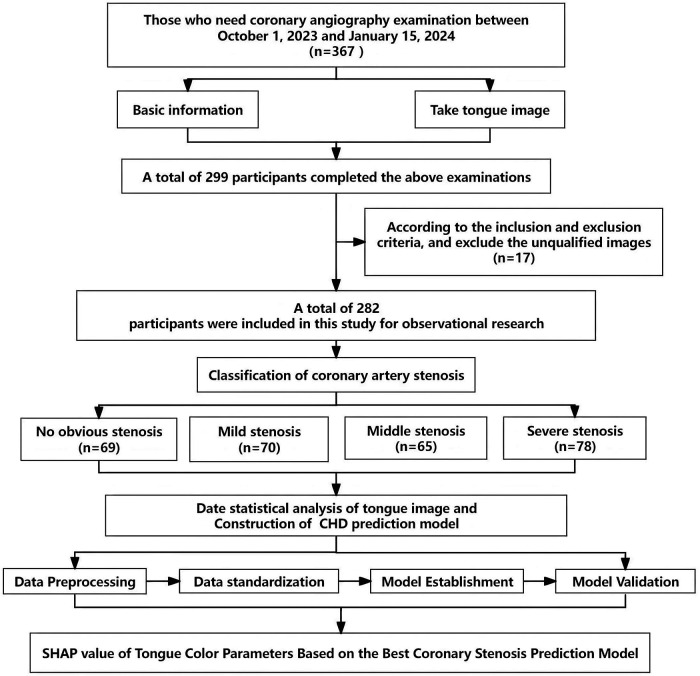
This retrospective cohort study aimed to analyze the relationship between tongue color and coronary artery stenosis severity in 282 patients after underwent coronary angiography.
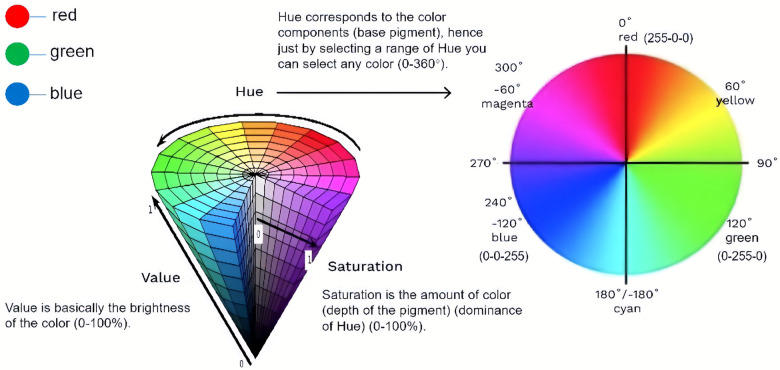
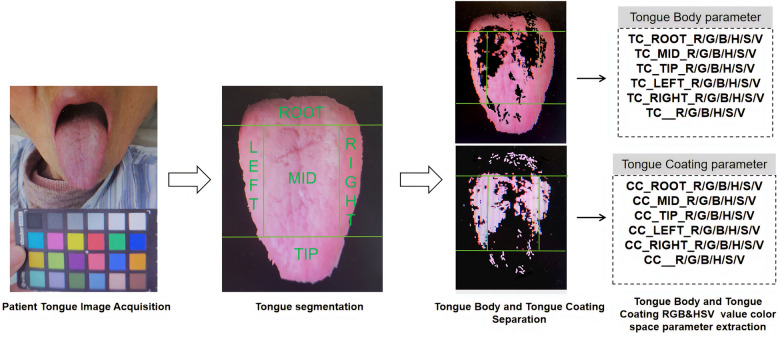
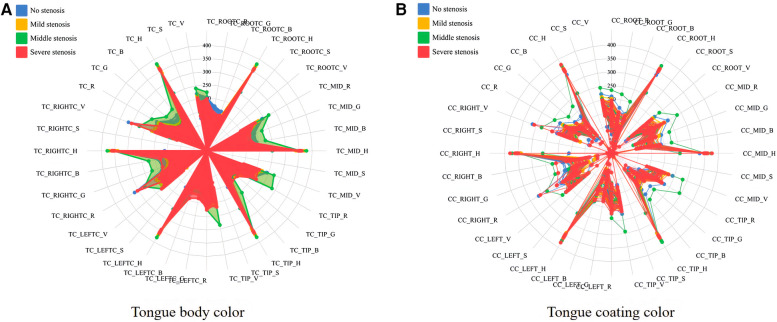
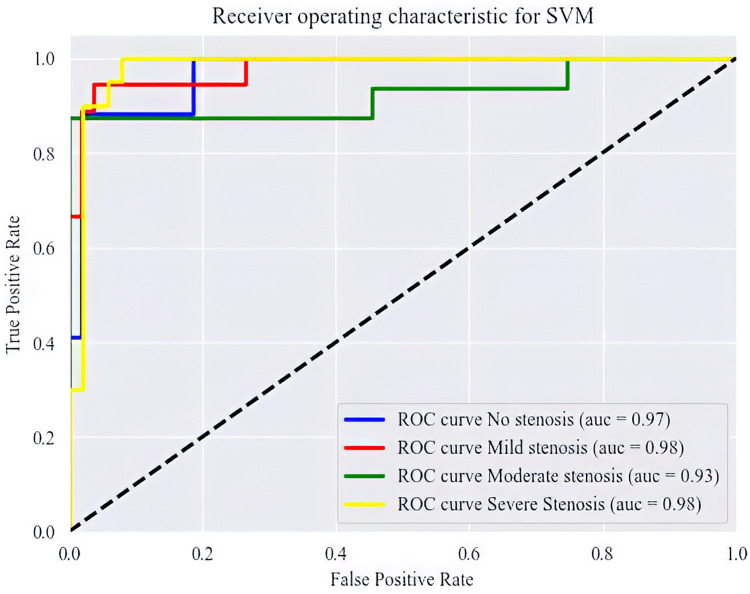
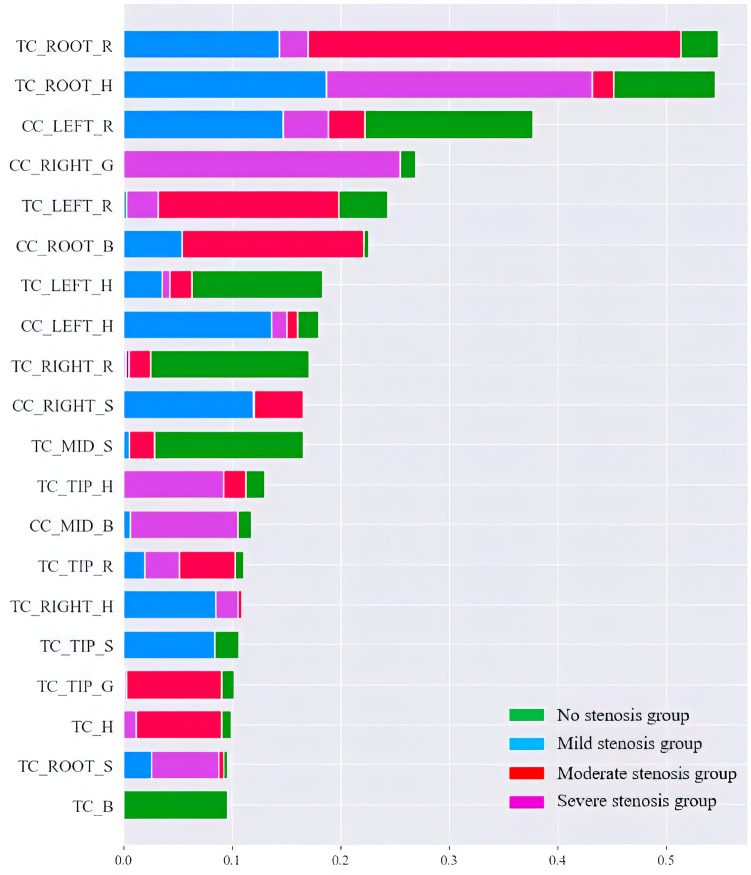
A retrospective cohort study was conducted to collect data from patients who underwent coronary angiography in the Department of Cardiology, Shanghai Jiading District Central Hospital from October 1, 2023 to January 15, 2024. All patients were divided into four various stenosis groups. The tongue images of each patient was normalized captured, tongue body (TC_) and tongue coating (CC_) data were converted into RGB and HSV model parameters using SMX System 2.0. Four supervised machine learning classifiers were used to establish a coronary artery stenosis grading prediction model, including random forest (RF), logistic regression, and support vector machine (SVM). Accuracy, precision, recall, and F1 score were used as classification indicators to evaluate the training and validation performance of the model. SHAP values were furthermore used to explore the impacts of features.
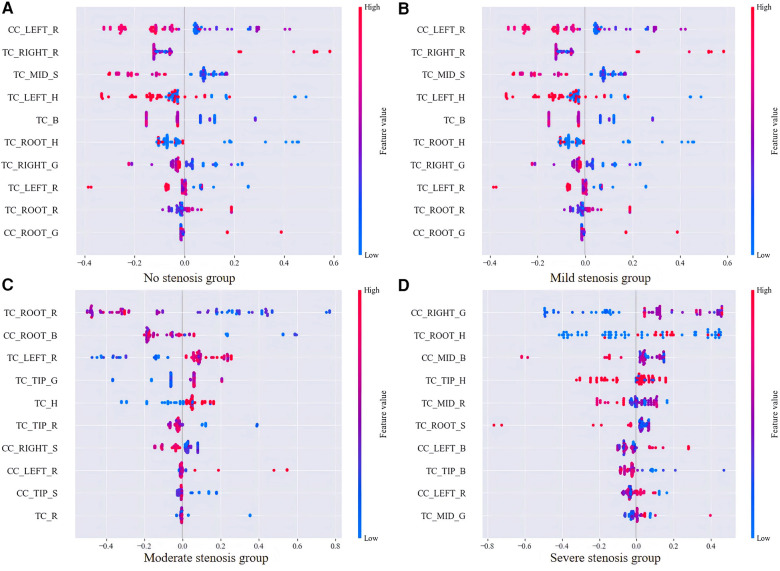
This study finally included 282 patients, including 164 males (58.16%) and 118 females (41.84%). 69 patients without stenosis, 70 patients with mild stenosis, 65 patients with moderate stenosis, and 78 patients with severe stenosis. Significant differences of tongue parameters were observed in the four groups [TC_R (= 0.000), TC_G (= 0.003), TC_H (= 0.001) and TC_S (= 0.024),CC_R (= 0.006), CC_B (= 0.023) and CC_S (= 0.001)]. The SVM model had the highest predictive ability, with AUC values above 0.9 in different stenosis groups, and was particularly good at identifying mild and severe stenosis (AUC = 0.98). SHAP value showed that high values of TC_RIGHT_R, low values of CC_LEFT_R were the most impact factors to predict no coronary stenosis; high CC_LEFT_R and low TC_ROOT_H for mild coronary stenosis; low TC_ROOT_R and CC_ROOT_B for moderate coronary stenosis; high CC_RIGHT_G and low TC_ROOT_H for severe coronary stenosis.
Tongue color parameters can provide a reference for predicting the degree of coronary artery stenosis. The study provides insights into the potential application of tongue color parameters in predicting coronary artery stenosis severity. Future research can expand on tongue features, optimize prediction models, and explore applications in other cardiovascular diseases.
本回顾性队列研究旨在分析282例接受冠状动脉造影术后患者的舌色与冠状动脉狭窄严重程度之间的关系。
进行一项回顾性队列研究,收集2023年10月1日至2024年1月15日在上海嘉定区中心医院心内科接受冠状动脉造影术患者的数据。所有患者被分为四个不同的狭窄组。对每位患者的舌图像进行标准化采集,使用SMX System 2.0将舌体(TC_)和舌苔(CC_)数据转换为RGB和HSV模型参数。使用四种监督机器学习分类器建立冠状动脉狭窄分级预测模型,包括随机森林(RF)、逻辑回归和支持向量机(SVM)。使用准确率、精确率、召回率和F1分数作为分类指标来评估模型的训练和验证性能。此外,使用SHAP值来探索特征的影响。
本研究最终纳入282例患者,其中男性164例(58.16%),女性118例(41.84%)。无狭窄患者69例,轻度狭窄患者70例,中度狭窄患者65例,重度狭窄患者78例。四组患者的舌参数存在显著差异[TC_R(=0.000),TC_G(=0.003),TC_H(=0.001)和TC_S(=0.024),CC_R(=0.006),CC_B(=0.023)和CC_S(=0.001)]。SVM模型具有最高的预测能力,在不同狭窄组中的AUC值均高于0.9,尤其擅长识别轻度和重度狭窄(AUC = 0.98)。SHAP值显示,TC_RIGHT_R高值、CC_LEFT_R低值是预测无冠状动脉狭窄的最主要影响因素;CC_LEFT_R高值和TC_ROOT_H低值用于预测轻度冠状动脉狭窄;TC_ROOT_R低值和CC_ROOT_B低值用于预测中度冠状动脉狭窄;CC_RIGHT_G高值和TC_ROOT_H低值用于预测重度冠状动脉狭窄。
舌色参数可为预测冠状动脉狭窄程度提供参考。本研究为舌色参数在预测冠状动脉狭窄严重程度方面的潜在应用提供了见解。未来的研究可以扩展舌特征,优化预测模型,并探索在其他心血管疾病中的应用。