Alharran Abdullah M, Alzayed Mooza M, Jamilian Parsa, Prabahar Kousalya, Kamal Aminah Hassan, Alotaibi Muteb N, Elshaer Omar E, Alhatm Mshal, Masmoum Mohd Diya, Hernández-Wolters Benjamin, Sindi Raghad, Kord-Varkaneh Hamed, Abu-Zaid Ahmed
College of Medicine & Medical Sciences, Arabian Gulf University, Manama, Bahrain.
School of Medicine, Keele University, Staffordshire, United Kingdom.
Curr Ther Res Clin Exp. 2024 Jul 31;101:100755. doi: 10.1016/j.curtheres.2024.100755. eCollection 2024.
Conflicting results on the effect of magnesium supplementation on blood pressure have been published in previous meta-analyses; hence, we conducted this umbrella meta-analysis of RCTs to provide a more robust conclusion on its effects.
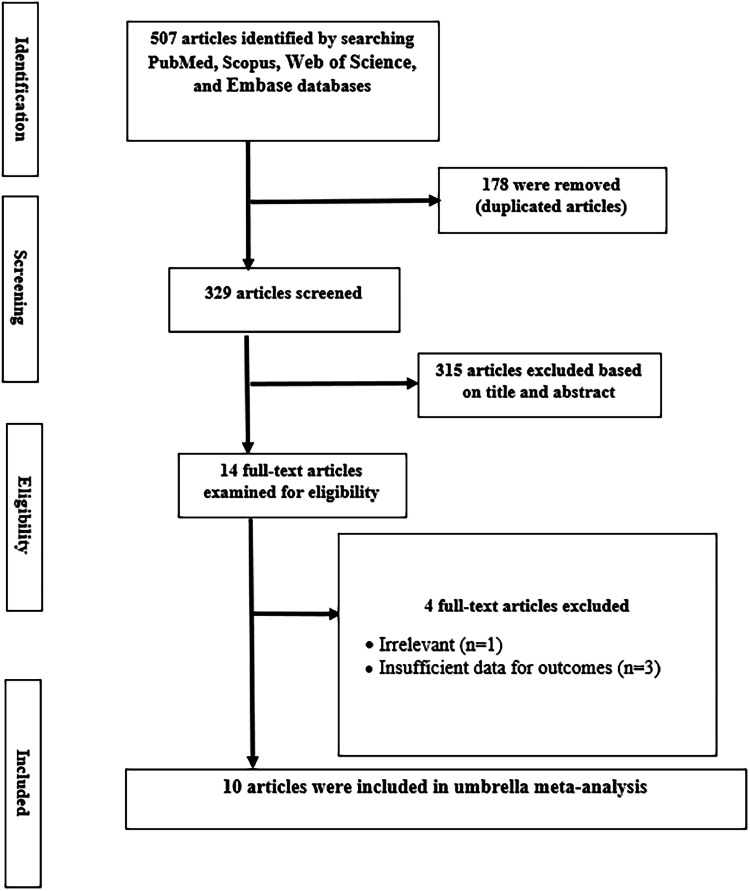
Four databases including PubMed, Scopus, EMBASE, and Web of Science were searched to find pertinent papers published on international scientific from inception up to July 15, 2024. We utilized STATA version 17.0 to carry out all statistical analyses (Stata Corporation, College Station, TX, US). The random effects model was used to calculate the overall effect size ES and CI.
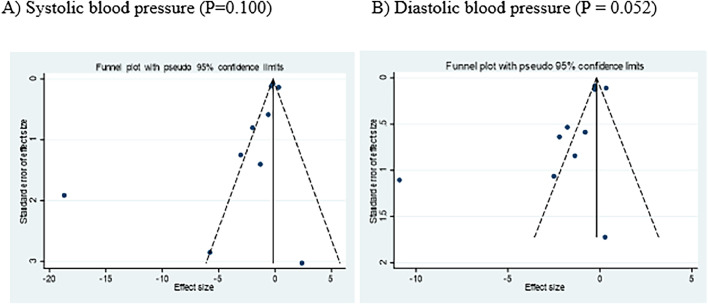
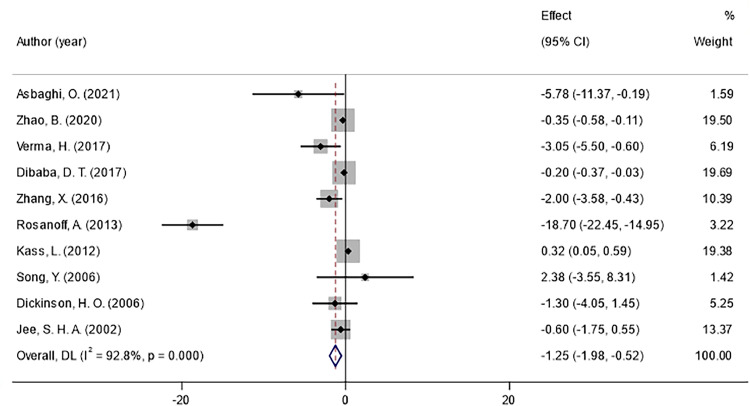
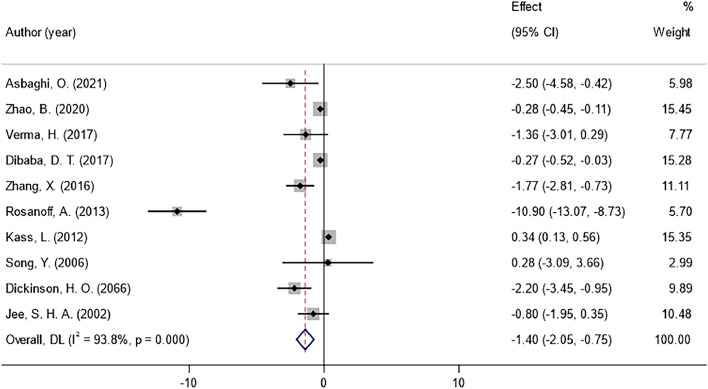
Ten eligible review papers with 8610 participants studied the influence of magnesium on SBP and DBP. The pooling of their effect sizes resulted in a significant reduction of SBP (ES = -1.25 mmHg; 95% CI: -1.98, -0.51, = 0.001) and DBP (ES = -1.40 mmHg; 95% CI: -2.04, -0.75, = 0.000) by magnesium supplementation. In subgroup analysis, a significant reduction in SBP and DBP was observed in magnesium intervention with dosage ≥400 mg/day (ES for SBP = -6.38 mmHg; ES for DBP = -3.71mmHg), as well as in studies with a treatment duration of ≥12 weeks (ES for SBP = -0.42 mmHg; ES for DBP = -0.45 mmHg).
The findings of the present umbrella meta-analysis showed an overall decrease of SBP and DBP with magnesium supplementation, particularly at doses of ≥400 mg/day for ≥12 weeks.
以往的荟萃分析中关于补充镁对血压影响的结果相互矛盾;因此,我们进行了这项随机对照试验的伞状荟萃分析,以就其影响得出更可靠的结论。
检索了包括PubMed、Scopus、EMBASE和Web of Science在内的四个数据库,以查找从创刊至2024年7月15日在国际科学期刊上发表的相关论文。我们使用STATA 17.0版进行所有统计分析(美国德克萨斯州大学城的Stata公司)。采用随机效应模型计算总体效应量ES和CI。
十篇符合条件的综述论文,共8610名参与者,研究了镁对收缩压和舒张压的影响。汇总它们的效应量后发现,补充镁可显著降低收缩压(ES = -1.25 mmHg;95% CI:-1.98,-0.51,P = 0.001)和舒张压(ES = -1.40 mmHg;95% CI:-2.04,-0.75,P = 0.000)。在亚组分析中,剂量≥400 mg/天的镁干预以及治疗持续时间≥12周的研究中,收缩压和舒张压均显著降低(收缩压的ES = -6.38 mmHg;舒张压的ES = -3.71 mmHg)(收缩压的ES = -0.42 mmHg;舒张压的ES = -0.45 mmHg)。
本伞状荟萃分析的结果表明,补充镁可使收缩压和舒张压总体下降,尤其是剂量≥400 mg/天且持续≥12周时。