Bragantini Jordão, Theodoro Ilan, Zhao Xiang, Huijben Teun A P M, Hirata-Miyasaki Eduardo, VijayKumar Shruthi, Balasubramanian Akilandeswari, Lao Tiger, Agrawal Richa, Xiao Sheng, Lammerding Jan, Mehta Shalin, Falcão Alexandre X, Jacobo Adrian, Lange Merlin, Royer Loïc A
Chan Zuckerberg Biohub, San Francisco, United States.
Institute of Computing - State University of Campinas, Campinas, Brazil.
bioRxiv. 2024 Sep 3:2024.09.02.610652. doi: 10.1101/2024.09.02.610652.
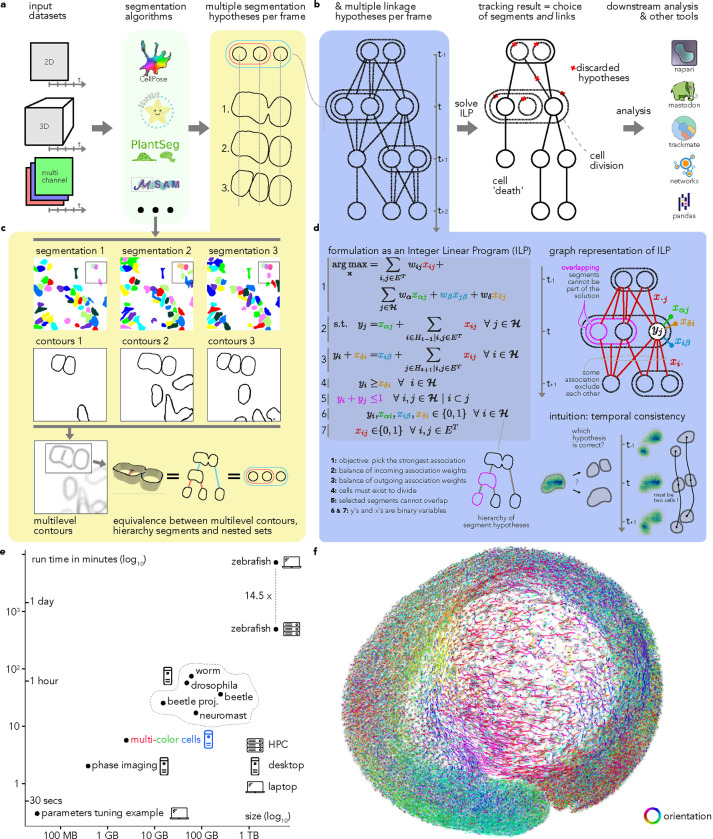
Tracking live cells across 2D, 3D, and multi-channel time-lapse recordings is crucial for understanding tissue-scale biological processes. Despite advancements in imaging technology, achieving accurate cell tracking remains challenging, particularly in complex and crowded tissues where cell segmentation is often ambiguous. We present Ultrack, a versatile and scalable cell-tracking method that tackles this challenge by considering candidate segmentations derived from multiple algorithms and parameter sets. Ultrack employs temporal consistency to select optimal segments, ensuring robust performance even under segmentation uncertainty. We validate our method on diverse datasets, including terabyte-scale developmental time-lapses of zebrafish, fruit fly, and nematode embryos, as well as multi-color and label-free cellular imaging. We show that Ultrack achieves state-of-the-art performance on the Cell Tracking Challenge and demonstrates superior accuracy in tracking densely packed embryonic cells over extended periods. Moreover, we propose an approach to tracking validation via dual-channel sparse labeling that enables high-fidelity ground truth generation, pushing the boundaries of long-term cell tracking assessment. Our method is freely available as a Python package with Fiji and napari plugins and can be deployed in a high-performance computing environment, facilitating widespread adoption by the research community.
在二维、三维和多通道延时记录中追踪活细胞对于理解组织尺度的生物过程至关重要。尽管成像技术取得了进步,但实现精确的细胞追踪仍然具有挑战性,尤其是在细胞分割常常模糊不清的复杂且拥挤的组织中。我们提出了Ultrack,一种通用且可扩展的细胞追踪方法,该方法通过考虑从多种算法和参数集得出的候选分割来应对这一挑战。Ultrack利用时间一致性来选择最优分割,即使在分割存在不确定性的情况下也能确保稳健的性能。我们在各种数据集上验证了我们的方法,包括斑马鱼、果蝇和线虫胚胎的太字节级发育延时记录,以及多色和无标记细胞成像。我们表明,Ultrack在细胞追踪挑战赛中达到了当前最优性能,并在长时间追踪密集堆积的胚胎细胞方面展示出卓越的准确性。此外,我们提出了一种通过双通道稀疏标记进行追踪验证的方法,该方法能够生成高保真的真实数据,推动了长期细胞追踪评估的边界。我们的方法作为一个带有Fiji和napari插件的Python包免费提供,并且可以部署在高性能计算环境中,便于研究社区广泛采用。