Stringer Carsen, Pachitariu Marius
HHMI Janelia Research Campus, Ashburn, VA, USA.
Nat Methods. 2025 Mar;22(3):592-599. doi: 10.1038/s41592-025-02595-5. Epub 2025 Feb 12.
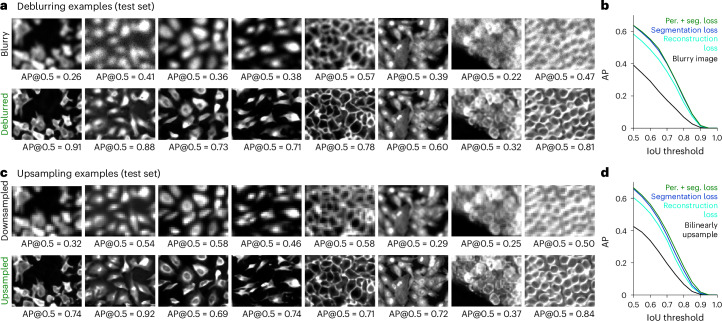
Generalist methods for cellular segmentation have good out-of-the-box performance on a variety of image types; however, existing methods struggle for images that are degraded by noise, blurring or undersampling, all of which are common in microscopy. We focused the development of Cellpose3 on addressing these cases and here we demonstrate substantial out-of-the-box gains in segmentation and image quality for noisy, blurry and undersampled images. Unlike previous approaches that train models to restore pixel values, we trained Cellpose3 to output images that are well segmented by a generalist segmentation model, while maintaining perceptual similarity to the target images. Furthermore, we trained the restoration models on a large, varied collection of datasets, thus ensuring good generalization to user images. We provide these tools as 'one-click' buttons inside the graphical interface of Cellpose as well as in the Cellpose API.
通用的细胞分割方法在各种图像类型上具有良好的开箱即用性能;然而,现有方法在处理因噪声、模糊或欠采样而退化的图像时存在困难,而这些情况在显微镜图像中很常见。我们将Cellpose3的开发重点放在解决这些情况上,在此我们展示了对于噪声、模糊和欠采样图像,在分割和图像质量方面开箱即用的显著提升。与之前训练模型恢复像素值的方法不同,我们训练Cellpose3输出能被通用分割模型很好分割的图像,同时保持与目标图像的感知相似性。此外,我们在大量多样的数据集上训练恢复模型,从而确保对用户图像有良好的泛化能力。我们将这些工具作为“一键式”按钮提供在Cellpose的图形界面以及Cellpose API中。