Edo Kazuki, Kawano Masahide, Maeda Hideki
Department of Regulatory Science, Faculty of Pharmacy, Meiji Pharmaceutical University, Tokyo, Japan.
Department of Regulatory Science, Graduate School of Pharmaceutical Science, Meiji Pharmaceutical University, Tokyo, Japan.
PLoS One. 2024 Sep 16;19(9):e0309992. doi: 10.1371/journal.pone.0309992. eCollection 2024.
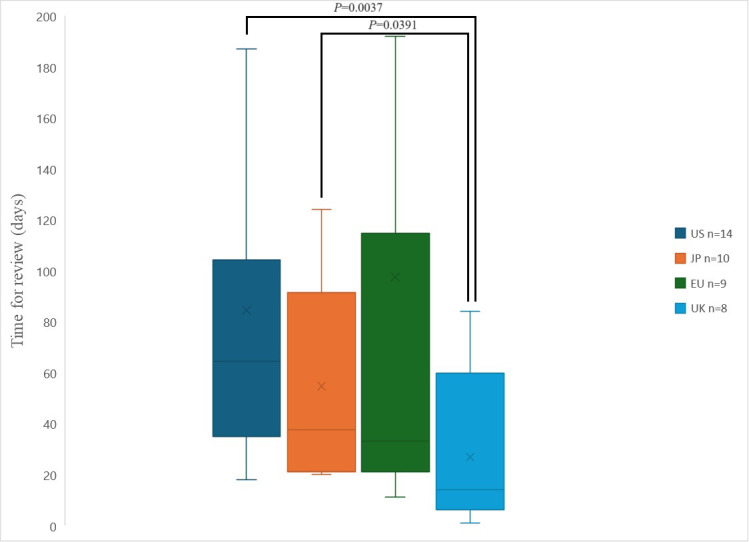
The approval of pharmaceuticals in response to the COVID-19 pandemic is a global concern, and during emergencies, emergency approval or authorization systems that enable the rapid use of unapproved drugs to maintain national health are essential. However, there is limited research comparing these systems across countries and their effects. This cross-sectional study examined such systems in Japan (JP), Europe (EU), the United Kingdom (UK), and China (CN) for pharmaceuticals (n = 23) authorized under Emergency Use Authorization (EUA) in the United States (US) between December 2019 to July 2023. As of the end of July 2023, JP had granted approval or permission for 14 drugs (60.9%), EU for 14 (60.9%), UK for 12 (52.2%), and CN for three (13.0%). An examination of the developmental status of the 23 drugs revealed that JP had 6 drugs (26.1%), the EU had 3 drugs (8.7%), the UK had 5 drugs (21.7%), and CN had 16 drugs (69.6%) yet to be developed. The US had significantly more granted permissions and developed drugs, while CN the least. The UK had a significantly shorter period for approval than the US and the shortest overall. The EU had the shortest period from the issuance of EUA to approval dates. Although not statistically significant, JP had the longest duration until unapproved drugs could be used. Pharmaceuticals granted usage permission under the EUA in JP, the EU, and the UK were developed or on the market in over 70% of cases, whereas in CN, more than two-thirds were yet to be developed. This suggests that CN may not actively utilize pharmaceuticals from other countries for COVID-19 treatment and may rely on its own. When comparing the emergency approval and permission systems of each country, the most significant difference was in the type of system granting approval.
应对新冠疫情的药品审批是一个全球关注的问题,在紧急情况下,能够快速使用未经批准的药物以维护国民健康的紧急批准或授权系统至关重要。然而,比较各国这些系统及其效果的研究有限。这项横断面研究考察了日本(JP)、欧洲(EU)、英国(UK)和中国(CN)针对2019年12月至2023年7月期间在美国(US)根据紧急使用授权(EUA)获批的药品(n = 23)的此类系统。截至2023年7月底,日本已批准或允许使用14种药物(60.9%),欧盟为14种(60.9%),英国为12种(52.2%),中国为3种(13.0%)。对这23种药物的研发状态进行考察发现,日本有6种药物(26.1%)、欧盟有3种药物(8.7%)、英国有5种药物(21.7%)、中国有16种药物(69.6%)尚未研发。美国获批许可和已研发药物的数量显著更多,而中国最少。英国的审批时间明显短于美国,且总体最短。欧盟从发布EUA到批准日期的时间最短。虽然无统计学意义,但日本直到未经批准的药物能够使用的持续时间最长。在日本、欧盟和英国根据EUA获批使用许可的药品,超过70%的情况是已研发或已上市,而在中国,超过三分之二尚未研发。这表明中国可能没有积极利用其他国家的药品进行新冠治疗,可能依赖自身。比较各国的紧急批准和许可系统时,最显著的差异在于批准系统的类型。