Li Jingguo, Ott Sascha
Wallenberg Initiative Materials Science for Sustainability, Department of Chemistry, Ångström Laboratory, Uppsala University, Box 523, 75120 Uppsala, Sweden.
Acc Chem Res. 2024 Oct 1;57(19):2836-2846. doi: 10.1021/acs.accounts.4c00430. Epub 2024 Sep 17.
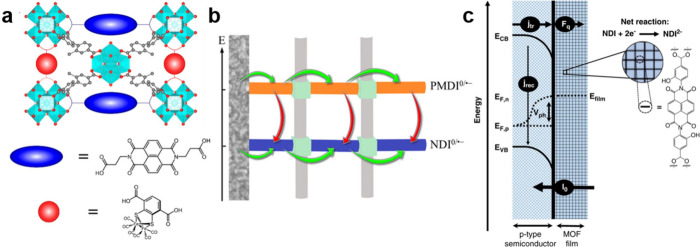
ConspectusRedox-conductive metal-organic frameworks (RC-MOFs) are a class of porous materials that exhibit electrical conductivity through a chain of self-exchange reactions between molecularly defined, neighboring redox-active units of differing oxidation states. To maintain electroneutrality, this electron hopping transport is coupled to the translocation of charge balancing counterions. Owing to the molecular nature of the redox active components, RC-MOFs have received increasing attention for potential applications in energy storage, electrocatalysis, reconfigurable electronics, etc. While our understanding of fundamental aspects that govern electron hopping transport in RC-MOFs has improved during the past decade, certain fundamental aspects such as questions that arise from the coupling between electron hopping and diffusion migration of charge balancing counterions are still not fully understood.In this Account, we summarize and discuss our group's efforts to answer some of these fundamental questions while also demonstrating the applicability of RC-MOFs in energy-related applications. First, we introduce general design strategies for RC-MOFs, fundamentals that govern their charge transport properties, and experimental diagnostics that allow for their identification. Selected examples with redox-active organic linkers or metallo-linkers are discussed to demonstrate how the molecular characteristics of the redox-active units inside RC-MOFs are retained. Second, we summarize experimental techniques that can be used to characterize charge transport properties in a RC-MOF. The apparent electron diffusion coefficient, , that is frequently determined in the field and obtained in large perturbation, transient experiments will be discussed and related to redox conductivity, σ, that is obtained in a steady state setup. It will be shown that both MOF-intrinsic (topology, pore size, and apertures) and experimental (nature of electrolyte, solvent) factors can have noticeable impact on electrical conductivity through RC-MOFs. Lastly, we summarize our progress in utilizing RC-MOFs as electrochromic materials, materials for harvesting minority carriers from illuminated semiconductors and within electrocatalysis. In the latter case, recent work on multivariate RC-MOFs in which redox active linkers are used to "wire" redox catalysts in the crystal interiors will be presented, offering opportunities to independently optimize charge transport and catalytic function.The ambition of this Account is to inspire the design of new RC-MOF systems, to aid their identification, to provide mechanistic insights into the governing ion-coupled electron hopping transport mode of conductivity, and ultimately to promote their applications in existing and emerging areas. With basically unlimited possibilities of molecular engineering tools, together with research in both fundamental and applied fields, we believe that RC-MOFs will attract even more attention in the future to unlock their full potential.

概述
氧化还原导电金属有机框架(RC-MOFs)是一类多孔材料,通过分子定义的、具有不同氧化态的相邻氧化还原活性单元之间的一系列自交换反应表现出导电性。为了保持电中性,这种电子跳跃传输与电荷平衡抗衡离子的迁移耦合。由于氧化还原活性成分的分子性质,RC-MOFs在能量存储、电催化、可重构电子学等潜在应用中受到越来越多的关注。虽然在过去十年中我们对RC-MOFs中电子跳跃传输的基本方面的理解有所提高,但某些基本方面,如电子跳跃与电荷平衡抗衡离子的扩散迁移之间的耦合所产生的问题,仍未完全理解。
在本综述中,我们总结并讨论了我们团队为回答其中一些基本问题所做的努力,同时也展示了RC-MOFs在能源相关应用中的适用性。首先,我们介绍了RC-MOFs的一般设计策略、控制其电荷传输性质的基本原理以及用于识别它们的实验诊断方法。讨论了一些具有氧化还原活性有机连接体或金属连接体的选定示例,以说明RC-MOFs内部氧化还原活性单元的分子特征是如何保留的。其次,我们总结了可用于表征RC-MOFs中电荷传输性质的实验技术。将讨论在该领域经常测定并在大扰动瞬态实验中获得的表观电子扩散系数,并将其与在稳态设置中获得的氧化还原电导率σ相关联。结果表明,MOF本身的因素(拓扑结构、孔径和孔口)以及实验因素(电解质、溶剂的性质)都可以对通过RC-MOFs的电导率产生显著影响。最后,我们总结了我们在将RC-MOFs用作电致变色材料、从光照半导体中收集少数载流子的材料以及电催化方面的进展。在后一种情况下,将介绍关于多元RC-MOFs的最新工作,其中氧化还原活性连接体用于在晶体内部“连接”氧化还原催化剂,为独立优化电荷传输和催化功能提供了机会。
本综述的目的是激发新的RC-MOF系统的设计,帮助识别它们,提供对控制离子耦合电子跳跃传输导电模式的机理见解,并最终促进它们在现有和新兴领域的应用。随着分子工程工具的可能性基本上是无限的,以及基础和应用领域的研究,我们相信RC-MOFs在未来将吸引更多关注,以释放它们的全部潜力。