Department of Radiology, Chonnam National University Hospital, Gwangju, Republic of Korea.
Department of Radiology, Stanford University School of Medicine, Stanford, CA, USA.
Sci Rep. 2024 Sep 17;14(1):21691. doi: 10.1038/s41598-024-72581-y.
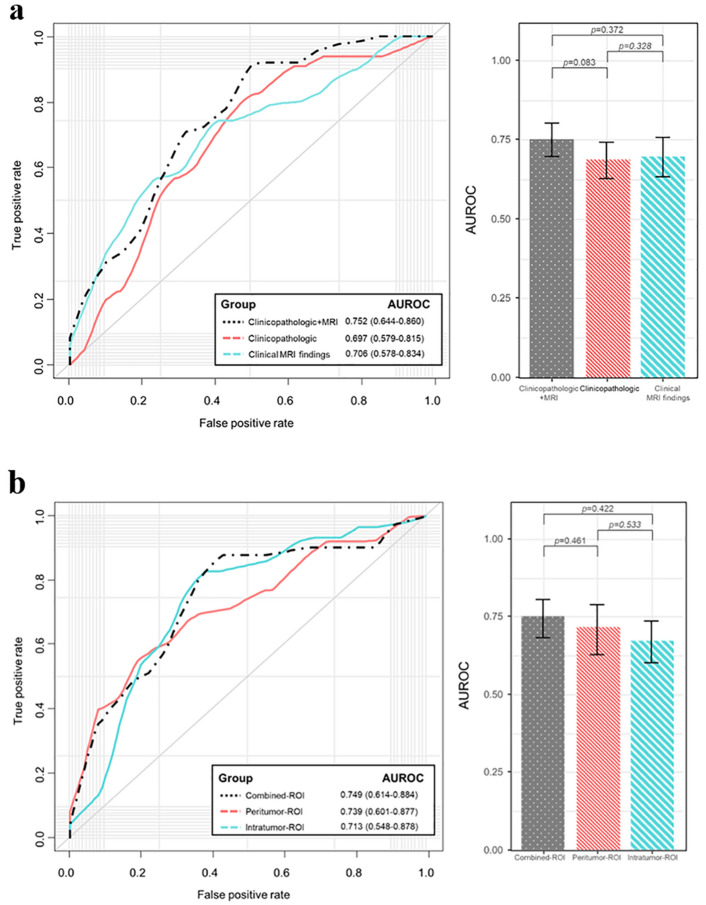
This study assessed pretreatment breast MRI coupled with machine learning for predicting early clinical responses to neoadjuvant chemotherapy (NAC) in triple-negative breast cancer (TNBC), focusing on identifying non-responders. A retrospective analysis of 135 TNBC patients (107 responders, 28 non-responders) treated with NAC from January 2015 to October 2022 was conducted. Non-responders were defined according to RECIST guidelines. Data included clinicopathologic factors and clinical MRI findings, with radiomics features from contrast-enhanced T1-weighted images, to train a stacking ensemble of 13 machine learning models. For subgroup analysis, propensity score matching was conducted to adjust for clinical disparities in NAC response. The efficacy of the models was evaluated using the area under the receiver-operating-characteristic curve (AUROC) before and after matching. The model combining clinicopathologic factors and clinical MRI findings achieved an AUROC of 0.752 (95% CI 0.644-0.860) for predicting non-responders, while radiomics-based models showed 0.749 (95% CI 0.614-0.884). An integrated model of radiomics, clinicopathologic factors, and clinical MRI findings reached an AUROC of 0.802 (95% CI 0.699-0.905). After propensity score matching, the hierarchical order of key radiomics features remained consistent. Our study demonstrated the potential of using machine learning models based on pretreatment MRI to non-invasively predict TNBC non-responders to NAC.
本研究评估了术前乳腺 MRI 结合机器学习在预测三阴性乳腺癌 (TNBC) 新辅助化疗 (NAC) 早期临床反应中的作用,重点是识别无应答者。对 2015 年 1 月至 2022 年 10 月期间接受 NAC 治疗的 135 例 TNBC 患者(107 例应答者,28 例无应答者)进行了回顾性分析。根据 RECIST 指南定义无应答者。数据包括临床病理因素和临床 MRI 发现,从增强 T1 加权图像中提取放射组学特征,以训练 13 个机器学习模型的堆叠集成。为了进行亚组分析,进行倾向评分匹配以调整 NAC 反应的临床差异。在匹配前后,使用受试者工作特征曲线下面积 (AUROC) 评估模型的疗效。将临床病理因素和临床 MRI 发现相结合的模型对预测无应答者的 AUROC 为 0.752(95%CI 0.644-0.860),而基于放射组学的模型为 0.749(95%CI 0.614-0.884)。放射组学、临床病理因素和临床 MRI 发现的综合模型的 AUROC 为 0.802(95%CI 0.699-0.905)。经过倾向评分匹配后,关键放射组学特征的层次顺序保持不变。本研究表明,使用基于术前 MRI 的机器学习模型预测 TNBC 对 NAC 的无应答者具有潜在的应用价值。