Menezes Juliana, Frosini Siân-Marie, Weese Scott, Perreten Vincent, Schwarz Stefan, Amaral Andreia J, Loeffler Anette, Pomba Constança
CIISA - Centre for Interdisciplinary Research in Animal Health, Faculty of Veterinary Medicine, University of Lisbon, Lisbon, Portugal.
Associate Laboratory for Animal and Veterinary Sciences (AL4AnimalS), Lisbon, Portugal.
Front Microbiol. 2024 Sep 3;15:1432240. doi: 10.3389/fmicb.2024.1432240. eCollection 2024.
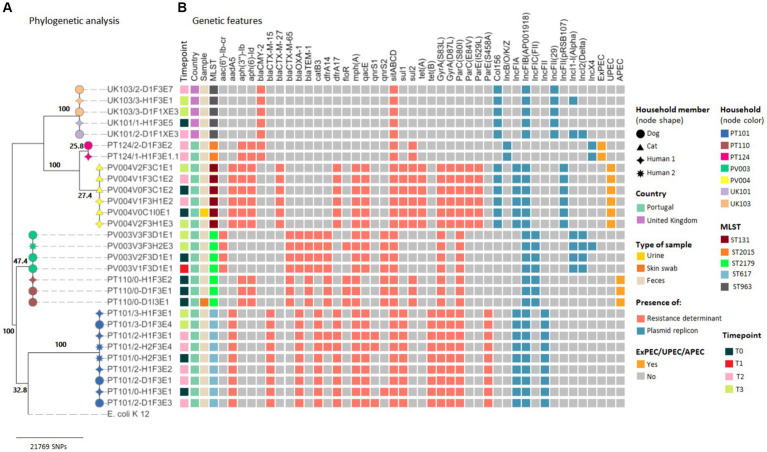
Antimicrobial resistance mediated by extended-spectrum beta-lactamase (ESBL)- and plasmid-mediated cephalosporinase (AmpC)-producing Enterobacterales, as well as carbapenemase-producing Enterobacterales have globally increased among companion animals, posing a potential health risk to humans in contact with them. This prospective longitudinal study investigates the transfer of ESBL/AmpC- and carbapenemase-producing Enterobacterales between companion animals and their cohabitant humans in Portugal (PT) and the United Kingdom (UK) during animal infection. Fecal samples and nasal swabs collected from dogs and cats with urinary tract infection (UTI) or skin and soft tissue infection (SSTI), and their cohabitant humans were screened for resistant strains. Relatedness between animal and human strains was established by whole-genome sequencing (WGS). ESBL/AmpC-producing Enterobacterales were detected in companion animals (PT = 55.8%; UK = 36.4%) and humans (PT = 35.9%; UK = 12.5%). Carbapenemase-producing Enterobacterales carriage was observed in one dog from Portugal (2.6%) and another dog from the UK (4.5%). Transmission of index clinical ESBL-producing and strains to cohabitant humans was observed in three Portuguese households (6.9%, = 43), with repeated isolation of the index strains on fecal samples from the animals and their cohabiting humans. In addition, longitudinal sharing of strains carried by companion animals and their owners was observed in other two Portuguese households and two households from the UK. Furthermore, a multidrug-resistant ACT-24-producing strains were also shared within another Portuguese household. These results highlight the importance of the household as an epidemiological unit in the efforts to mitigate the spread of antimicrobial resistance, further emphasizing the need for antimicrobial surveillance in this context, capable of producing data that can inform and evaluate public health actions.
由产超广谱β-内酰胺酶(ESBL)和质粒介导的头孢菌素酶(AmpC)的肠杆菌科细菌以及产碳青霉烯酶的肠杆菌科细菌介导的抗菌药物耐药性,在伴侣动物中全球范围内都有所增加,这对与其接触的人类构成了潜在的健康风险。这项前瞻性纵向研究调查了在葡萄牙(PT)和英国(UK),伴侣动物及其同居人类在动物感染期间产ESBL/AmpC和产碳青霉烯酶的肠杆菌科细菌的传播情况。对患有尿路感染(UTI)或皮肤及软组织感染(SSTI)的犬猫及其同居人类采集的粪便样本和鼻拭子进行耐药菌株筛查。通过全基因组测序(WGS)确定动物和人类菌株之间的亲缘关系。在伴侣动物中检测出产ESBL/AmpC的肠杆菌科细菌(PT = 55.8%;UK = 36.4%)以及人类(PT = 35.9%;UK = 12.5%)。在葡萄牙的一只犬(2.6%)和英国的另一只犬(4.5%)中观察到产碳青霉烯酶的肠杆菌科细菌携带情况。在三个葡萄牙家庭(6.9%,n = 43)中观察到临床产ESBL的指示菌株传播给同居人类,并且在动物及其同居人类的粪便样本中反复分离出指示菌株。此外,在另外两个葡萄牙家庭和两个英国家庭中观察到伴侣动物及其主人携带的菌株存在纵向共享情况。此外,在另一个葡萄牙家庭中还共享了一株产多重耐药ACT - 24的菌株。这些结果凸显了家庭作为一个流行病学单位在减轻抗菌药物耐药性传播努力中的重要性,进一步强调了在此背景下进行抗菌药物监测的必要性,这种监测能够产生可为公共卫生行动提供信息和评估的数据。