Rubenstein Madeleine A, Weiskopf Sarah R, Bertrand Romain, Carter Shawn L, Comte Lise, Eaton Mitchell J, Johnson Ciara G, Lenoir Jonathan, Lynch Abigail J, Miller Brian W, Morelli Toni Lyn, Rodriguez Mari Angel, Terando Adam, Thompson Laura M
U.S. Geological Survey (USGS), National Climate Adaptation Science Center, Reston, USA.
Université de Toulouse 3, Toulouse, France.
Environ Evid. 2023 Apr 11;12(1):7. doi: 10.1186/s13750-023-00296-0.
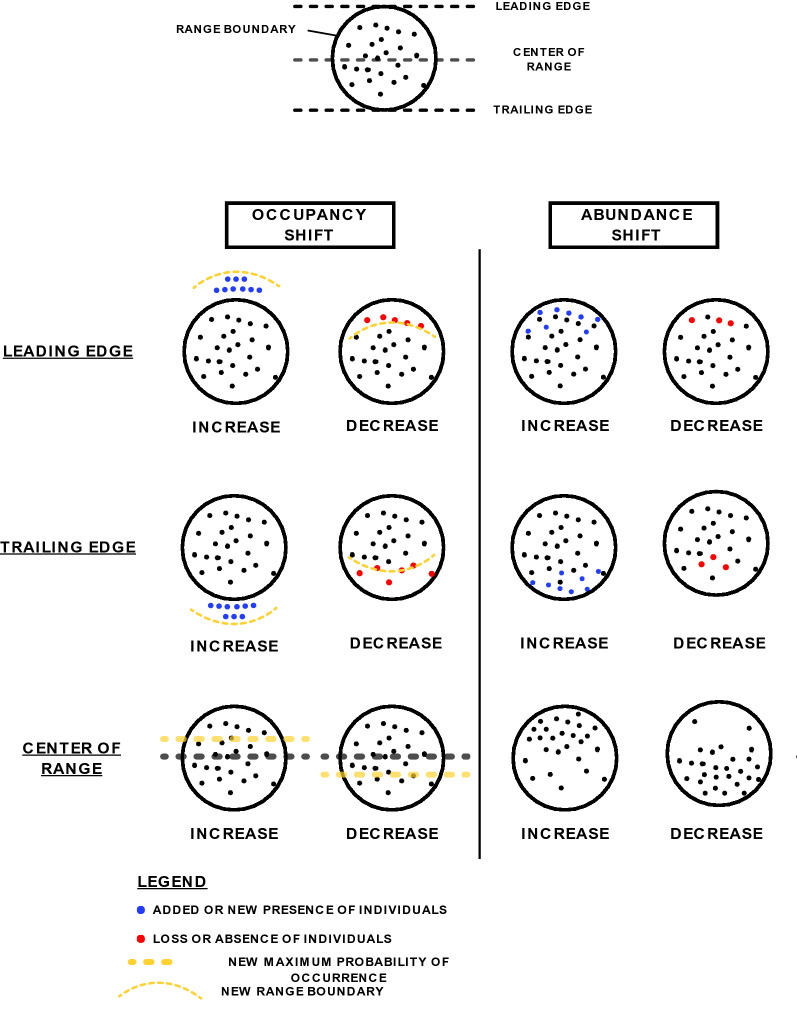
Among the most widely predicted climate change-related impacts to biodiversity are geographic range shifts, whereby species shift their spatial distribution to track their climate niches. A series of commonly articulated hypotheses have emerged in the scientific literature suggesting species are expected to shift their distributions to higher latitudes, greater elevations, and deeper depths in response to rising temperatures associated with climate change. Yet, many species are not demonstrating range shifts consistent with these expectations. Here, we evaluate the impact of anthropogenic climate change (specifically, changes in temperature and precipitation) on species' ranges, and assess whether expected range shifts are supported by the body of empirical evidence.
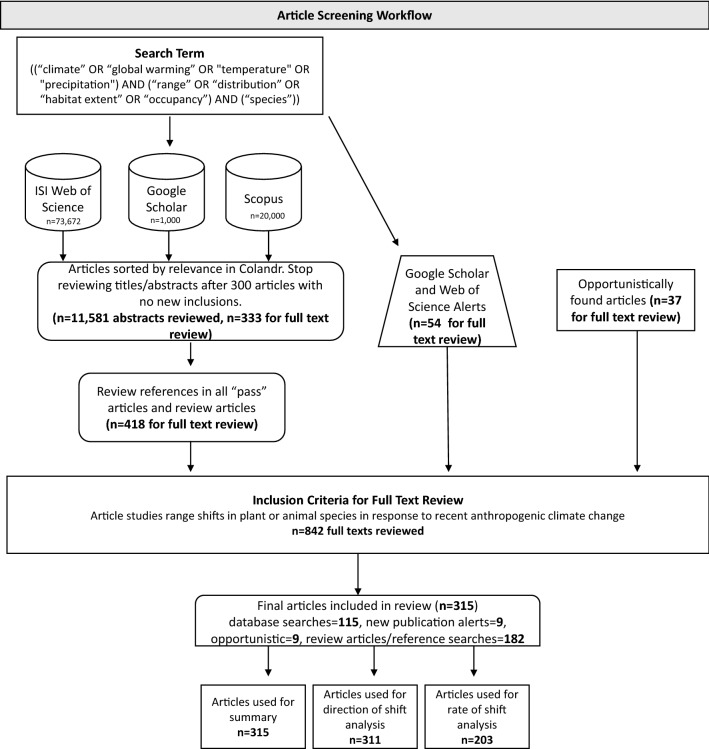
We conducted a Systematic Review, searching online databases and search engines in English. Studies were screened in a two-stage process (title/abstract review, followed by full-text review) to evaluate whether they met a list of eligibility criteria. Data coding, extraction, and study validity assessment was completed by a team of trained reviewers and each entry was validated by at least one secondary reviewer. We used logistic regression models to assess whether the direction of shift supported common range-shift expectations (i.e., shifts to higher latitudes and elevations, and deeper depths). We also estimated the magnitude of shifts for the subset of available range-shift data expressed in distance per time (i.e., km/decade). We accounted for methodological attributes at the study level as potential sources of variation. This allowed us to answer two questions: (1) are most species shifting in the direction we expect (i.e., each observation is assessed as support/fail to support our expectation); and (2) what is the average speed of range shifts?
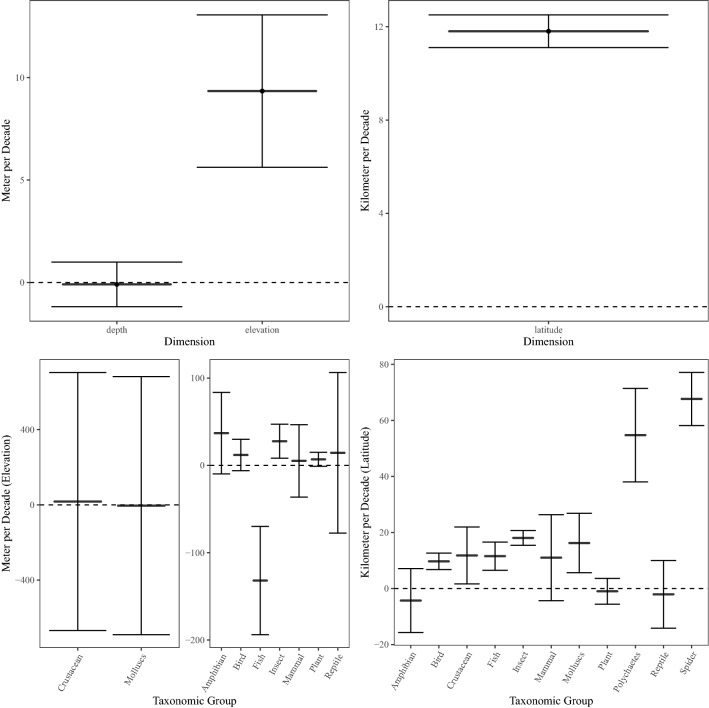
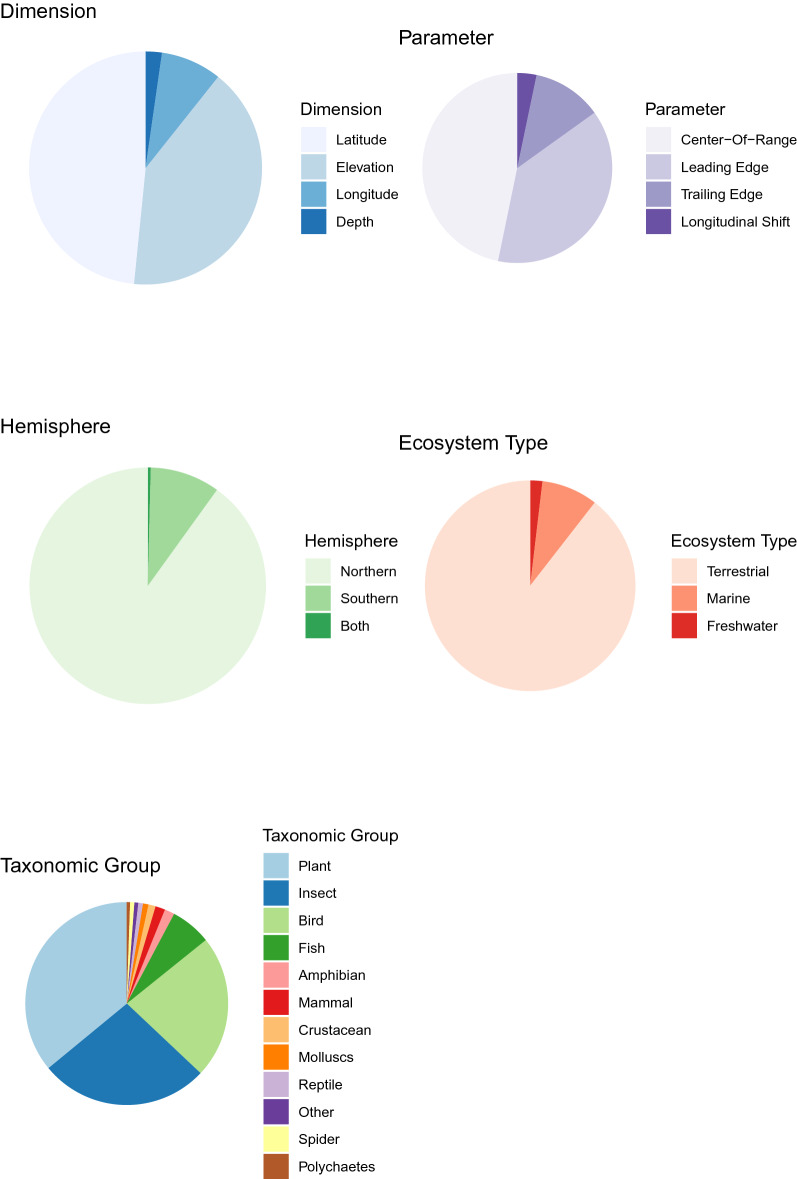
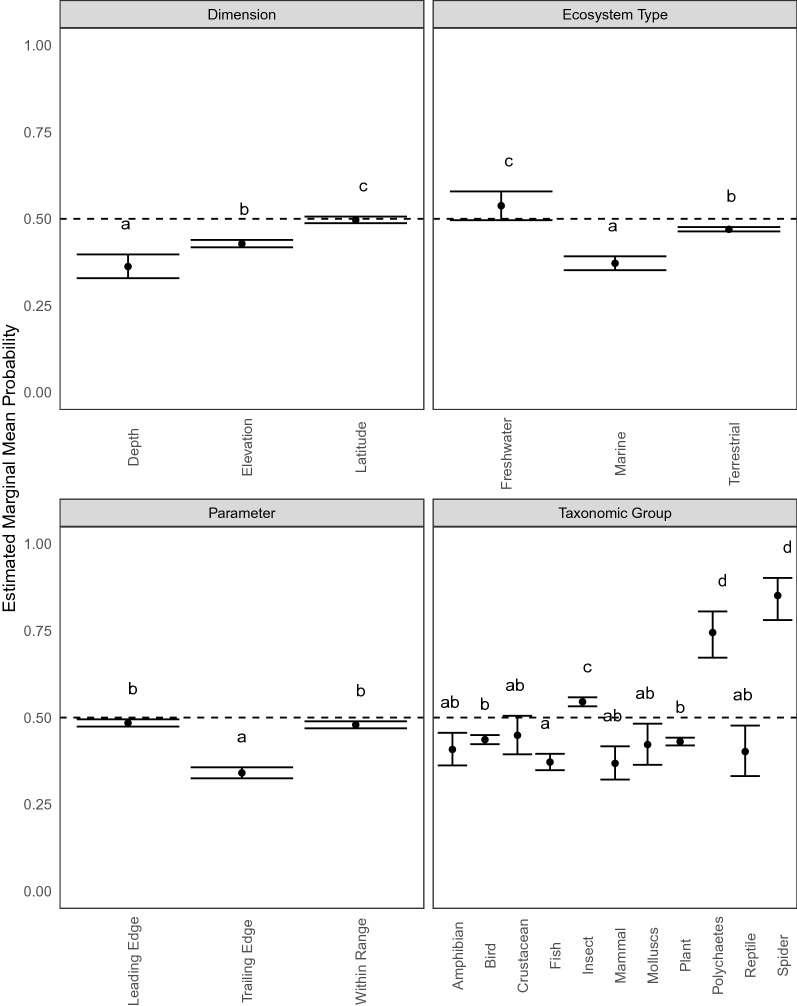
We found that less than half of all range-shift observations (46.60%) documented shifts towards higher latitudes, higher elevations, and greater marine depths, demonstrating significant variation in the empirical evidence for general range shift expectations. For the subset of studies looking at range shift rates, we found that species demonstrated significant average shifts towards higher latitudes (average = 11.8 km/dec) and higher elevations (average = 9 m/dec), although we failed to find significant evidence for shifts to greater marine depths. We found that methodological factors in individual range-shift studies had a significant impact on the reported direction and magnitude of shifts. Finally, we identified important variation across dimensions of range shifts (e.g., greater support for latitude and elevation shifts than depth), parameters (e.g., leading edge shifts faster than trailing edge for latitude), and taxonomic groups (e.g., faster latitudinal shifts for insects than plants).
Despite growing evidence that species are shifting their ranges in response to climate change, substantial variation exists in the extent to which definitively empirical observations confirm these expectations. Even though on average, rates of shift show significant movement to higher elevations and latitudes for many taxa, most species are not shifting in expected directions. Variation across dimensions and parameters of range shifts, as well as differences across taxonomic groups and variation driven by methodological factors, should be considered when assessing overall confidence in range-shift hypotheses. In order for managers to effectively plan for species redistribution, we need to better account for and predict which species will shift and by how much. The dataset produced for this analysis can be used for future research to explore additional hypotheses to better understand species range shifts.
在与气候变化相关的、被广泛预测的对生物多样性的影响中,地理范围转移最为常见,即物种通过改变其空间分布来追踪其气候生态位。科学文献中出现了一系列普遍认可的假说,表明随着气候变化导致温度上升,物种预计会将其分布范围转移到更高纬度、更高海拔以及更深海域。然而,许多物种并未表现出与这些预期相符的范围转移。在此,我们评估人为气候变化(具体而言,温度和降水的变化)对物种分布范围的影响,并评估实证证据是否支持预期的范围转移。
我们进行了一项系统综述,在英文在线数据库和搜索引擎中进行检索。研究在两个阶段进行筛选(标题/摘要审查,随后是全文审查),以评估它们是否符合一系列纳入标准。数据编码、提取和研究有效性评估由一组经过培训的评审人员完成,每个条目至少由一名二级评审人员进行验证。我们使用逻辑回归模型来评估转移方向是否支持常见的范围转移预期(即转移到更高纬度、更高海拔和更深海域)。我们还估计了以距离/时间(即千米/十年)表示的可用范围转移数据子集中转移的幅度。我们将研究层面的方法学属性视为潜在的变异来源。这使我们能够回答两个问题:(1)大多数物种是否朝着我们预期的方向转移(即每个观察结果被评估为支持/不支持我们的预期);(2)范围转移的平均速度是多少?
我们发现,在所有记录的范围转移观察结果中,不到一半(46.60%)显示向更高纬度、更高海拔和更深海域转移,这表明在支持一般范围转移预期的实证证据方面存在显著差异。对于研究范围转移速率的子集,我们发现物种向更高纬度(平均 = 11.8千米/十年)和更高海拔(平均 = 9米/十年)有显著的平均转移,尽管我们没有找到向更深海域转移的显著证据。我们发现个体范围转移研究中的方法学因素对报告的转移方向和幅度有显著影响。最后,我们确定了范围转移各维度(例如,对纬度和海拔转移的支持比对深度转移的支持更大)、参数(例如,纬度的前沿转移比后沿转移更快)和分类群(例如,昆虫的纬度转移比植物更快)之间存在重要差异。
尽管越来越多的证据表明物种正在因气候变化而转移其分布范围,但在实证观察明确证实这些预期的程度上仍存在很大差异。尽管平均而言,许多分类群的转移速率显示出向更高海拔和纬度的显著移动,但大多数物种并未朝着预期方向转移。在评估对范围转移假说的总体信心时,应考虑范围转移各维度和参数的差异,以及分类群之间的差异和方法学因素导致的变异。为了使管理者能够有效地规划物种重新分布,我们需要更好地考虑并预测哪些物种会转移以及转移多少。本次分析生成的数据集可用于未来研究,以探索其他假说,从而更好地理解物种范围转移。