Ye Jean, Tejavibulya Link, Dai Wei, Cope Lora M, Hardee Jillian E, Heitzeg Mary M, Lichenstein Sarah, Yip Sarah W, Banaschewski Tobias, Baker Gareth J, Bokde Arun L W, Brühl Rüdiger, Desrivières Sylvane, Flor Herta, Gowland Penny, Grigis Antoine, Heinz Andreas, Martinot Jean-Luc, Paillère Martinot Marie-Laure, Artiges Eric, Nees Frauke, Orfanos Dimitri Papadopoulos, Poustka Luise, Hohmann Sarah, Holz Nathalie, Baeuchl Christian, Smolka Michael N, Vaidya Nilakshi, Walter Henrik, Whelan Robert, Schumann Gunter, Garavan Hugh, Chaarani Bader, Gee Dylan G, Baskin-Sommers Arielle, Casey B J, Scheinost Dustin
Interdepartmental Neuroscience Program, Yale University, New Haven, Connecticut.
Department of Biostatistics, Yale School of Public Health, New Haven, Connecticut.
bioRxiv. 2024 Sep 11:2024.09.06.611627. doi: 10.1101/2024.09.06.611627.
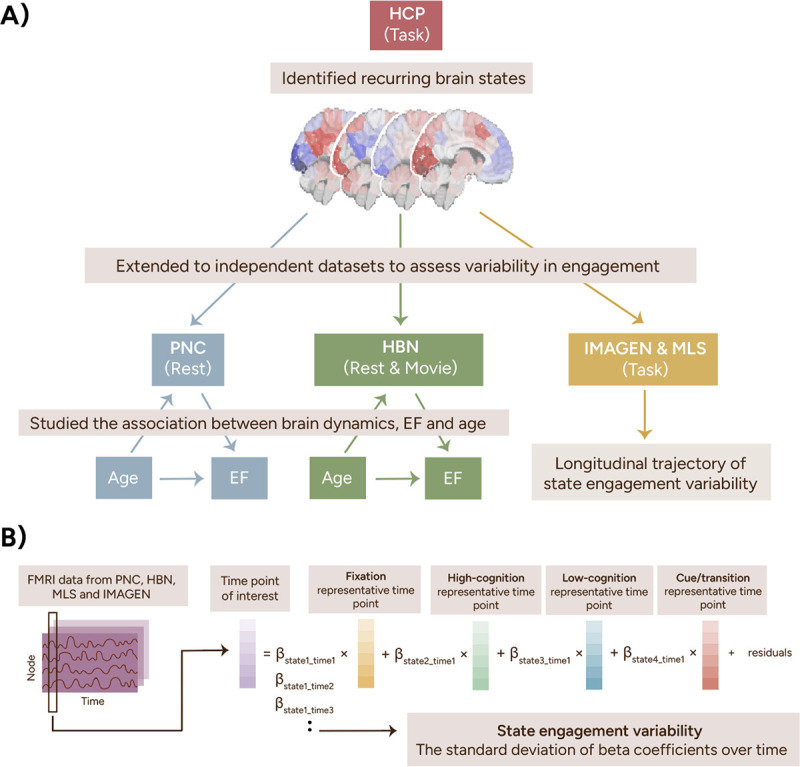
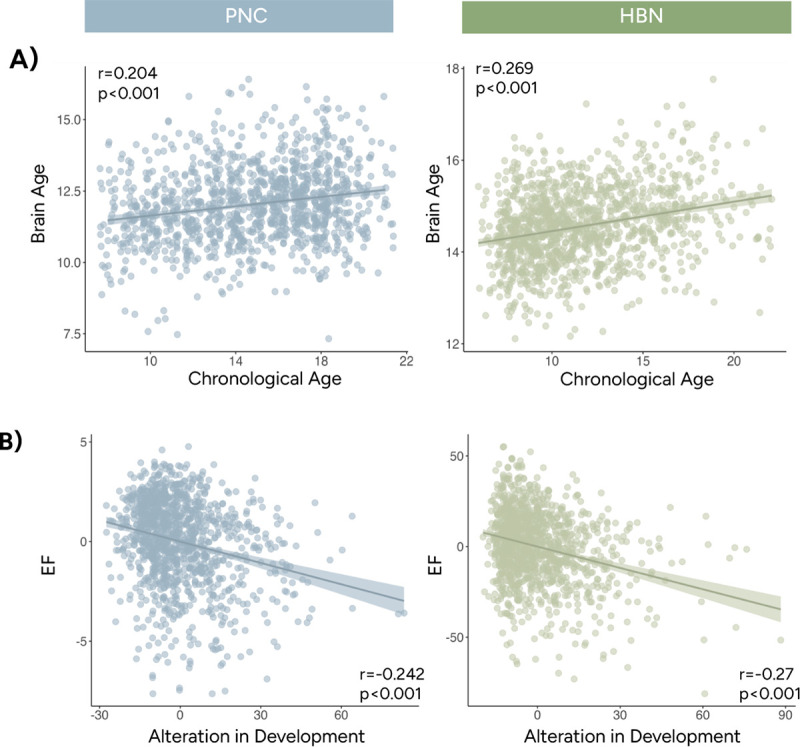
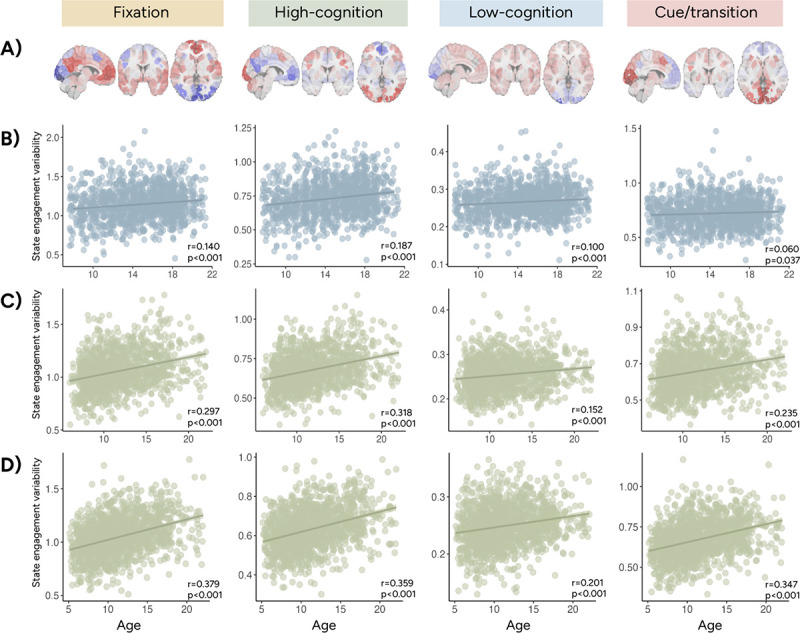
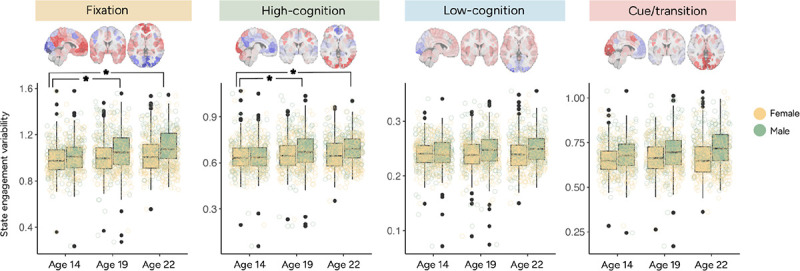
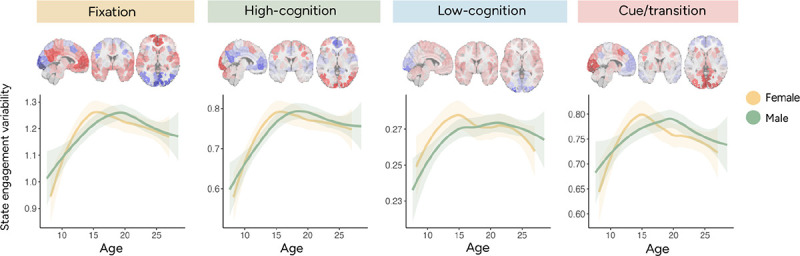
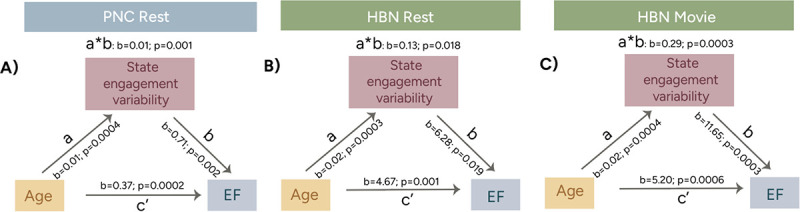
Neural variability, or variation in brain signals, facilitates dynamic brain responses to ongoing demands. This flexibility is important during development from childhood to young adulthood, a period characterized by rapid changes in experience. However, little is known about how variability in the engagement of recurring brain states changes during development. Such investigations would require the continuous assessment of multiple brain states concurrently. Here, we leverage a new computational framework to study state engagement variability (SEV) during development. A consistent pattern of SEV changing with age was identified across cross-sectional and longitudinal datasets (N>3000). SEV developmental trajectories stabilize around mid-adolescence, with timing varying by sex and brain state. SEV successfully predicts executive function (EF) in youths from an independent dataset. Worse EF is further linked to alterations in SEV development. These converging findings suggest SEV changes over development, allowing individuals to flexibly recruit various brain states to meet evolving needs.
神经变异性,即大脑信号的变化,有助于大脑对持续需求做出动态反应。这种灵活性在从童年到青年期的发育过程中很重要,这一时期的特点是经历快速变化。然而,对于反复出现的大脑状态的参与度变异性在发育过程中如何变化,我们知之甚少。此类研究需要同时对多种大脑状态进行持续评估。在此,我们利用一个新的计算框架来研究发育过程中的状态参与变异性(SEV)。在横断面和纵向数据集中(N>3000),我们确定了一种随年龄变化的SEV一致模式。SEV发育轨迹在青春期中期左右稳定下来,其时间因性别和大脑状态而异。SEV成功预测了来自独立数据集的青少年的执行功能(EF)。较差的EF进一步与SEV发育的改变有关。这些趋同的发现表明,SEV在发育过程中发生变化,使个体能够灵活地调用各种大脑状态以满足不断变化的需求。