Department of Genetics, Washington University School of Medicine in St. Louis, St. Louis, Missouri 63110, USA.
Edison Family Center for Genome Sciences and Systems Biology, Washington University School of Medicine in St. Louis, St. Louis, Missouri 63110, USA.
Genome Res. 2024 Oct 29;34(10):1540-1552. doi: 10.1101/gr.279415.124.
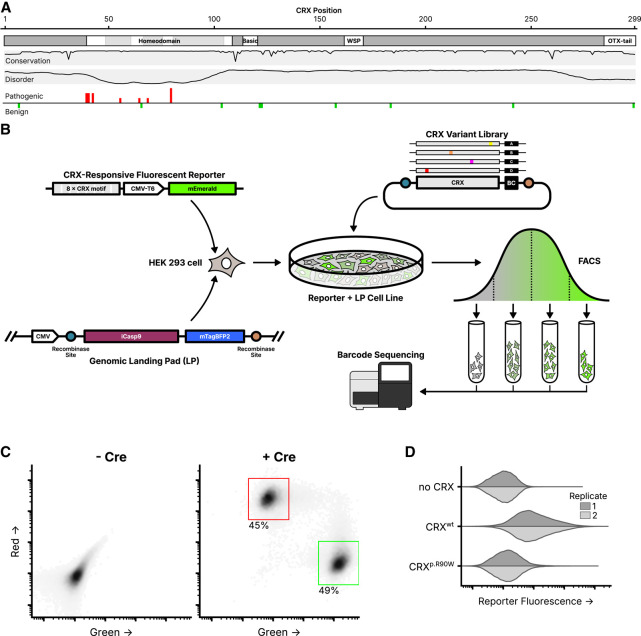
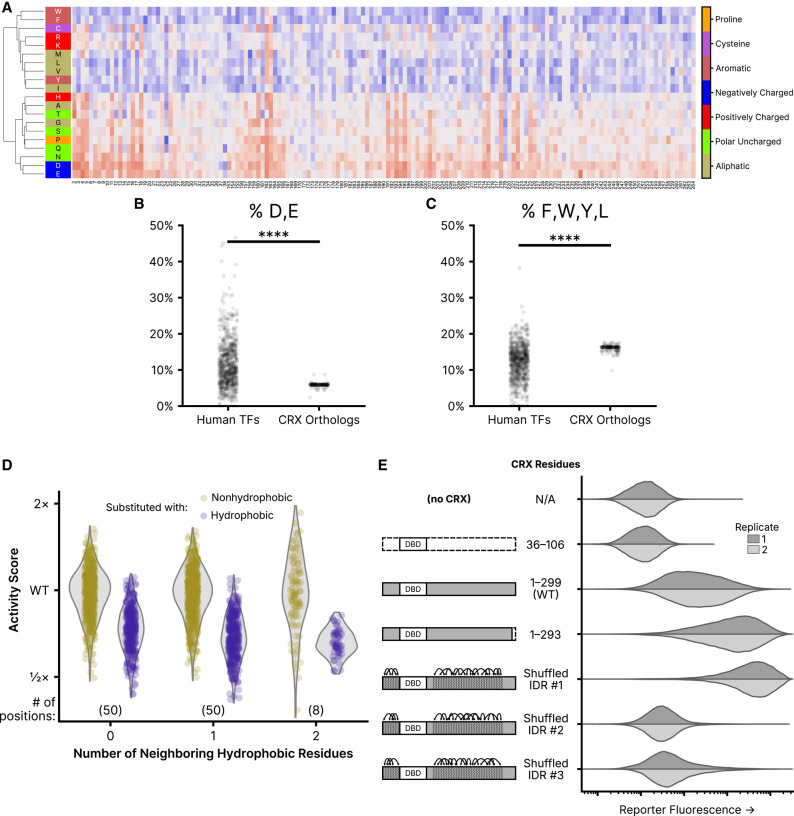
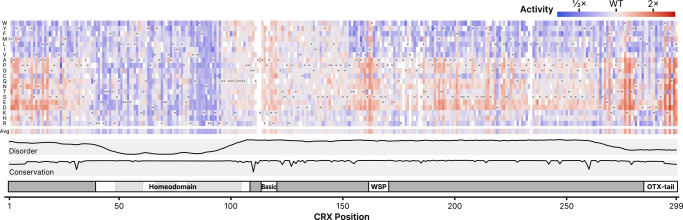
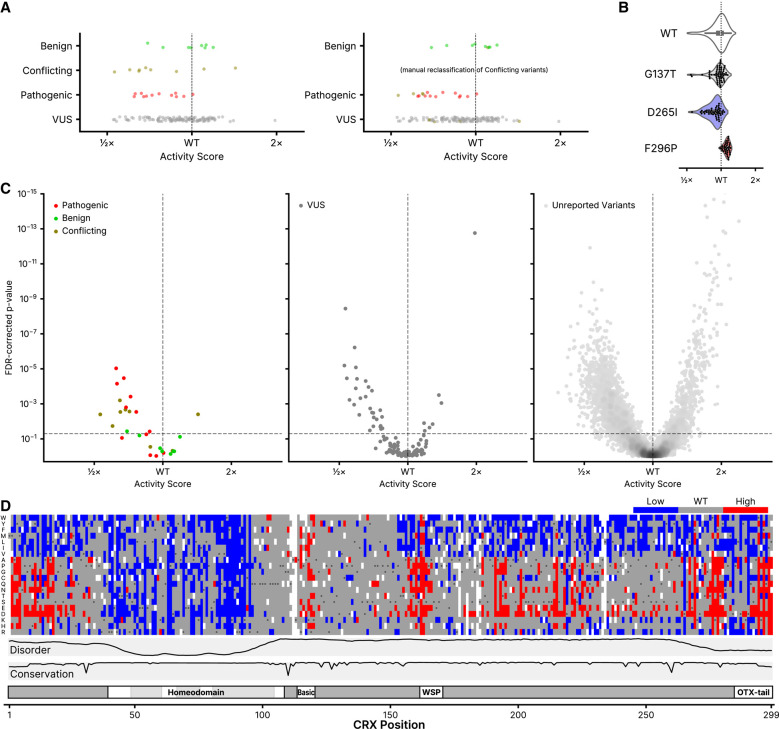
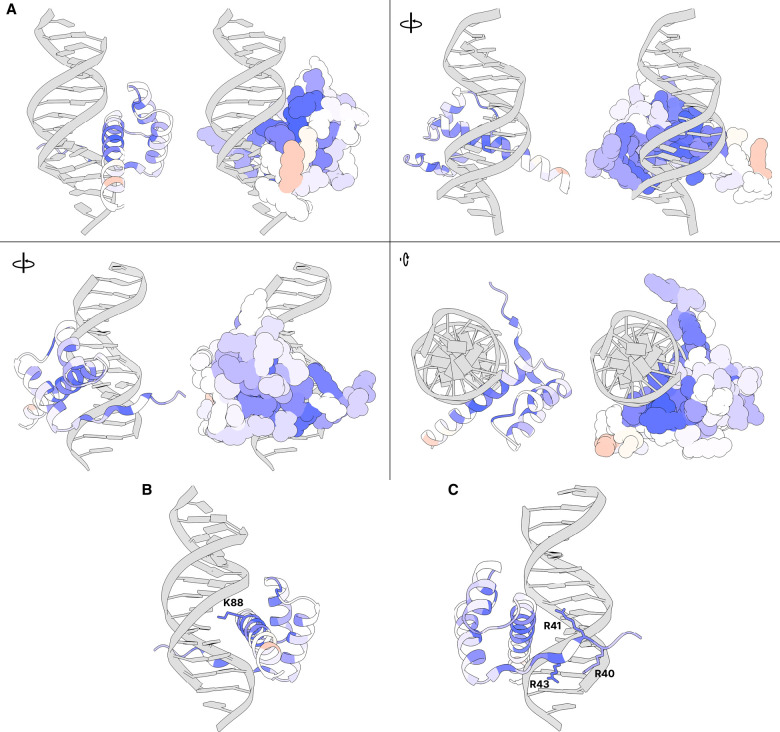
The transcription factor (TF) cone-rod homeobox (CRX) is essential for the differentiation and maintenance of photoreceptor cell identity. Several human variants cause degenerative retinopathies, but most are variants of uncertain significance. We performed a deep mutational scan (DMS) of nearly all possible single amino acid substitutions in CRX using a cell-based transcriptional reporter assay, curating a high-confidence list of nearly 2000 variants with altered transcriptional activity. In the structured homeodomain, activity scores closely aligned to a predicted structure and demonstrated position-specific constraints on amino acid substitution. In contrast, the intrinsically disordered transcriptional effector domain displayed a qualitatively different pattern of substitution effects, following compositional constraints without specific residue position requirements in the peptide chain. These compositional constraints were consistent with the acidic exposure model of transcriptional activation. We evaluated the performance of the DMS assay as a clinical variant classification tool using gold-standard classified human variants from ClinVar, identifying pathogenic variants with high specificity and moderate sensitivity. That this performance could be achieved using a synthetic reporter assay in a foreign cell type, even for a highly cell type-specific TF like CRX, suggests that this approach shows promise for DMS of other TFs that function in cell types that are not easily accessible. Together, the results of the DMS identify molecular features of the CRX effector domain and demonstrate utility for integration into the clinical variant classification pipeline.
转录因子(TF)cone-rod 同源盒(CRX)对于光感受器细胞身份的分化和维持至关重要。几种人类变异导致退行性视网膜病变,但大多数是意义不明的变异。我们使用基于细胞的转录报告基因检测,对 CRX 中几乎所有可能的单个氨基酸取代进行了深度突变扫描(DMS),精心整理了近 2000 种具有改变转录活性的高可信度变体列表。在结构同源域中,活性评分与预测结构紧密一致,并证明了氨基酸取代的位置特异性限制。相比之下,内在无序的转录效应子域显示出替代效应的定性不同模式,遵循组成限制,而肽链中没有特定残基位置要求。这些组成限制与转录激活的酸性暴露模型一致。我们使用 ClinVar 中的黄金标准分类人类变体评估了 DMS 检测作为临床变异分类工具的性能,该检测具有高特异性和中等敏感性的致病性变体。即使对于像 CRX 这样高度细胞类型特异性的 TF,这种性能也可以使用合成报告基因检测在外国细胞类型中实现,这表明这种方法有望用于 DMS 其他在不易获得的细胞类型中发挥作用的 TF。总之,DMS 的结果确定了 CRX 效应子域的分子特征,并证明了将其集成到临床变异分类管道中的实用性。