Mirgh Divya, Sonar Swarup, Ghosh Srestha, Adhikari Manab Deb, Subramaniyan Vetriselvan, Gorai Sukhamoy, Anand Krishnan
Vaccine and Immunotherapy Centre, Massachusetts General Hospital Boston USA
Center for Global Health Research, Saveetha Medical College & Hospitals, Saveetha Institute of Medical and Technical Sciences Chennai Tamil Nadu 602105 India
RSC Adv. 2024 Sep 26;14(42):30807-30829. doi: 10.1039/d4ra04512b. eCollection 2024 Sep 24.
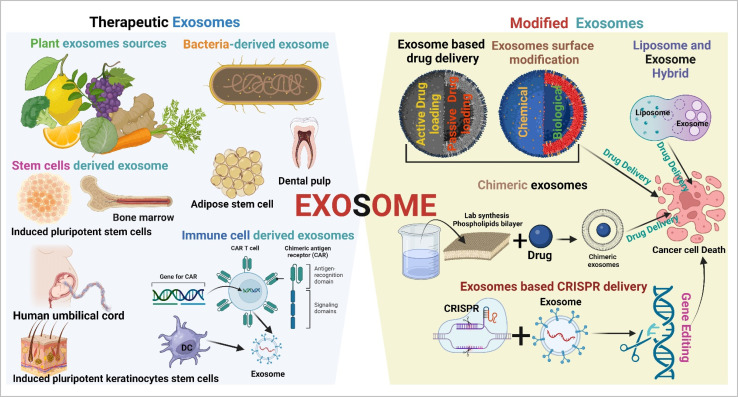
Exosomes are a subpopulation of extracellular vesicles (EVs) that naturally originate from endosomes. They play a significant role in cellular communication. Tumor-secreted exosomes play a crucial role in cancer development and significantly contribute to tumorigenesis, angiogenesis, and metastasis by intracellular communication. Tumor-derived exosomes (TEXs) are a promising biomarker source of cancer detection in the early stages. On the other hand, they offer revolutionary cutting-edge approaches to cancer therapeutics. Exosomes offer a cell-free approach to cancer therapeutics, which overcomes immune cell and stem cell therapeutics-based limitations (complication, toxicity, and cost of treatment). There are multiple sources of therapeutic exosomes present (stem cells, immune cells, plant cells, and synthetic and modified exosomes). This article explores the dynamic source of exosomes (plants, mesenchymal stem cells, and immune cells) and their modification (chimeric, hybrid exosomes, exosome-based CRISPR, and drug delivery) based on cancer therapeutic development. This review also highlights exosomes based clinical trials and the challenges and future orientation of exosome research. We hope that this article will inspire researchers to further explore exosome-based cancer therapeutic platforms for precision oncology.
外泌体是细胞外囊泡(EVs)的一个亚群,天然起源于内体。它们在细胞通讯中发挥着重要作用。肿瘤分泌的外泌体在癌症发展中起关键作用,并通过细胞内通讯对肿瘤发生、血管生成和转移有显著贡献。肿瘤来源的外泌体(TEXs)是早期癌症检测中有前景的生物标志物来源。另一方面,它们为癌症治疗提供了革命性的前沿方法。外泌体为癌症治疗提供了一种无细胞方法,克服了基于免疫细胞和干细胞治疗的局限性(并发症、毒性和治疗成本)。存在多种治疗性外泌体来源(干细胞、免疫细胞、植物细胞以及合成和修饰的外泌体)。本文基于癌症治疗发展,探讨外泌体的动态来源(植物、间充质干细胞和免疫细胞)及其修饰(嵌合、杂交外泌体、基于外泌体的CRISPR和药物递送)。本综述还强调了基于外泌体的临床试验以及外泌体研究的挑战和未来方向。我们希望本文能激励研究人员进一步探索基于外泌体的癌症治疗平台,以实现精准肿瘤学。