Pogorelyy Mikhail V, Kirk Allison M, Adhikari Samir, Minervina Anastasia A, Sundararaman Balaji, Vegesana Kasi, Brice David C, Scott Zachary B, Thomas Paul G
St. Jude Children's Research Hospital, Memphis, TN, USA.
bioRxiv. 2024 Oct 31:2024.09.16.613345. doi: 10.1101/2024.09.16.613345.
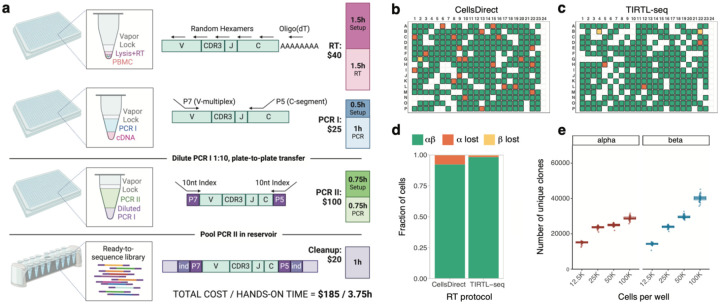
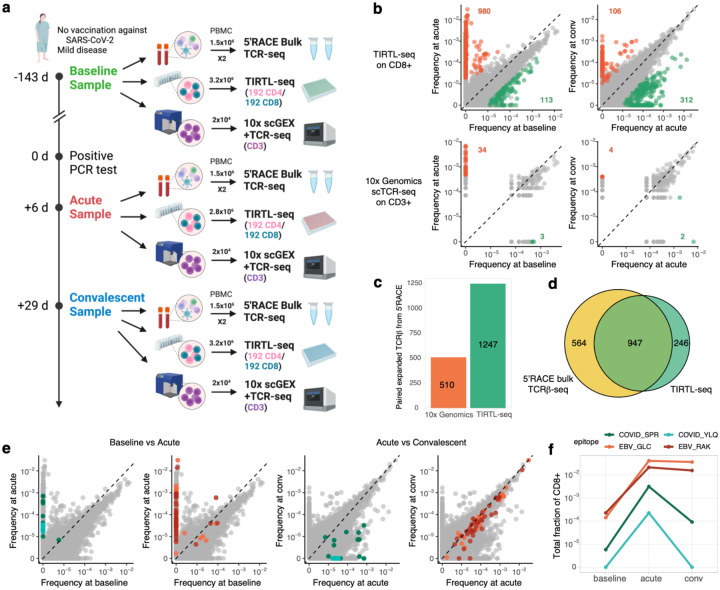
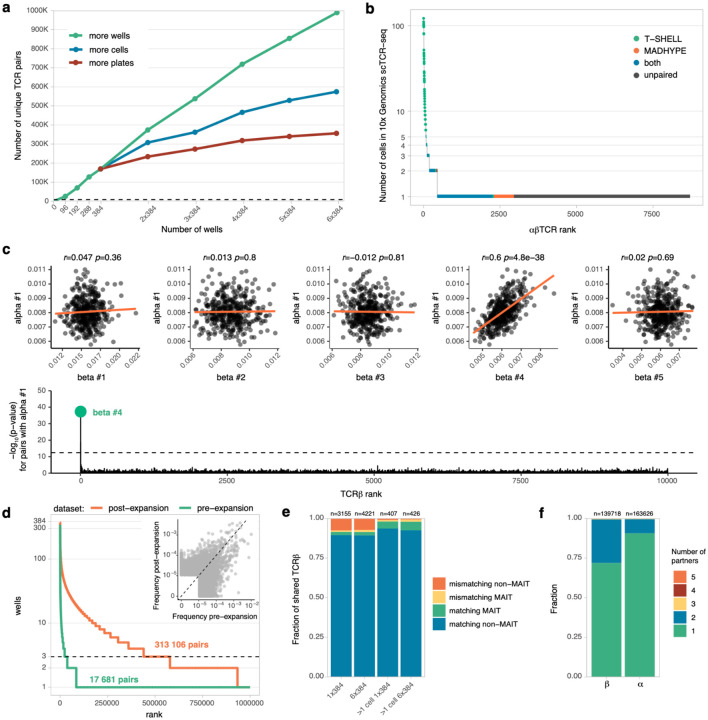
ɑ/β T cells are key players in adaptive immunity. The specificity of T cells is determined by the sequences of the hypervariable T cell receptor (TCR) ɑ and β chains. Although bulk TCR sequencing offers a cost-effective approach for in-depth TCR repertoire profiling, it does not provide chain pairings, which are essential for determining T cell specificity. In contrast, single-cell TCR sequencing technologies produce paired chain data, but are limited in throughput to thousands of cells and are cost-prohibitive for cohort-scale studies. Here, we present hroughput-ntensive apid CR ibrary uencing, a novel approach that generates ready-to-sequence TCR libraries from live cells in less than 7 hours. The protocol is optimized for use with non-contact liquid handlers in an automation-friendly 384-well plate format. Reaction volume miniaturization reduces library preparation costs to <$0.50 per well. The core principle of TIRTL-seq is the parallel generation of hundreds of libraries providing multiple biological replicates from a single sample that allows precise inference of both frequencies of individual clones and TCR chain pairings from well-occurrence patterns. We demonstrate scalability of our approach up to 1 million unique paired αβTCR clonotypes corresponding to over 30 million T cells per sample at a cost of less than $2000. For a sample of 10 million cells the cost is ~$200. We benchmarked TIRTL-seq against state-of-the-art 5'RACE bulk TCR-seq and 10x Genomics Chromium technologies on longitudinal samples. We show that TIRTL-seq is able to quantitatively identify expanding and contracting clonotypes between timepoints while providing accurate TCR chain pairings, including distinct temporal dynamics of SARS-CoV-2-specific and EBV-specific CD8+ T cell responses after infection. While clonal expansion was followed by sharp contraction for SARS-CoV-2 specific TCRs, EBV-specific TCRs remained stable once established. The sequences of both ɑ and β TCR chains are essential for determining T cell specificity. As the field moves towards greater applications in diagnostics and immunotherapy that rely on TCR specificity, we anticipate that our scalable paired TCR sequencing methodology will be instrumental for collecting large paired-chain datasets and ultimately extracting therapeutically relevant information from the TCR repertoire.
α/β T细胞是适应性免疫中的关键角色。T细胞的特异性由高变T细胞受体(TCR)α和β链的序列决定。尽管批量TCR测序为深入分析TCR库提供了一种经济高效的方法,但它无法提供链配对信息,而链配对对于确定T细胞特异性至关重要。相比之下,单细胞TCR测序技术可产生配对链数据,但通量仅限于数千个细胞,且对于队列规模研究而言成本过高。在此,我们介绍高通量密集型快速CR文库测序,这是一种新颖的方法,可在不到7小时的时间内从活细胞生成可直接测序的TCR文库。该方案针对在自动化友好的384孔板格式中与非接触式液体处理仪配合使用进行了优化。反应体积的小型化将文库制备成本降低至每孔<$0.50。TIRTL-seq的核心原理是并行生成数百个文库,从单个样本提供多个生物学重复,从而允许根据出现模式精确推断单个克隆的频率和TCR链配对。我们展示了我们的方法可扩展性高达100万个独特的配对αβTCR克隆型,对应于每个样本超过3000万个T细胞,成本低于2000美元。对于1000万个细胞的样本,成本约为200美元。我们在纵向样本上对TIRTL-seq与最先进的5'RACE批量TCR-seq和10x Genomics Chromium技术进行了基准测试。我们表明,TIRTL-seq能够在提供准确的TCR链配对的同时,定量识别不同时间点之间扩增和收缩的克隆型,包括感染后SARS-CoV-2特异性和EBV特异性CD8 + T细胞反应的独特时间动态。虽然SARS-CoV-2特异性TCR的克隆扩增后紧接着急剧收缩,但EBV特异性TCR一旦建立就保持稳定。α和β TCR链的序列对于确定T细胞特异性都至关重要。随着该领域在依赖TCR特异性的诊断和免疫治疗中的应用越来越多,我们预计我们可扩展的配对TCR测序方法将有助于收集大型配对链数据集,并最终从TCR库中提取与治疗相关的信息。