Feng Fengliu, Ma Yuxia, Qin Pengpeng, Zhao Yuhan, Liu Zongrui, Wang Wanci, Cheng Bowen
Key Laboratory of Semi-Arid Climate Change College of Atmospheric Sciences Ministry of Education Lanzhou University Lanzhou China.
Geohealth. 2024 Sep 27;8(10):e2024GH001059. doi: 10.1029/2024GH001059. eCollection 2024 Oct.
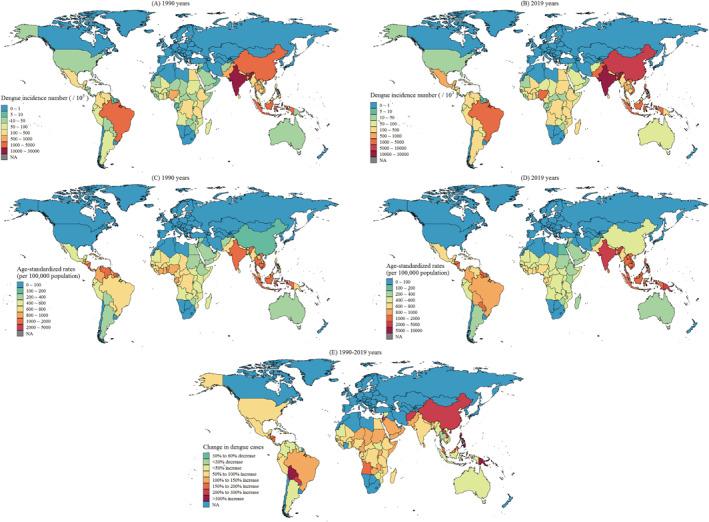
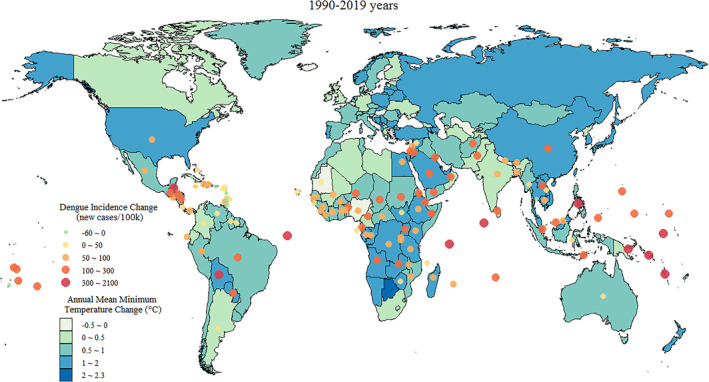
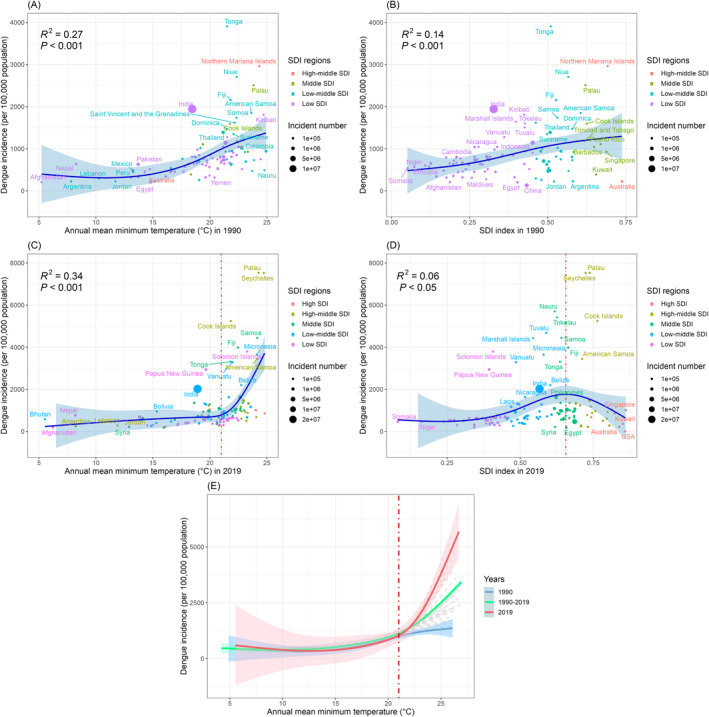
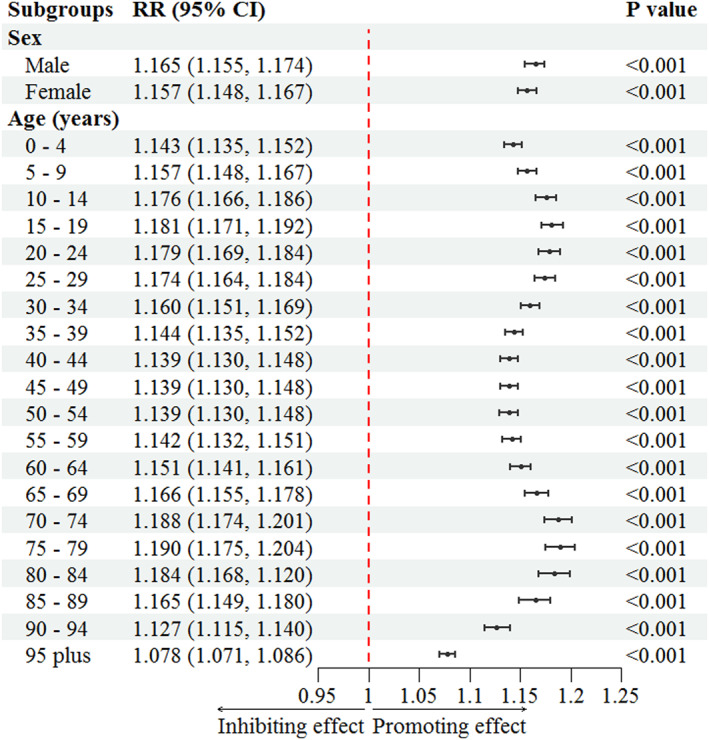
Dengue is a rapidly spreading mosquito-borne infectious disease that is sensitive to climate factors and poses a major public health concern worldwide. We analyzed dengue incidence trends and the relationship between annual mean minimum temperatures (AMMTs) and dengue incidence rates from 1990 to 2019 in 122 countries using the Global Burden of Disease and TerraClimate data sets. We also projected global dengue incidence rates under different carbon emission scenarios using temperature data from the Coupled Model Intercomparison Project Phase 6 (CMIP6) data set. Our results reveal a significant increase in global dengue cases from 1990 to 2019 and a positive correlation between temperature and dengue incidence. The association between AMMT and dengue incidence strengthened at temperatures exceeding 21°C. Central and eastern sub-Saharan Africa, as well as Oceania, were identified as the regions most sensitive to dengue; males and individuals aged 15-19 or 70-84 years were the most susceptible to dengue under rising temperatures. Our projections suggest that global dengue incidence will substantially increase by 2050 and 2100. By 2100, regions including Africa, the Arabian Peninsula, the southern United States, southern China, and island countries in the Pacific and Indian Oceans are projected to become year-round dengue-endemic under a high-emission climate scenario. Our findings underscore the importance of implementing effective measures to mitigate the impact of climate change on dengue transmission. Identifying high-risk areas and susceptible populations, along with understanding the projected expansion of dengue-endemic regions, will provide valuable guidance for targeted interventions to address this growing global health challenge in the face of changing climatic conditions.
登革热是一种迅速传播的蚊媒传染病,对气候因素敏感,在全球范围内构成重大公共卫生问题。我们利用全球疾病负担和TerraClimate数据集,分析了1990年至2019年122个国家的登革热发病率趋势以及年平均最低温度(AMMT)与登革热发病率之间的关系。我们还使用耦合模式比较计划第6阶段(CMIP6)数据集的温度数据,预测了不同碳排放情景下的全球登革热发病率。我们的结果显示,1990年至2019年全球登革热病例显著增加,且温度与登革热发病率呈正相关。当温度超过21°C时,AMMT与登革热发病率之间的关联增强。撒哈拉以南非洲中部和东部以及大洋洲被确定为对登革热最敏感的地区;在气温上升的情况下,男性以及15 - 19岁或70 - 84岁的个体最易感染登革热。我们的预测表明,到2050年和2100年全球登革热发病率将大幅上升。到2100年,在高排放气候情景下,包括非洲、阿拉伯半岛、美国南部、中国南部以及太平洋和印度洋岛国在内的地区预计将全年流行登革热。我们的研究结果强调了采取有效措施减轻气候变化对登革热传播影响的重要性。识别高风险地区和易感人群,以及了解登革热流行地区预计的扩张情况,将为在气候变化背景下应对这一日益严峻的全球健康挑战的针对性干预措施提供有价值的指导。