Tung Wei Shao, Baker Riley, Toy Kendal, Eftekhari Mani, Casey George, Jahani Rana, Bono Christopher, Harteveld Casper, Bejarano-Pineda Lorena, Ashkani-Esfahani Soheil
Department of Orthopaedics, Massachusetts General Hospital, Harvard Medical School, Boston, USA.
Foot and Ankle Research and Innovation Laboratory, Massachusetts General Hospital, Harvard Medical School, Boston, USA.
Cureus. 2024 Aug 30;16(8):e68234. doi: 10.7759/cureus.68234. eCollection 2024 Aug.
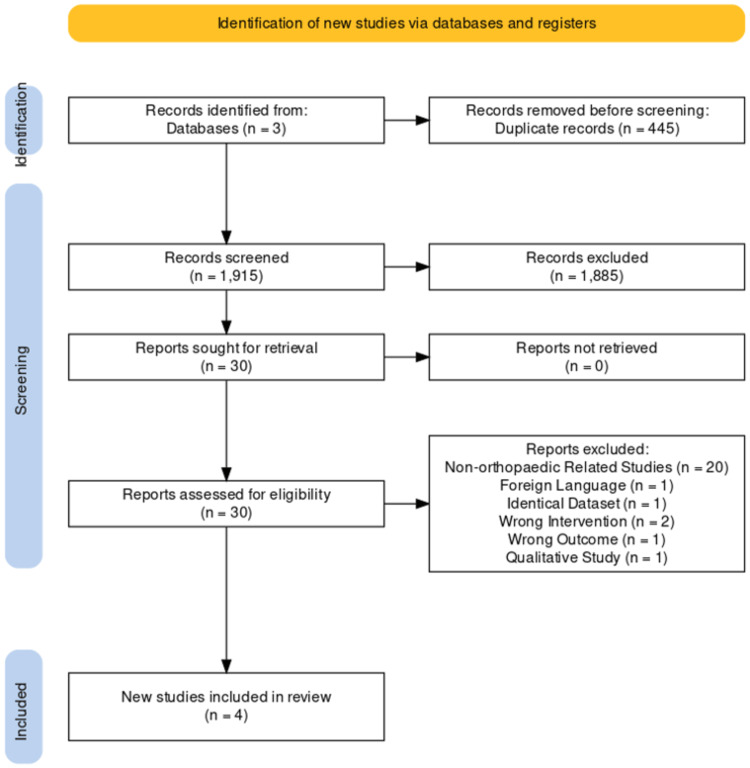
Gamification and serious games have successfully been used in surgical specialties to improve technical skills related to systematic procedures. However, the use of gamified education material has remained limited in orthopedic residency training. The objective of this systematic review is to summarize the current use, development, and future directions of gamification for developing orthopedic skills. A comprehensive literature search was performed on Ovid MEDLINE, Web of Science, and Scopus between January 1, 2012, and the search date of July 1, 2023. After screening 1,915 papers, a total of four publications that utilized elements of gamification in acquiring and/or improving orthopedic skills were included. Three studies showed a positive correlation between video gaming experience and orthopedic skill performance, acquisition, or both. One study showed a positive response from residents when training sessions were hosted in a competitive, but friendly environment with direct observation from their attendings. Gamified learning has the potential to improve orthopedic education, but its current use is largely unexplored. A competitive or rewarding environment promotes engagement and active learning. To enable the highest and most efficient level of training, future development should be geared toward virtual reality simulators that incorporate haptic feedback to better simulate other orthopedic-based tasks.
游戏化和严肃游戏已成功应用于外科专业,以提高与系统程序相关的技术技能。然而,在骨科住院医师培训中,游戏化教育材料的使用仍然有限。本系统评价的目的是总结游戏化在培养骨科技能方面的当前应用、发展情况及未来方向。于2012年1月1日至2023年7月1日检索日期期间,在Ovid MEDLINE、科学网和Scopus上进行了全面的文献检索。在筛选了1915篇论文后,共纳入了4篇利用游戏化元素来获取和/或提高骨科技能的出版物。三项研究表明,电子游戏体验与骨科技能表现、技能习得或两者之间存在正相关。一项研究表明,当培训课程在具有竞争性但友好的环境中进行,并由主治医生直接观察时,住院医师会有积极的反应。游戏化学习有改善骨科教育的潜力,但其目前的应用在很大程度上尚未得到探索。竞争性或奖励性环境可促进参与和主动学习。为了实现最高效的培训水平,未来的发展应朝着结合触觉反馈以更好地模拟其他基于骨科的任务的虚拟现实模拟器方向发展。