• 文献检索
  • 文档翻译
  • 深度研究
  • 学术资讯
  • Suppr Zotero 插件Zotero 插件
  • 邀请有礼
  • 套餐&价格
  • 历史记录
应用&插件
Suppr Zotero 插件Zotero 插件浏览器插件Mac 客户端Windows 客户端微信小程序
定价
高级版会员购买积分包购买API积分包
服务
文献检索文档翻译深度研究API 文档MCP 服务
关于我们
关于 Suppr公司介绍联系我们用户协议隐私条款
关注我们

Suppr 超能文献

核心技术专利:CN118964589B侵权必究
粤ICP备2023148730 号-1Suppr @ 2026

文献检索

告别复杂PubMed语法,用中文像聊天一样搜索,搜遍4000万医学文献。AI智能推荐,让科研检索更轻松。

立即免费搜索

文件翻译

保留排版,准确专业,支持PDF/Word/PPT等文件格式,支持 12+语言互译。

免费翻译文档

深度研究

AI帮你快速写综述,25分钟生成高质量综述,智能提取关键信息,辅助科研写作。

立即免费体验

在综合性医疗保健系统中识别不同人群中心脏瓣膜狭窄和反流的严重程度:自然语言处理方法。

Identifying the Severity of Heart Valve Stenosis and Regurgitation Among a Diverse Population Within an Integrated Health Care System: Natural Language Processing Approach.

机构信息

Department of Research and Evaluation, Kaiser Permanente Southern California, Pasadena, CA, United States.

Department of Cardiology, Los Angeles Medical Center, Kaiser Permanente Southern California, Pasadena, CA, United States.

出版信息

JMIR Cardio. 2024 Sep 30;8:e60503. doi: 10.2196/60503.

DOI:10.2196/60503
PMID:39348175
原文链接:https://pmc.ncbi.nlm.nih.gov/articles/PMC11474122/
Abstract

BACKGROUND

Valvular heart disease (VHD) is a leading cause of cardiovascular morbidity and mortality that poses a substantial health care and economic burden on health care systems. Administrative diagnostic codes for ascertaining VHD diagnosis are incomplete.

OBJECTIVE

This study aimed to develop a natural language processing (NLP) algorithm to identify patients with aortic, mitral, tricuspid, and pulmonic valve stenosis and regurgitation from transthoracic echocardiography (TTE) reports within a large integrated health care system.

METHODS

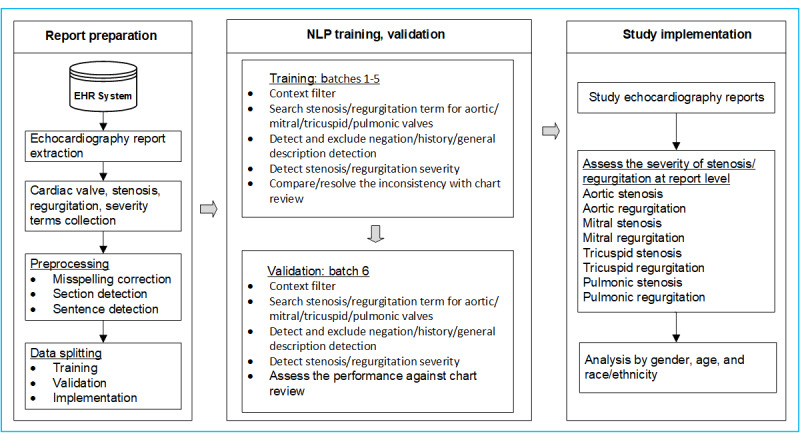
We used reports from echocardiograms performed in the Kaiser Permanente Southern California (KPSC) health care system between January 1, 2011, and December 31, 2022. Related terms/phrases of aortic, mitral, tricuspid, and pulmonic stenosis and regurgitation and their severities were compiled from the literature and enriched with input from clinicians. An NLP algorithm was iteratively developed and fine-trained via multiple rounds of chart review, followed by adjudication. The developed algorithm was applied to 200 annotated echocardiography reports to assess its performance and then the study echocardiography reports.

RESULTS

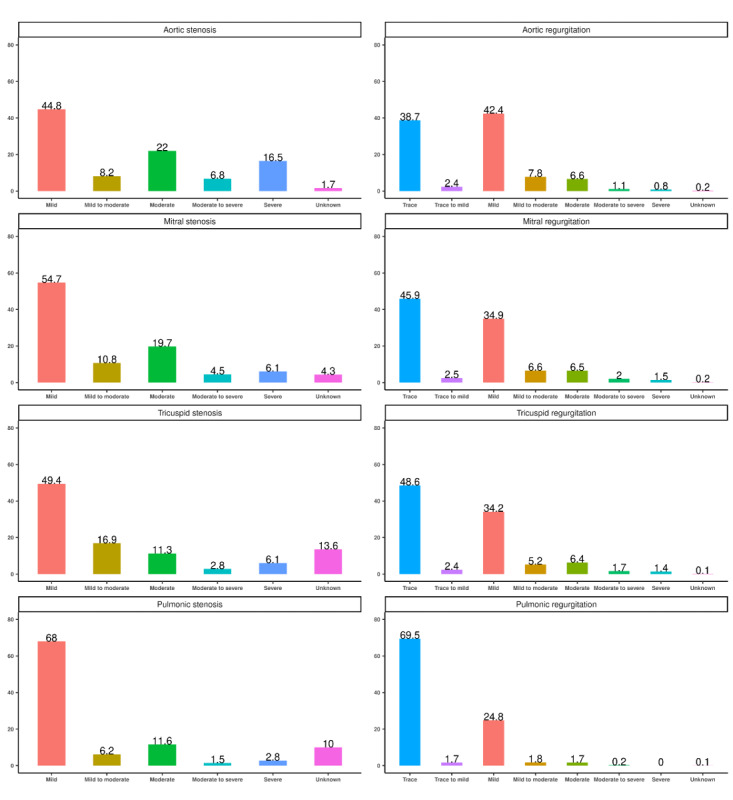
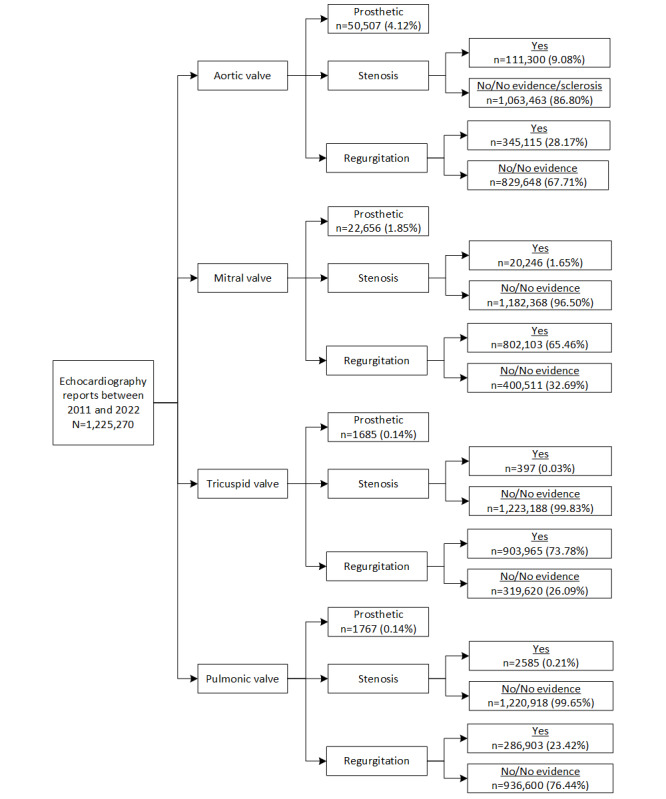
A total of 1,225,270 TTE reports were extracted from KPSC electronic health records during the study period. In these reports, valve lesions identified included 111,300 (9.08%) aortic stenosis, 20,246 (1.65%) mitral stenosis, 397 (0.03%) tricuspid stenosis, 2585 (0.21%) pulmonic stenosis, 345,115 (28.17%) aortic regurgitation, 802,103 (65.46%) mitral regurgitation, 903,965 (73.78%) tricuspid regurgitation, and 286,903 (23.42%) pulmonic regurgitation. Among the valves, 50,507 (4.12%), 22,656 (1.85%), 1685 (0.14%), and 1767 (0.14%) were identified as prosthetic aortic valves, mitral valves, tricuspid valves, and pulmonic valves, respectively. Mild and moderate were the most common severity levels of heart valve stenosis, while trace and mild were the most common severity levels of regurgitation. Males had a higher frequency of aortic stenosis and all 4 valvular regurgitations, while females had more mitral, tricuspid, and pulmonic stenosis. Non-Hispanic Whites had the highest frequency of all 4 valvular stenosis and regurgitations. The distribution of valvular stenosis and regurgitation severity was similar across race/ethnicity groups. Frequencies of aortic stenosis, mitral stenosis, and regurgitation of all 4 heart valves increased with age. In TTE reports with stenosis detected, younger patients were more likely to have mild aortic stenosis, while older patients were more likely to have severe aortic stenosis. However, mitral stenosis was opposite (milder in older patients and more severe in younger patients). In TTE reports with regurgitation detected, younger patients had a higher frequency of severe/very severe aortic regurgitation. In comparison, older patients had higher frequencies of mild aortic regurgitation and severe mitral/tricuspid regurgitation. Validation of the NLP algorithm against the 200 annotated TTE reports showed excellent precision, recall, and F1-scores.

CONCLUSIONS

The proposed computerized algorithm could effectively identify heart valve stenosis and regurgitation, as well as the severity of valvular involvement, with significant implications for pharmacoepidemiological studies and outcomes research.
https://cdn.ncbi.nlm.nih.gov/pmc/blobs/b842/11474122/0531582846df/cardio_v8i1e60503_fig3.jpg
https://cdn.ncbi.nlm.nih.gov/pmc/blobs/b842/11474122/06d29163d21a/cardio_v8i1e60503_fig1.jpg
https://cdn.ncbi.nlm.nih.gov/pmc/blobs/b842/11474122/66bc14ead3ce/cardio_v8i1e60503_fig2.jpg
https://cdn.ncbi.nlm.nih.gov/pmc/blobs/b842/11474122/0531582846df/cardio_v8i1e60503_fig3.jpg
https://cdn.ncbi.nlm.nih.gov/pmc/blobs/b842/11474122/06d29163d21a/cardio_v8i1e60503_fig1.jpg
https://cdn.ncbi.nlm.nih.gov/pmc/blobs/b842/11474122/66bc14ead3ce/cardio_v8i1e60503_fig2.jpg
https://cdn.ncbi.nlm.nih.gov/pmc/blobs/b842/11474122/0531582846df/cardio_v8i1e60503_fig3.jpg
摘要

背景

瓣膜性心脏病(VHD)是导致心血管发病率和死亡率的主要原因,给医疗保健系统带来了巨大的医疗和经济负担。确定 VHD 诊断的行政诊断代码并不完整。

目的

本研究旨在开发一种自然语言处理(NLP)算法,以识别大型综合医疗保健系统中经胸超声心动图(TTE)报告中的主动脉瓣、二尖瓣、三尖瓣和肺动脉瓣狭窄和反流患者。

方法

我们使用了 2011 年 1 月 1 日至 2022 年 12 月 31 日期间在 Kaiser Permanente Southern California(KPSC)医疗保健系统进行的超声心动图报告。主动脉瓣、二尖瓣、三尖瓣和肺动脉瓣狭窄和反流及其严重程度的相关术语/短语是从文献中编译的,并通过临床医生的输入进行了丰富。通过多次图表审查和裁决,迭代开发和精细训练了 NLP 算法。该开发的算法应用于 200 份标注的超声心动图报告,以评估其性能,然后应用于研究超声心动图报告。

结果

在研究期间,从 KPSC 电子健康记录中提取了 1225270 份 TTE 报告。在这些报告中,确定的瓣膜病变包括 111300 例(9.08%)主动脉瓣狭窄、20246 例(1.65%)二尖瓣狭窄、397 例(0.03%)三尖瓣狭窄、2585 例(0.21%)肺动脉瓣狭窄、345115 例(28.17%)主动脉瓣反流、802103 例(65.46%)二尖瓣反流、903965 例(73.78%)三尖瓣反流和 286903 例(23.42%)肺动脉瓣反流。在这些瓣膜中,50507 例(4.12%)、22656 例(1.85%)、1685 例(0.14%)和 1767 例(0.14%)分别被鉴定为人工主动脉瓣、二尖瓣、三尖瓣和肺动脉瓣。心脏瓣膜狭窄的最常见严重程度级别是轻度和中度,而反流的最常见严重程度级别是微量和轻度。男性主动脉瓣狭窄和所有 4 种瓣膜反流的发生率较高,而女性二尖瓣、三尖瓣和肺动脉瓣狭窄的发生率较高。非西班牙裔白人的所有 4 种瓣膜狭窄和反流的发生率最高。瓣膜狭窄和反流严重程度的分布在种族/族裔群体中相似。主动脉瓣狭窄、二尖瓣狭窄和所有 4 种心脏瓣膜反流的严重程度随着年龄的增长而增加。在检测到狭窄的 TTE 报告中,年轻患者更可能患有轻度主动脉瓣狭窄,而年龄较大的患者更可能患有严重的主动脉瓣狭窄。然而,二尖瓣狭窄则相反(年龄较大的患者较轻,年龄较小的患者较重)。在检测到反流的 TTE 报告中,年轻患者主动脉瓣反流严重/非常严重的频率较高。相比之下,年龄较大的患者主动脉瓣反流轻度和二尖瓣/三尖瓣反流严重的频率较高。该 NLP 算法与 200 份标注的 TTE 报告的验证结果显示出优异的精度、召回率和 F1 评分。

结论

该计算机算法可有效识别心脏瓣膜狭窄和反流以及瓣膜受累的严重程度,对药物流行病学研究和结果研究具有重要意义。

相似文献

1
Identifying the Severity of Heart Valve Stenosis and Regurgitation Among a Diverse Population Within an Integrated Health Care System: Natural Language Processing Approach.在综合性医疗保健系统中识别不同人群中心脏瓣膜狭窄和反流的严重程度:自然语言处理方法。
JMIR Cardio. 2024 Sep 30;8:e60503. doi: 10.2196/60503.
2
Echocardiographic assessment of mitral stenosis and its associated valvular lesions in 205 patients and lack of association with mitral valve prolapse.205例二尖瓣狭窄及其相关瓣膜病变的超声心动图评估以及与二尖瓣脱垂的无关性
J Am Soc Echocardiogr. 1997 Mar;10(2):141-8. doi: 10.1016/s0894-7317(97)70086-5.
3
[Clinical characteristics of patients with moderate or severe valvular heart disease].[中重度瓣膜性心脏病患者的临床特征]
Zhonghua Xin Xue Guan Bing Za Zhi. 2024 Oct 24;52(10):1200-1206. doi: 10.3760/cma.j.cn112148-20230816-00082.
4
'Color Doppler stripes' make it difficult to diagnose the severity of valvular heart diseases: a report of two cases.“彩色多普勒条纹”使瓣膜性心脏病的严重程度难以诊断:两例报告。
Cardiovasc Ultrasound. 2024 Oct 7;22(1):12. doi: 10.1186/s12947-024-00331-1.
5
Tricuspid regurgitation: Frequency, clinical presentation, management and outcome among patients with severe left-sided valvular heart disease in Europe. Insights from the ESC-EORP Valvular Heart Disease II survey.三尖瓣反流:欧洲重度左侧瓣膜性心脏病患者的发生率、临床表现、管理及预后。欧洲心脏病学会-欧洲注册瓣膜性心脏病II调查的见解
Eur J Heart Fail. 2024 Apr;26(4):994-1003. doi: 10.1002/ejhf.3157. Epub 2024 Feb 19.
6
[The best of valvular heart disease in 2006].[2006年心脏瓣膜病研究精粹]
Arch Mal Coeur Vaiss. 2007 Jan;100 Spec No 1:19-28.
7
Comprehensive Nursing Management for Valvular Disease.瓣膜病的综合护理管理
Crit Care Nurs Clin North Am. 2019 Mar;31(1):31-38. doi: 10.1016/j.cnc.2018.11.002. Epub 2018 Dec 22.
8
Comparison of cardiac computed tomographic angiography to transesophageal echocardiography for evaluation of patients with native valvular heart disease.心脏计算机断层血管造影术与经食管超声心动图在评估原发性瓣膜性心脏病患者中的比较。
Am J Cardiol. 2009 Nov 15;104(10):1421-8. doi: 10.1016/j.amjcard.2009.06.066. Epub 2009 Sep 26.
9
Impact of selective serotonin reuptake inhibitor therapy on heart valves in patients exposed to benfluorex: a multicentre study.暴露于苯氟雷司的患者中选择性 5-羟色胺再摄取抑制剂治疗对心瓣膜的影响:一项多中心研究。
Arch Cardiovasc Dis. 2013 Jun-Jul;106(6-7):349-56. doi: 10.1016/j.acvd.2013.04.006. Epub 2013 May 31.
10
Heart valve involvement in Fabry cardiomyopathy.法布里心肌病中的心脏瓣膜受累
Ultrasound Med Biol. 2009 May;35(5):730-5. doi: 10.1016/j.ultrasmedbio.2008.10.010. Epub 2008 Dec 24.

本文引用的文献

1
Harnessing the power of artificial intelligence in predicting all-cause mortality in transcatheter aortic valve replacement: a systematic review and meta-analysis.利用人工智能预测经导管主动脉瓣置换术全因死亡率:一项系统评价和荟萃分析。
Front Cardiovasc Med. 2024 May 31;11:1343210. doi: 10.3389/fcvm.2024.1343210. eCollection 2024.
2
BERT-Based Neural Network for Inpatient Fall Detection From Electronic Medical Records: Retrospective Cohort Study.基于BERT的神经网络用于从电子病历中检测住院患者跌倒:回顾性队列研究
JMIR Med Inform. 2024 Jan 30;12:e48995. doi: 10.2196/48995.
3
Development and Evaluation of a Natural Language Processing System for Curating a Trans-Thoracic Echocardiogram (TTE) Database.
用于整理经胸超声心动图(TTE)数据库的自然语言处理系统的开发与评估
Bioengineering (Basel). 2023 Nov 10;10(11):1307. doi: 10.3390/bioengineering10111307.
4
Comprehensive Review of Natural Language Processing (NLP) in Vascular Surgery.血管外科中自然语言处理(NLP)的综合综述
EJVES Vasc Forum. 2023 Sep 17;60:57-63. doi: 10.1016/j.ejvsvf.2023.09.002. eCollection 2023.
5
Echocardiographic Evaluation of Aortic Stenosis: A Comprehensive Review.主动脉瓣狭窄的超声心动图评估:全面综述
Diagnostics (Basel). 2023 Jul 29;13(15):2527. doi: 10.3390/diagnostics13152527.
6
Enhanced detection of severe aortic stenosis via artificial intelligence: a clinical cohort study.人工智能增强重度主动脉瓣狭窄的检测:一项临床队列研究。
Open Heart. 2023 Jul;10(2). doi: 10.1136/openhrt-2023-002265.
7
Multi-center retrospective cohort study applying deep learning to electrocardiograms to identify left heart valvular dysfunction.一项多中心回顾性队列研究,应用深度学习分析心电图以识别左心瓣膜功能障碍。
Commun Med (Lond). 2023 Feb 14;3(1):24. doi: 10.1038/s43856-023-00240-w.
8
Artificial intelligence-based detection of aortic stenosis from chest radiographs.基于人工智能的胸部X光片主动脉瓣狭窄检测
Eur Heart J Digit Health. 2021 Dec 7;3(1):20-28. doi: 10.1093/ehjdh/ztab102. eCollection 2022 Mar.
9
Racial and Ethnic Differences in the Clinical Diagnosis of Aortic Stenosis.种族和民族差异对主动脉瓣狭窄的临床诊断影响
J Am Heart Assoc. 2022 Dec 20;11(24):e025692. doi: 10.1161/JAHA.122.025692. Epub 2022 Dec 19.
10
Accurately Identifying Cerebroarterial Stenosis from Angiography Reports Using Natural Language Processing Approaches.使用自然语言处理方法从血管造影报告中准确识别脑动脉狭窄
Diagnostics (Basel). 2022 Aug 3;12(8):1882. doi: 10.3390/diagnostics12081882.