Graduate School of Medical Science and Engineering, Korea Advanced Institute of Science and Technology (KAIST), Daejeon, 34141, Republic of Korea.
KAIST Institute for Health Science and Technology, Daejeon, 34141, Republic of Korea.
Exp Mol Med. 2024 Oct;56(10):2162-2170. doi: 10.1038/s12276-024-01312-0. Epub 2024 Oct 1.
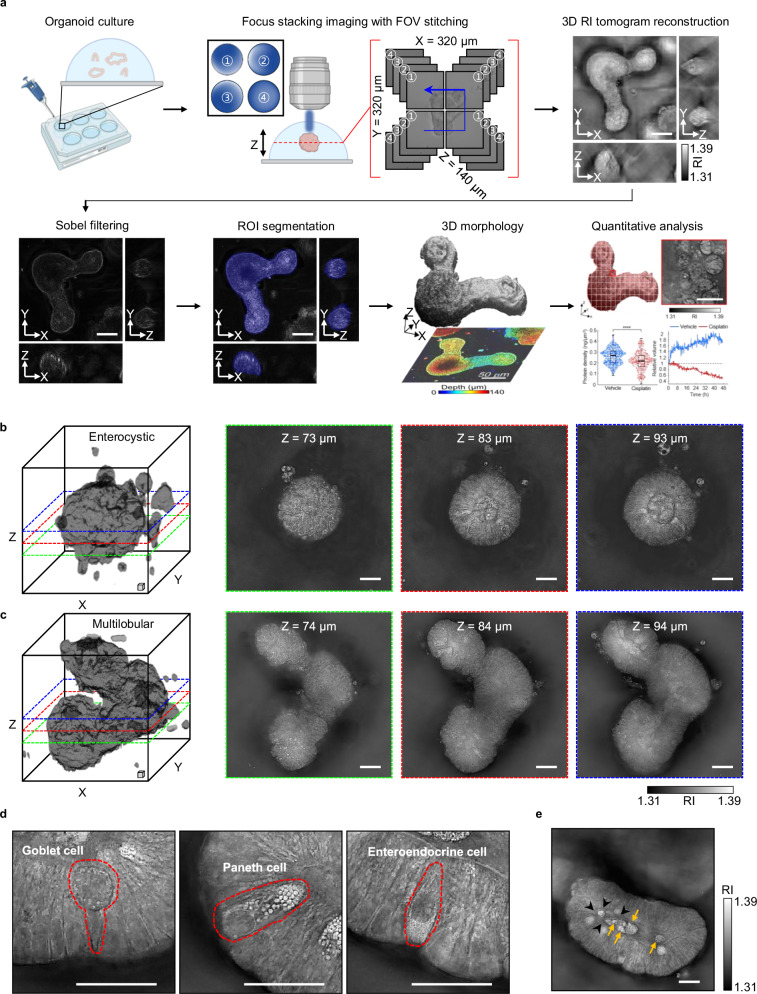
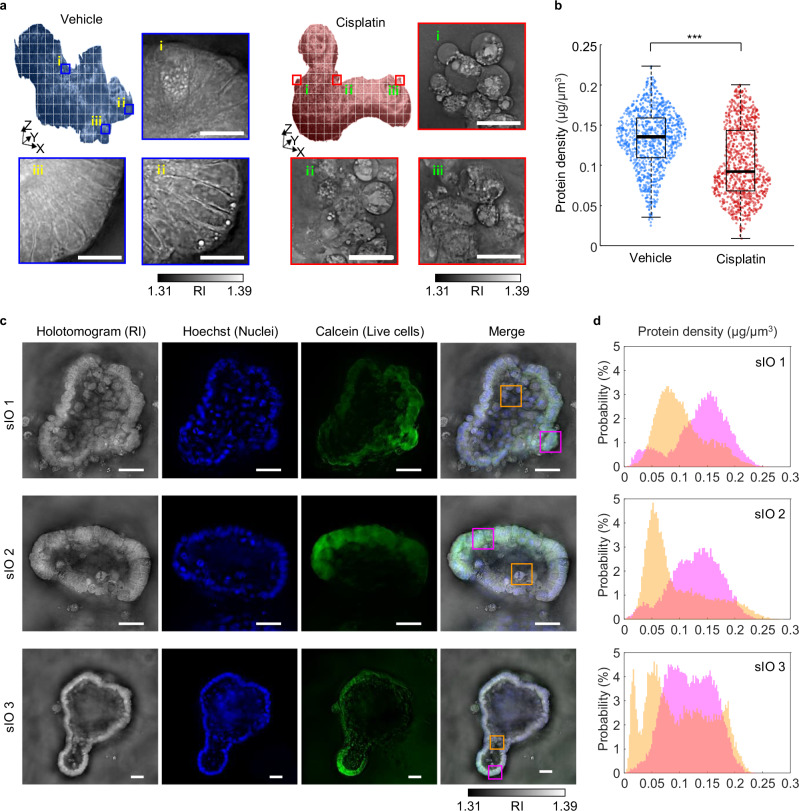
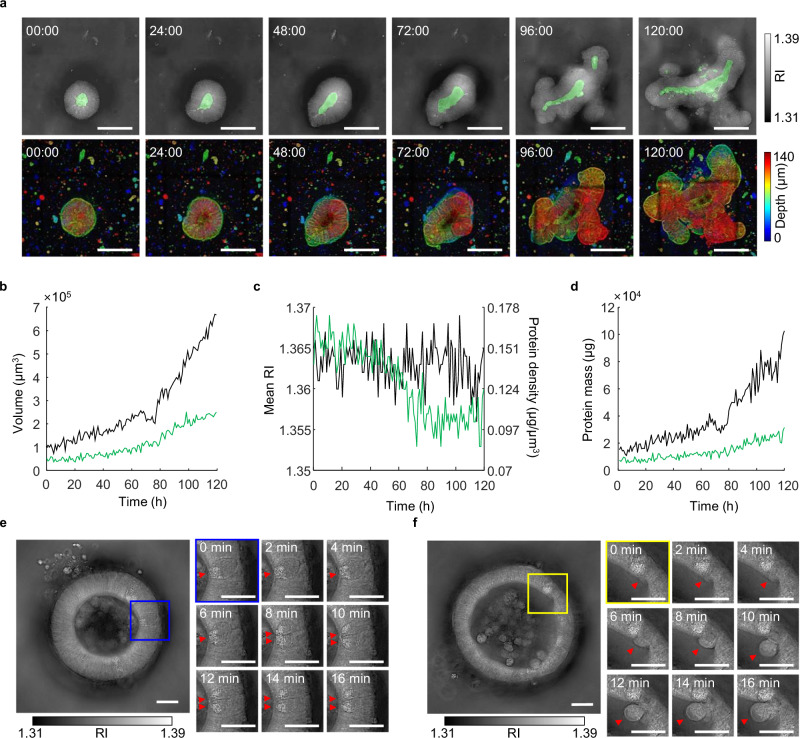
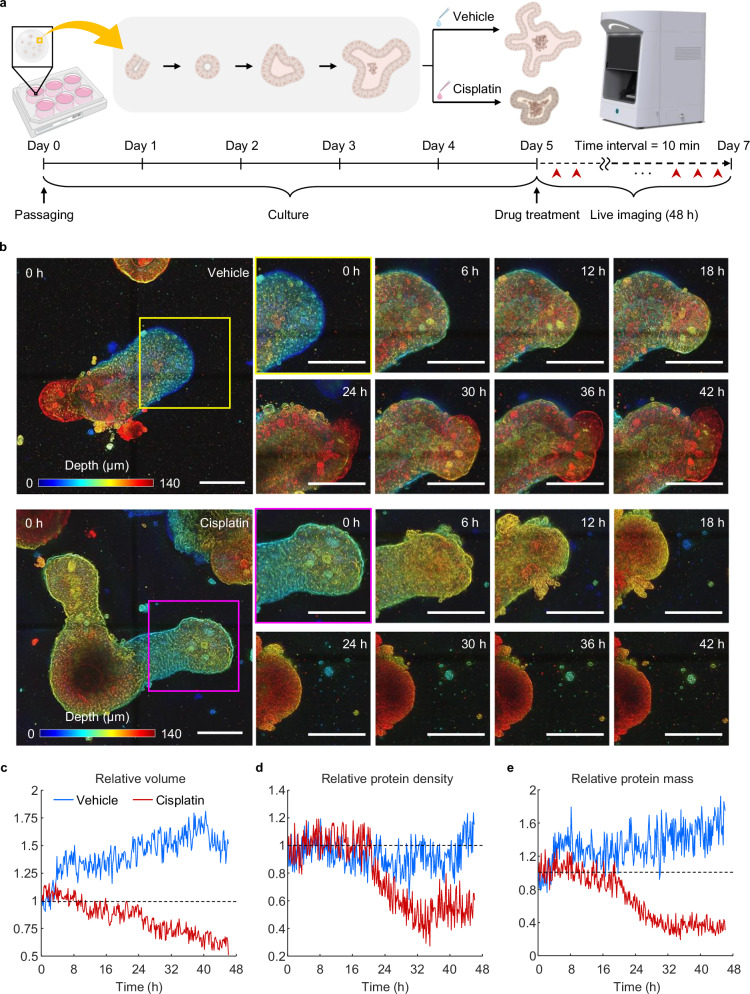
Organoids, which are miniature in vitro versions of organs, possess significant potential for studying human diseases and elucidating their underlying mechanisms. Live imaging techniques play a crucial role in organoid research and contribute to elucidating the complex structure and dynamic biological phenomena of organoids. However, live, unlabeled high-resolution imaging of native organoids is challenging, primarily owing to the complexities of sample handling and optical scattering inherent in three-dimensional (3D) structures. Additionally, conventional imaging methods fail to capture the real-time dynamic processes of growing organoids. In this study, we introduce low-coherence holotomography as an advanced, label-free, quantitative imaging modality designed to overcome several technical obstacles for long-term live imaging of 3D organoids. We demonstrate the efficacy of low-coherence holotomography by capturing high-resolution morphological details and dynamic activities within mouse small intestinal organoids at subcellular resolution. Moreover, our approach facilitates the distinction between viable and nonviable organoids, significantly enhancing its utility in organoid-based research. This advancement underscores the critical role of live imaging in organoid studies, offering a more comprehensive understanding of these complex systems.
类器官是微型的体外器官模型,在研究人类疾病和阐明其潜在机制方面具有重要潜力。活细胞成像技术在类器官研究中起着至关重要的作用,有助于阐明类器官的复杂结构和动态生物学现象。然而,对天然类器官进行活细胞、无标记的高分辨率成像具有挑战性,主要是由于三维(3D)结构中样品处理和光散射的复杂性。此外,传统的成像方法无法捕捉到正在生长的类器官的实时动态过程。在本研究中,我们引入低相干全层析成像作为一种先进的、无标记的定量成像方式,旨在克服长期对 3D 类器官进行活细胞成像的若干技术障碍。我们通过在亚细胞分辨率下捕获小鼠小肠类器官的高分辨率形态细节和动态活动,证明了低相干全层析成像的有效性。此外,我们的方法能够区分有活力和无活力的类器官,极大地提高了其在基于类器官的研究中的应用价值。这一进展突显了活细胞成像在类器官研究中的关键作用,为深入了解这些复杂系统提供了更全面的认识。