Tran Quynh T, Breuer Alex, Lin Tong, Tatevossian Ruth, Allen Sariah J, Clay Michael, Furtado Larissa V, Chen Mark, Hedges Dale, Michael Tylman, Robinson Giles, Northcott Paul, Gajjar Amar, Azzato Elizabeth, Shurtleff Sheila, Ellison David W, Pounds Stanley, Orr Brent A
Department of Pathology, St. Jude Children's Research Hospital, Memphis, TN, USA.
Clinical Biomarkers Lab, St. Jude Children's Research Hospital, Memphis, TN, USA.
NPJ Precis Oncol. 2024 Oct 2;8(1):218. doi: 10.1038/s41698-024-00718-3.
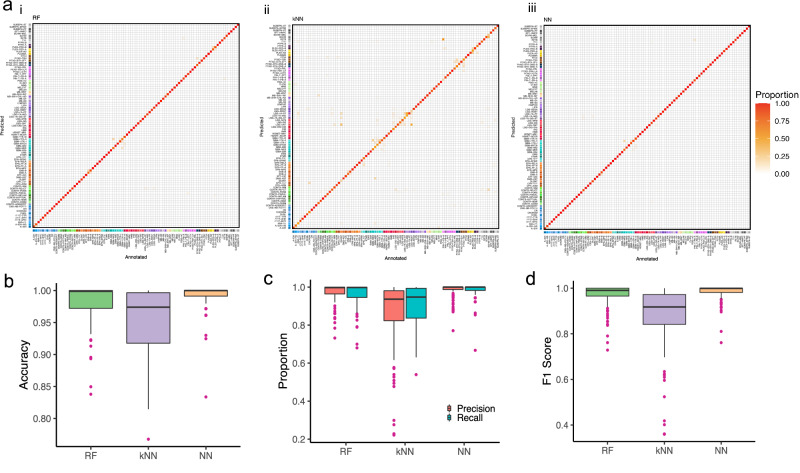
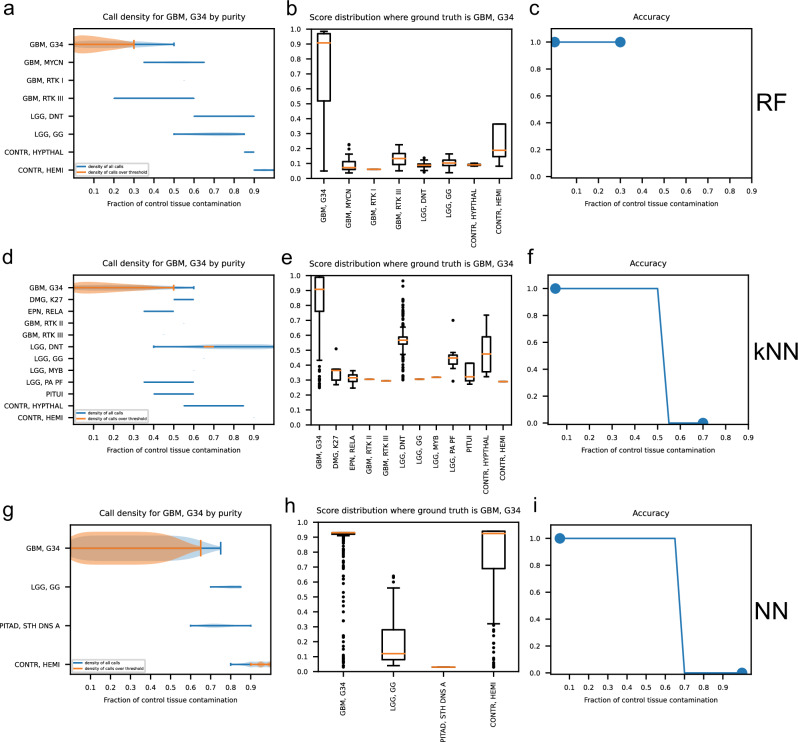
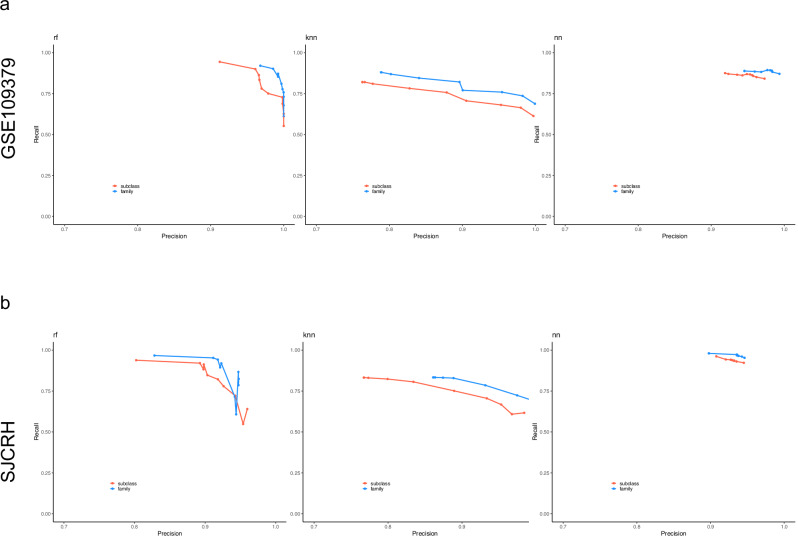
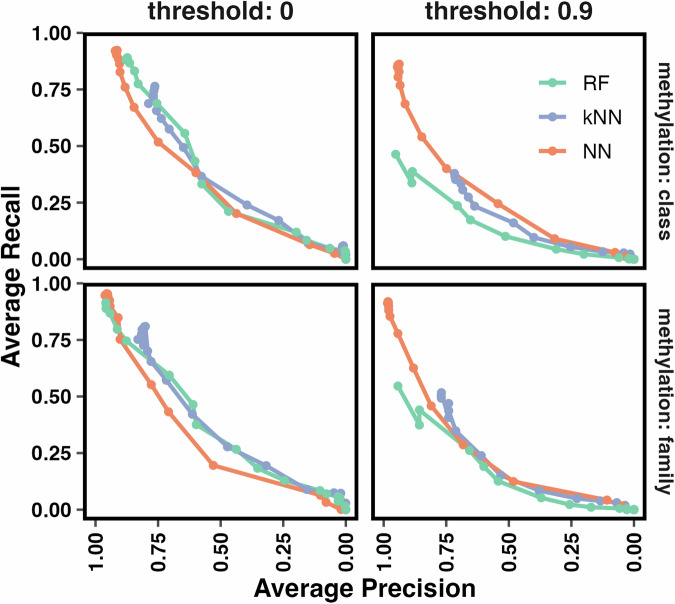
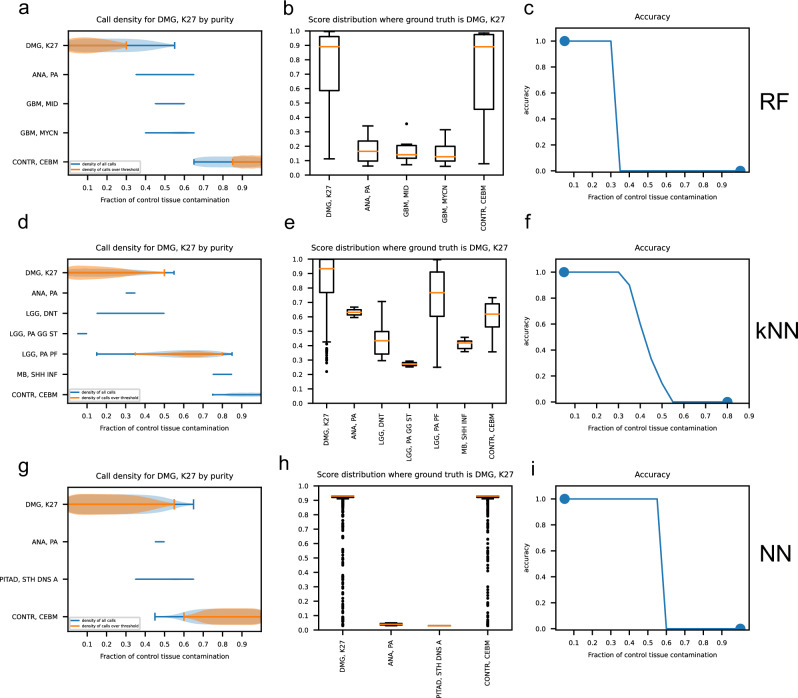
As part of the advancement in therapeutic decision-making for brain tumor patients at St. Jude Children's Research Hospital (SJCRH), we developed three robust classifiers, a deep learning neural network (NN), k-nearest neighbor (kNN), and random forest (RF), trained on a reference series DNA-methylation profiles to classify central nervous system (CNS) tumor types. The models' performance was rigorously validated against 2054 samples from two independent cohorts. In addition to classic metrics of model performance, we compared the robustness of the three models to reduced tumor purity, a critical consideration in the clinical utility of such classifiers. Our findings revealed that the NN model exhibited the highest accuracy and maintained a balance between precision and recall. The NN model was the most resistant to drops in performance associated with a reduction in tumor purity, showing good performance until the purity fell below 50%. Through rigorous validation, our study emphasizes the potential of DNA-methylation-based deep learning methods to improve precision medicine for brain tumor classification in the clinical setting.
作为圣裘德儿童研究医院(SJCRH)脑肿瘤患者治疗决策进展的一部分,我们开发了三种强大的分类器:深度学习神经网络(NN)、k近邻(kNN)和随机森林(RF),它们基于参考系列DNA甲基化谱进行训练,以对中枢神经系统(CNS)肿瘤类型进行分类。针对来自两个独立队列的2054个样本,对模型的性能进行了严格验证。除了经典的模型性能指标外,我们还比较了这三种模型对降低肿瘤纯度的稳健性,这是此类分类器临床应用中的一个关键考虑因素。我们的研究结果表明,NN模型表现出最高的准确性,并在精确率和召回率之间保持平衡。NN模型对与肿瘤纯度降低相关的性能下降最具抗性,在纯度降至50%以下之前表现良好。通过严格验证,我们的研究强调了基于DNA甲基化的深度学习方法在临床环境中改善脑肿瘤分类精准医学的潜力。