Federal State Autonomous Educational Institution of Higher Education, I.M. Sechenov First Moscow State Medical University of the Ministry of Health of the Russian Federation (Sechenov University), 119435, Moscow, Russia.
Federal State Budgetary Scientific Institution, "Research Institute of Fundamental and Clinical Immunology" (RIFCI), 630099, Novosibirsk, Russia.
J Transl Med. 2024 Oct 4;22(1):897. doi: 10.1186/s12967-024-05703-9.
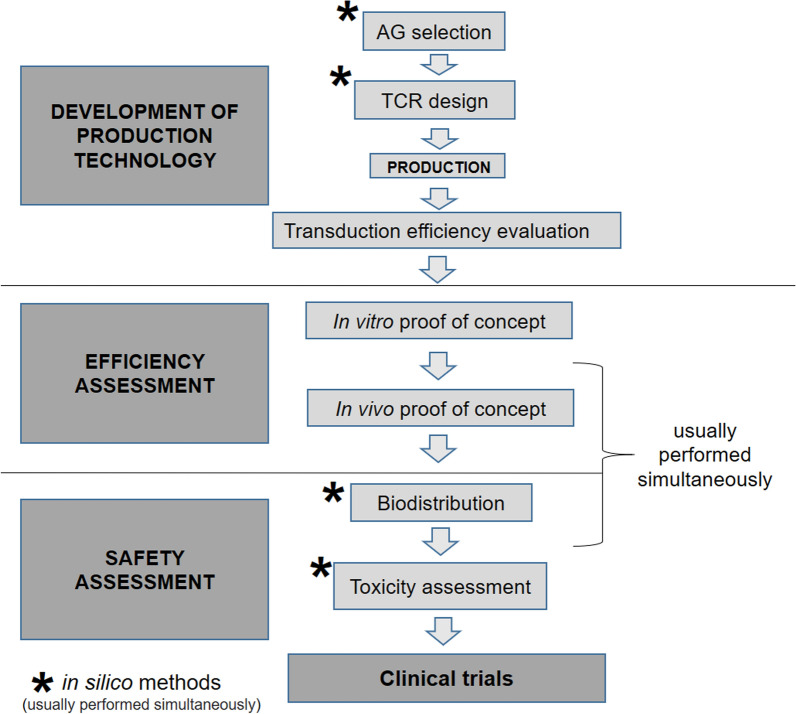
TCR-T cell therapy represents a promising advancement in adoptive immunotherapy for cancer treatment. Despite its potential, the development and preclinical testing of TCR-T cells face significant challenges. This review provides a structured overview of the key stages in preclinical testing, including in silico, in vitro, and in vivo methods, within the context of the sequential development of novel therapies. This review aimed to systematically outline the processes for evaluating TCR-T cells at each stage: from in silico approaches used to predict target antigens, assess cross-reactivity, and minimize off-target effects, to in vitro assays designed to measure cell functionality, cytotoxicity, and activation. Additionally, the review discusses the limitations of in vivo testing in animal models, particularly in accurately reflecting the human tumor microenvironment and immune responses. Performed analysis emphasizes the importance of these preclinical stages in the safe and effective development of TCR-T cell therapies. While current models provide valuable insights, we identify critical gaps, particularly in in vivo biodistribution and toxicity assessments, and propose the need for enhanced standardization and the development of more representative models. This structured approach aims to improve the predictability and safety of TCR-T cell therapy as it advances towards clinical application.
TCR-T 细胞疗法代表了癌症治疗中过继免疫疗法的一项有前途的进展。尽管具有潜力,但 TCR-T 细胞的开发和临床前测试面临重大挑战。本综述在新型疗法的序贯开发背景下,提供了临床前测试关键阶段的结构化概述,包括计算方法、体外和体内方法。本综述旨在系统概述在每个阶段评估 TCR-T 细胞的过程:从用于预测靶抗原、评估交叉反应和最小化脱靶效应的计算方法,到旨在测量细胞功能、细胞毒性和激活的体外测定。此外,该综述讨论了动物模型中体内测试的局限性,特别是在准确反映人类肿瘤微环境和免疫反应方面的局限性。所进行的分析强调了这些临床前阶段在 TCR-T 细胞疗法的安全有效开发中的重要性。虽然目前的模型提供了有价值的见解,但我们确定了关键的差距,特别是在体内生物分布和毒性评估方面,并提出需要增强标准化和开发更具代表性的模型。这种结构化方法旨在提高 TCR-T 细胞疗法的预测性和安全性,因为它朝着临床应用推进。