Cancer Biology Graduate Program, Miller School of Medicine, University of Miami, Miami, Florida.
Division of Gynecologic Oncology, Department of Obstetrics, Gynecology, and Reproductive Sciences, Miller School of Medicine, University of Miami, Miami, Florida.
JAMA Netw Open. 2024 Oct 1;7(10):e2438091. doi: 10.1001/jamanetworkopen.2024.38091.
Breast cancer (BC) is commonly diagnosed among Caribbean women. Shifts in reproductive patterns modify the incidence of BC diagnosis and age at BC diagnosis in population-based studies; however, reproductive patterns in Caribbean women remain understudied.
To describe the temporal trends in reproductive patterns and age at BC diagnosis in Caribbean-born women.
DESIGN, SETTING, AND PARTICIPANTS: A cross-sectional observational study-the Caribbean Women's Cancer Study-was conducted, with data on reproductive patterns known to affect BC risk collected in The Bahamas, Barbados, Cayman Islands, Dominica, Haiti, Jamaica, and Trinidad and Tobago. Participants were recruited prospectively. The sample included women born in Caribbean countries and diagnosed with invasive BC and/or ovarian cancer from June 1, 2010, to June 30, 2018, and was divided into 4 birth cohorts (born before 1950, 1950-1959, 1960-1969, and in or after 1970). Data were analyzed between August 1, 2023, and July 31, 2024.
Receipt of a BC diagnosis and birth in a Caribbean country.
Change in reproductive patterns between birth cohorts, including age at BC diagnosis, family history of cancer, age at first pregnancy, number of pregnancies, number of full-term pregnancies, number of siblings, age at menarche and menopause, estrogen receptor status, and germline pathogenic/likely pathogenic variants.
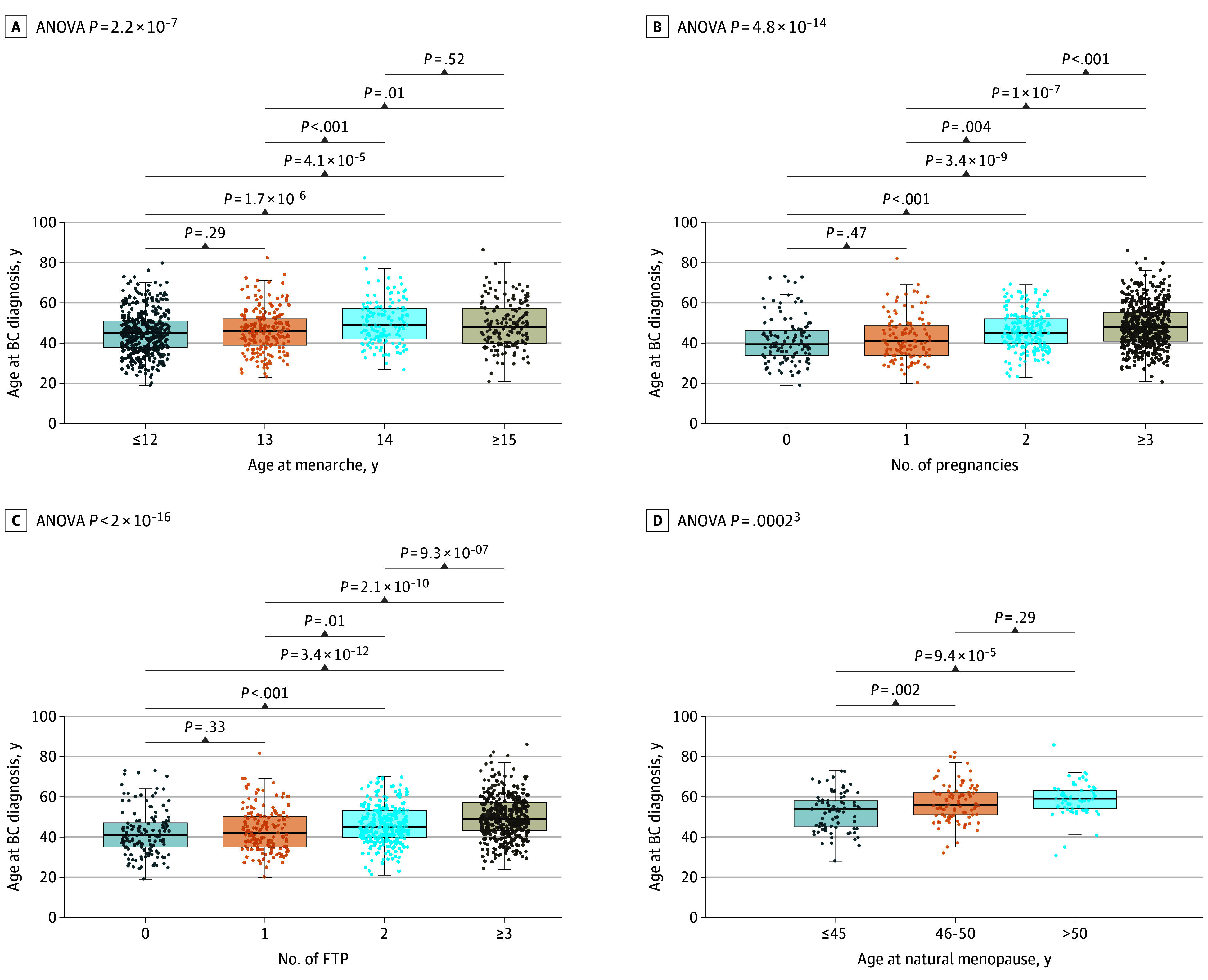
Of 1015 participants diagnosed with BC and ovarian cancer, 995 women (mean [SD] age, 46.6 [10.8] years; 605 [81.8%] Afro-Caribbean, 98 [13.2%] East Indian, 22 [3.0%] White, and 12 [1.6%] >1 race) received a diagnosis of invasive BC. Comparison from older to younger birth cohorts (presented in the order of born before 1950, 1950-1959, 1960-1969 and in or after 1970) showed an increased proportion of women experiencing menarche at age 12 years or younger (33.0% vs 47.3% vs 45.5% vs 57.9%; P < .001), women with no pregnancies (6.8% vs 6.8% vs 10.5% vs 22.8%; P < .001), and nulliparous women (8.6% vs 9.2% vs 13.9% vs 27.6%; P < .001). Younger age at BC diagnosis was observed in women experiencing menarche at age 12 years or younger (mean [SD], 45.0 [10.5] years) vs 15 years or older (mean [SD], 49.1 [11.2] years) and in nulliparous women (mean [SD], 42.1 [11.2] years) vs 3 or more full-term pregnancies (mean [SD], 49.9 [10.6] years; P < .001). For every year of first pregnancy delay, women had a 4% increased chance of being diagnosed with estrogen receptor-positive tumors (odds ratio, 1.04; 95% CI, 1.01-1.08; P = .02).
In this cross-sectional study, between each 10-year birth cohort, women diagnosed with BC had a lower age at menarche, number of pregnancies, and number of full-term pregnancies. These findings suggest that interventions targeting other BC risk factors need to be implemented.
乳腺癌(BC)在加勒比女性中常见。生育模式的变化会改变基于人群的研究中 BC 诊断的发生率和诊断时的年龄;然而,加勒比女性的生育模式仍研究不足。
描述加勒比出生女性的生育模式和 BC 诊断时年龄的时间趋势。
设计、地点和参与者:进行了一项横断面观察性研究-加勒比女性癌症研究,在巴哈马、巴巴多斯、开曼群岛、多米尼克、海地、牙买加和特立尼达和多巴哥收集了已知影响 BC 风险的生育模式数据。参与者是前瞻性招募的。该样本包括 1950 年前、1950-1959 年、1960-1969 年和 1970 年及以后出生于加勒比国家的、被诊断为浸润性 BC 和/或卵巢癌的女性。该样本分为 4 个出生队列(1950 年前出生、1950-1959 年出生、1960-1969 年出生和 1970 年及以后出生)。数据分析于 2023 年 8 月 1 日至 2024 年 7 月 31 日进行。
BC 诊断和出生于加勒比国家。
出生队列之间生育模式的变化,包括 BC 诊断时的年龄、癌症家族史、首次妊娠年龄、妊娠次数、足月妊娠次数、兄弟姐妹数量、初潮和绝经年龄、雌激素受体状态以及种系致病性/可能致病性变异。
在 1015 名被诊断为 BC 和卵巢癌的患者中,995 名女性(平均[标准差]年龄,46.6[10.8]岁;605 名[81.8%]为非裔加勒比人,98 名[13.2%]为东印度人,22 名[3.0%]为白人,12 名[1.6%]为 1 个以上种族)被诊断为浸润性 BC。从较老的出生队列到较年轻的出生队列(按出生于 1950 年前、1950-1959 年、1960-1969 年和 1970 年及以后的顺序呈现)的比较显示,经历 12 岁或以下初潮的女性比例增加(33.0%比 47.3%比 45.5%比 57.9%;P<.001)、无妊娠的女性比例增加(6.8%比 6.8%比 10.5%比 22.8%;P<.001)和未生育的女性比例增加(8.6%比 9.2%比 13.9%比 27.6%;P<.001)。经历 12 岁或以下初潮的女性 BC 诊断年龄较小(平均[标准差],45.0[10.5]岁)比 15 岁或以上(平均[标准差],49.1[11.2]岁)和未生育的女性(平均[标准差],42.1[11.2]岁)比 3 次或更多足月妊娠(平均[标准差],49.9[10.6]岁;P<.001)。首次妊娠推迟每增加一年,女性患雌激素受体阳性肿瘤的几率增加 4%(优势比,1.04;95%置信区间,1.01-1.08;P=.02)。
在这项横断面研究中,每 10 年出生的队列中,被诊断为 BC 的女性的初潮年龄、妊娠次数和足月妊娠次数都较低。这些发现表明,需要实施针对其他 BC 风险因素的干预措施。