Wang Shan, Maglangit Fleurdeliz, Fang Qing, Kyeremeh Kwaku, Deng Hai
State Key Laboratory of Microbial Technology, Shandong University Qingdao 266237 China
Department of Chemistry, School of Natural and Computing Sciences, University of Aberdeen Aberdeen AB24 3UE UK
RSC Chem Biol. 2024 Sep 30;5(11):1177-85. doi: 10.1039/d4cb00186a.
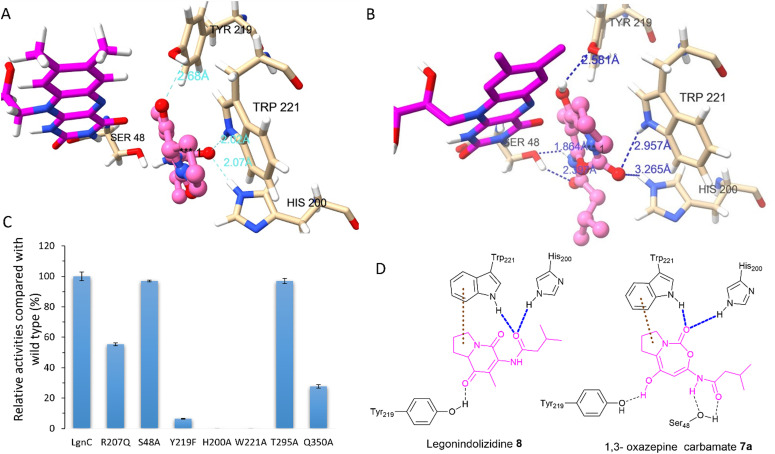
The Baeyer-Villiger monooxygenase (BVMO), LgnC, plays a crucial role in the biosynthesis of bacterial pyrrolizidine alkaloids, legonmycins. It processes bicyclic indolizidine substrates generated from the coordinative action of two non-ribosomal peptide synthetases (LgnB and LgnD) and the standalone type II thioesterase-like enzyme (LgnA). It has been demonstrated that the enzyme selectively inserts molecular oxygen into the carbon-carbon bond adjacent to the carbonyl group in legonindolizidines to form bicyclic 1,3-oxazepine carbamate intermediates. After ring opening and contraction, the most advanced products, prelegonmycins, are formed. However, factors controlling the final hydroxylation step and how the enzyme handles the substrates have remained elusive. In this study, we show that the final hydroxylation at the activated carbon of the electron-rich pyrrole system is attributed to either spontaneous oxidation or the action of an endogenous redox reagent. Substrate docking on the structural model of LgnC combined with site-directed mutagenesis allows the identification of several key amino acids that are essential for substrate/intermediate binding and a mechanism of LgnC-catalysed transformation is proposed.
拜耳-维利格单加氧酶(BVMO)LgnC在细菌吡咯里西啶生物碱莱戈霉素的生物合成中起着关键作用。它处理由两种非核糖体肽合成酶(LgnB和LgnD)以及独立的II型硫酯酶样酶(LgnA)协同作用产生的双环吲哚嗪底物。已证明该酶能选择性地将分子氧插入莱戈吲哚嗪中羰基相邻的碳-碳键,形成双环1,3-恶唑嗪氨基甲酸酯中间体。经过开环和缩环后,形成了最先进的产物前莱戈霉素。然而,控制最终羟基化步骤的因素以及该酶如何处理底物仍然不清楚。在本研究中,我们表明富电子吡咯系统活性碳上的最终羟基化归因于自发氧化或内源性氧化还原试剂的作用。底物对接在LgnC的结构模型上并结合定点诱变,使得能够鉴定出几个对底物/中间体结合至关重要的关键氨基酸,并提出了LgnC催化转化的机制。