Chu Lee-Shin, Sarma Sudeep, Gray Jeffrey J
Department of Chemical and Biomolecular Engineering, Johns Hopkins University, Baltimore, MD 21218, USA.
bioRxiv. 2024 Sep 28:2024.09.27.615401. doi: 10.1101/2024.09.27.615401.
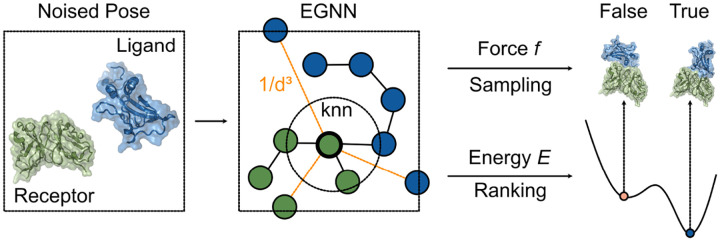
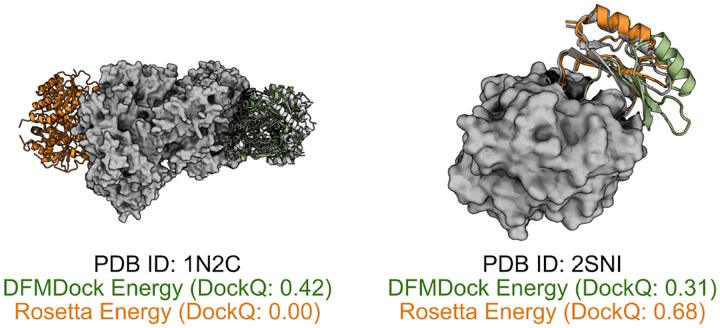
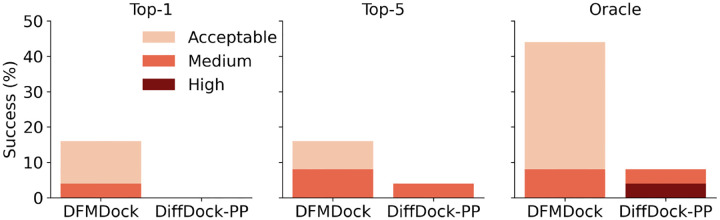
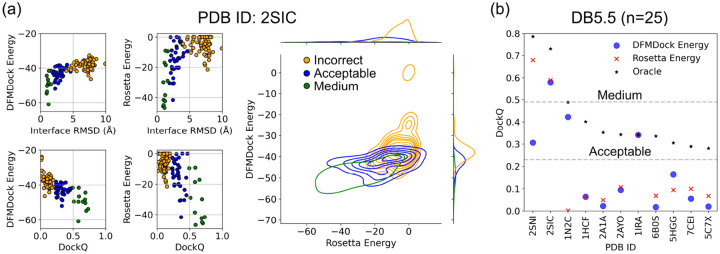
Diffusion models have shown promise in addressing the protein docking problem. Traditionally, these models are used solely for sampling docked poses, with a separate confidence model for ranking. We introduce DFMDock (Denoising Force Matching Dock), a diffusion model that unifies sampling and ranking within a single framework. DFMDock features two output heads: one for predicting forces and the other for predicting energies. The forces are trained using a denoising force matching objective, while the energy gradients are trained to align with the forces. This design enables our model to sample using the predicted forces and rank poses using the predicted energies, thereby eliminating the need for an additional confidence model. Our approach outperforms the previous diffusion model for protein docking, DiffDock-PP, with a sampling success rate of 44% compared to its 8%, and a Top- 1 ranking success rate of 16% compared to 0% on the Docking Benchmark 5.5 test set. In successful decoy cases, the DFMDock Energy forms a binding funnel similar to the physics-based Rosetta Energy, suggesting that DFMDock can capture the underlying energy landscape.
扩散模型在解决蛋白质对接问题方面已展现出前景。传统上,这些模型仅用于对接姿势的采样,通过一个单独的置信度模型进行排序。我们引入了DFMDock(去噪力匹配对接),这是一种在单一框架内统一采样和排序的扩散模型。DFMDock具有两个输出头:一个用于预测力,另一个用于预测能量。力通过去噪力匹配目标进行训练,而能量梯度则被训练为与力对齐。这种设计使我们的模型能够使用预测的力进行采样,并使用预测的能量对姿势进行排序,从而无需额外的置信度模型。我们的方法优于先前用于蛋白质对接的扩散模型DiffDock-PP,在对接基准5.5测试集上,采样成功率为44%,而DiffDock-PP为8%;Top-1排序成功率为16%,而DiffDock-PP为0%。在成功的诱饵案例中,DFMDock能量形成了一个类似于基于物理的Rosetta能量的结合漏斗,这表明DFMDock能够捕捉潜在的能量景观。