Guizhou Center for Disease Control and Prevention, Guiyang, 550004, China.
BMC Public Health. 2024 Oct 13;24(1):2798. doi: 10.1186/s12889-024-20254-w.
To estimate and compare the association between metabolically healthy overweight/obesity (MHO) and the risk of type 2 diabetes (T2DM) among different ethnic groups in southwest China, while also exploring possible ethnic differences.
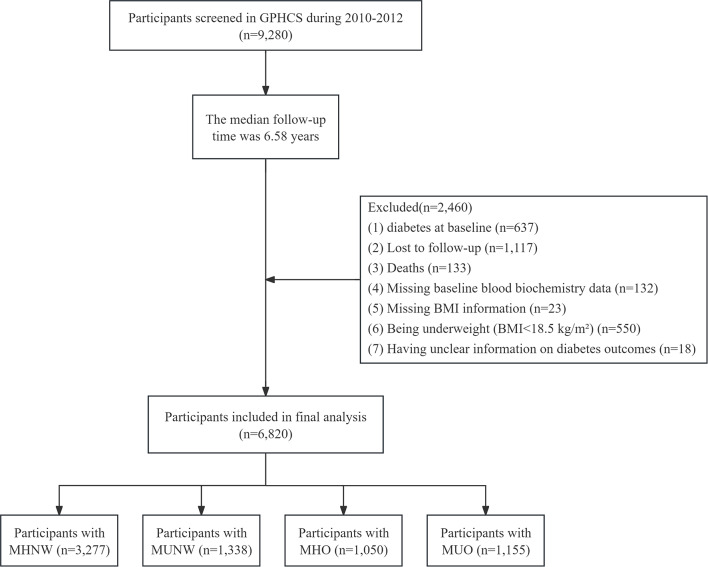
This is a prospective cohort study of 6,820 participants in Southwest China. MHO was defined as body mass index (BMI) ≥ 24 kg/m and the presence of ≤ 1 component of metabolic syndrome. Cox proportional risk models were utilized to analyze the association between MHO and the risk of T2DM.
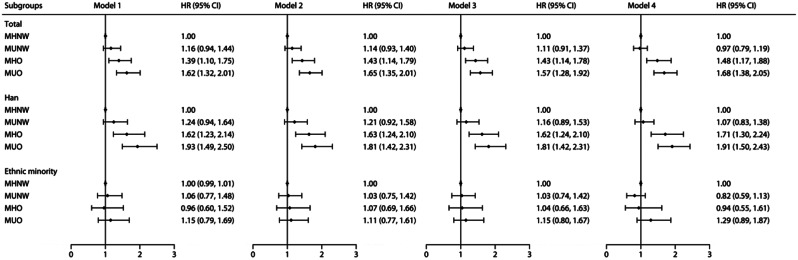
The median follow-up time was 6.58 years, during which 708 new cases of T2DM were diagnosed. In the total population, after adjusting for confounding factors, MHO was found to increase the risk of T2DM compared to metabolically healthy normal weight (MHNW) individuals (HR = 1.49, 95% CI: 1.15-1.93). Subgroup analysis by ethnicity revealed that, MHO increased the risk of T2DM in the Han population (HR = 1.64, 95% CI: 1.21-2.23), however, the difference was not statistically significant in the ethnic minority population.The results of sensitivity analysis further supported the robustness of these findings. Meanwhile, stratified by sex, age, and urban/rural, it was found that ethnic differences in the association between MHO and T2DM still existed, however, it is important to note that the association between MHO and T2DM was not statistically significant in the Han population subgroup aged ≥ 45 years (p > 0.05).
MHO was associated with an increased risk of T2DM compared to MHNW, and there are ethnic differences. Future interventions need to be strengthened for Han Chinese key populations to reduce the risk of T2DM.
本研究旨在评估和比较中国西南地区不同民族人群中代谢健康型超重/肥胖(MHO)与 2 型糖尿病(T2DM)风险之间的关联,并探讨可能存在的民族差异。
这是一项在中国西南地区进行的前瞻性队列研究,共纳入 6820 名参与者。MHO 定义为体质指数(BMI)≥24kg/m2 且存在≤1 项代谢综合征组分。采用 Cox 比例风险模型分析 MHO 与 T2DM 风险之间的关联。
中位随访时间为 6.58 年,期间共诊断出 708 例新的 T2DM 病例。在总人群中,在校正混杂因素后,与代谢健康正常体重(MHNW)个体相比,MHO 增加了 T2DM 的发病风险(HR=1.49,95%CI:1.15-1.93)。按民族亚组分析显示,在汉族人群中,MHO 增加了 T2DM 的发病风险(HR=1.64,95%CI:1.21-2.23),但在少数民族人群中差异无统计学意义。敏感性分析结果进一步支持了这些发现的稳健性。此外,按性别、年龄和城乡分层分析显示,MHO 与 T2DM 之间的关联在不同民族人群中仍存在差异,但需要注意的是,在汉族≥45 岁人群亚组中,MHO 与 T2DM 之间的关联无统计学意义(p>0.05)。
与 MHNW 相比,MHO 与 T2DM 风险增加相关,且存在民族差异。未来需要针对汉族等关键人群加强干预,以降低 T2DM 风险。