Jimma Zone Agriculture Office, Jimma, Oromia, Ethiopia.
Ethiopian Ministry of Agriculture, Addis Ababa, Ethiopia.
PLoS Negl Trop Dis. 2024 Oct 14;18(10):e0012551. doi: 10.1371/journal.pntd.0012551. eCollection 2024 Oct.
Rabies is a disease of warm-blooded animals that affects the central nervous system and is almost invariably fatal once clinical signs develop. It is one of the most neglected tropical diseases in several areas of the world, including Ethiopia. Additionally, the burden of the disease is estimated to be high in Ethiopia, and public awareness contributes to prevention.
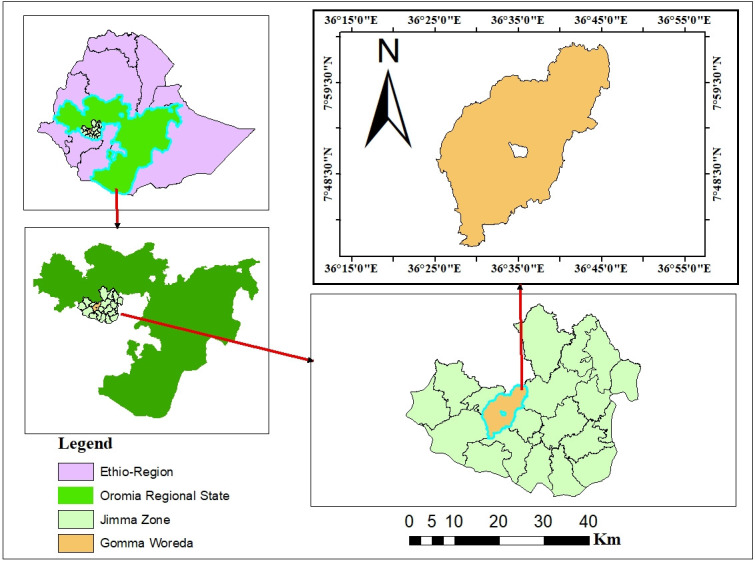
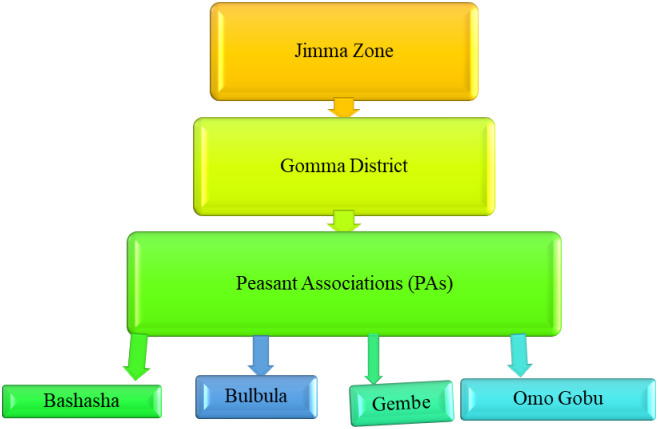
A community-based cross-sectional study design was conducted from June-August 2023 in the Gomma district, Jimma zone, Oromia regional state, Ethiopia, to assess the knowledge, attitudes, and practices of communities towards rabies and associated risk factors using a structured questionnaire survey. A multi-stage sampling technique was used for the selection of the sampling units and a total of 140 participants were interviewed. The questionnaire parts included socio-demographics information, knowledge, attitudes, and practices of the community's respect for rabies management and control. The data was analyzed by Statistical Package for Social Science (SPSS) Version 20. Descriptive analyses were employed and multivariable logistic regression was used to calculate the association between independent and dependent variables (Knowledge, Attitudes, and Practice scores).
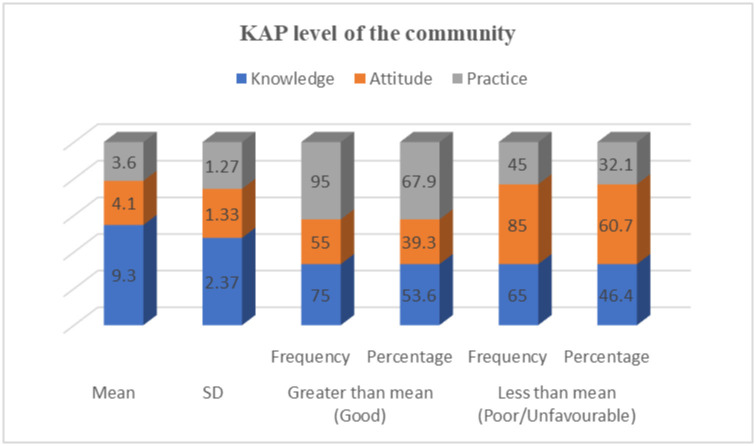
About 134 (95.7%) respondents had heard about rabies. Likewise, 75 (53.6%), 55 (39.3%), and 95 (67.9%) of the respondents had good knowledge, favorable attitudes, and good practices, respectively. Christians were more likely to have higher knowledge scores than Muslims (AOR = 6.876, CI = 1.750-27.016, p = 0.006). Respondents who knew someone's exposure had a higher knowledge score than those who did not (AOR = 6.208, CI = 2.750-14.012, p = 0.000). Moreover, Muslims were found to have a more favorable attitudes than Christians (AOR = 5.518, CI = 1.199-25.391, p = 0.028). Those who knew someone's exposure to rabies were found to have a more favorable attitudes than those who did not (AOR = 2.367, CI = 1.157-4.839, p = 0.018). Respondents who had favorable attitudes towards rabies were found to have more good practices than unfavorable attitudes (AOR = 3.267, CI = 1.391, 7.730, p = 0.005).
The study revealed a gap in knowledge among communities in the study area. Thus, rabies control activity and community awareness should be implemented with stakeholders.
狂犬病是一种影响中枢神经系统的温血动物疾病,一旦出现临床症状,几乎总是致命的。它是世界上包括埃塞俄比亚在内的几个地区最被忽视的热带病之一。此外,据估计,该病在埃塞俄比亚的负担很重,公众意识有助于预防。
2023 年 6 月至 8 月,在埃塞俄比亚奥罗米亚州吉马地区的戈马区,采用基于社区的横断面研究设计,评估社区对狂犬病的知识、态度和实践以及相关危险因素,使用结构化问卷进行调查。采用多阶段抽样技术选择抽样单位,共访谈了 140 名参与者。问卷部分包括社会人口统计学信息、社区对狂犬病管理和控制的知识、态度和实践。数据由社会科学统计软件(SPSS)版本 20 进行分析。采用描述性分析,使用多变量逻辑回归计算独立和因变量(知识、态度和实践得分)之间的关联。
约 134 名(95.7%)受访者听说过狂犬病。同样,75 名(53.6%)、55 名(39.3%)和 95 名(67.9%)受访者分别具有良好的知识、有利的态度和良好的实践。与穆斯林相比,基督徒更有可能具有更高的知识得分(优势比=6.876,置信区间=1.750-27.016,p=0.006)。知道某人接触过狂犬病的受访者比不知道的受访者具有更高的知识得分(优势比=6.208,置信区间=2.750-14.012,p=0.000)。此外,穆斯林被发现比基督徒有更有利的态度(优势比=5.518,置信区间=1.199-25.391,p=0.028)。与没有接触过狂犬病的人相比,知道某人接触过狂犬病的人更有有利的态度(优势比=2.367,置信区间=1.157-4.839,p=0.018)。对狂犬病有有利态度的受访者比态度不利的受访者有更多的良好做法(优势比=3.267,置信区间=1.391,7.730,p=0.005)。
研究表明,研究区域社区的知识存在差距。因此,应该与利益攸关方一起实施狂犬病控制活动和社区意识。