Malfa Giuseppe Antonio, Bianchi Simone, Spadaro Vivienne, Kozuharova Ekaterina, Marino Pasquale, Pappalardo Francesco, Di Giacomo Claudia, Acquaviva Rosaria
Department of Drug and Health Sciences, University of Catania, Viale A. Doria 6, 95125 Catania, Italy.
Research Centre on Nutraceuticals and Health Products (CERNUT), University of Catania, Viale A. Doria 6, 95125 Catania, Italy.
Plants (Basel). 2024 Sep 30;13(19):2748. doi: 10.3390/plants13192748.
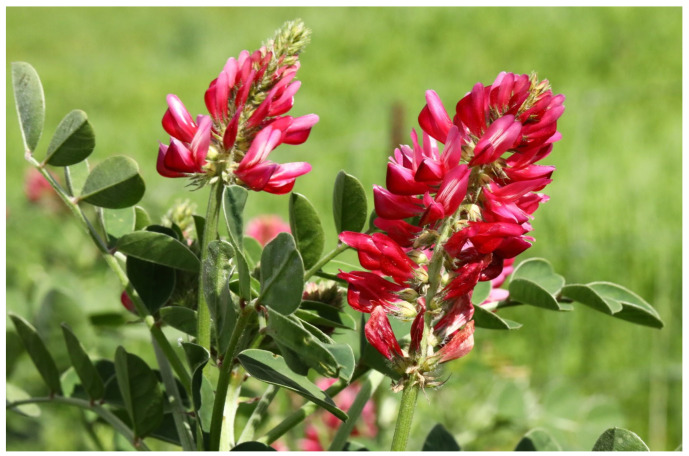
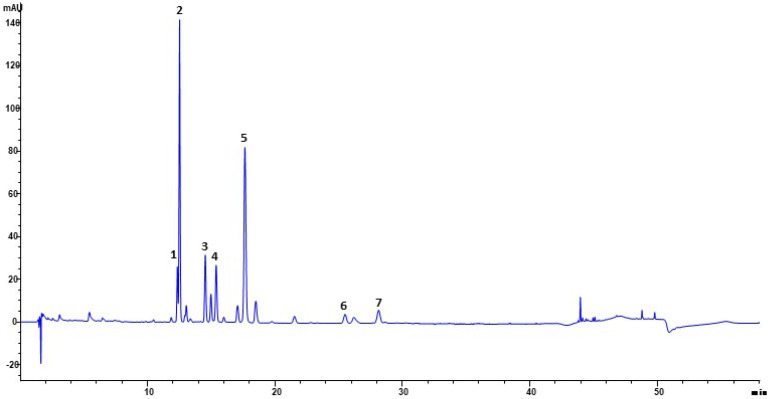
is indigenous to the Mediterranean region. It is grown as fodder in southern Italy because it contains various secondary metabolites with beneficial activities on animals. Recently, its potential use in cosmeceutical treatments for skin problems was reported. In this scenario, to contribute to a possible cosmeceutical application, we characterized the phytochemical profile of flowers' hydroalcoholic extract by HPLC-DAD, Folin-Ciocalteu, Aluminum Chloride methods, DPPH assay, and, for the first time, we evaluated the antioxidant and anti-inflammatory activities on dermal fibroblasts. The phytochemical analysis confirmed the significant content of phenolic compounds (TPC 69.8 ± 0.6 mg GAE/g extract, TFC 15.07 mg CE/g extract) and the remarkable presence of rutin, quercetin, and isorhamnetin derivatives that give to the phytocomplex a good antioxidant activity as highlighted by the DPPH assay (IC of 8.04 ± 0.5 µg/mL). Through the reduction in NO• and ROS levels in human dermal fibroblasts, the biological tests demonstrated both the safety of the extract and its ability to counteract the inflammatory state generated by Interleukin-1β exposure. Our findings indicate that the antioxidant activities of the phytocomplex are strictly related to the anti-inflammatory action of the flowers extract, confirming that this plant could be a valuable source of bioactive molecules for cosmeceutical and nutraceutical applications.
原产于地中海地区。在意大利南部,它被作为饲料种植,因为它含有多种对动物具有有益活性的次生代谢产物。最近,有报道称其在治疗皮肤问题的药妆产品中有潜在用途。在这种情况下,为了促进其在药妆领域的可能应用,我们通过高效液相色谱 - 二极管阵列检测法(HPLC - DAD)、福林 - 西奥尔特法、氯化铝法、二苯基苦味酰基自由基(DPPH)测定法对花的水醇提取物的植物化学特征进行了表征,并且首次评估了其对皮肤成纤维细胞的抗氧化和抗炎活性。植物化学分析证实了酚类化合物的显著含量(总酚含量为69.8 ± 0.6毫克没食子酸当量/克提取物,总黄酮含量为15.07毫克儿茶素当量/克提取物)以及芦丁、槲皮素和异鼠李素衍生物的显著存在,这些物质赋予该植物复合物良好的抗氧化活性,如DPPH测定法所强调的(半数抑制浓度为8.04 ± 0.5微克/毫升)。通过降低人皮肤成纤维细胞中的一氧化氮(NO•)和活性氧(ROS)水平,生物学测试证明了提取物的安全性及其对抗白细胞介素 - 1β暴露所产生的炎症状态的能力。我们的研究结果表明,该植物复合物的抗氧化活性与花提取物的抗炎作用密切相关,证实这种植物可能是药妆和营养保健品应用中有价值的生物活性分子来源。